

 Français
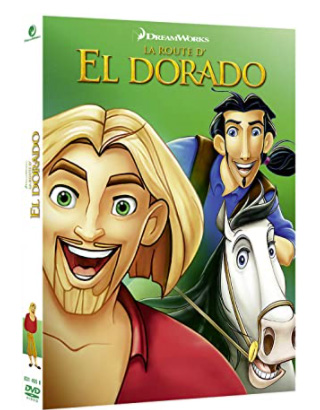
The Road to El Dorado
Synopsis
Tulio and Miguel, two Spanish con men, win a map to the legendary city of gold in a rigged dice game and stow away on Hernán Cortés's expedition. Washed ashore in the New World, they find the hidden city of El Dorado, where the inhabitants mistake them for gods. As they plan to leave with as much gold as they can carry, the pair are drawn into a power struggle between a kind-hearted chief and a scheming high priest. Their friendship and their conscience will be tested as Cortés draws nearer.
The Making of the Film
The Road to El Dorado was produced by DreamWorks Animation at a time when the young studio was trying to challenge Disney's dominance in feature animation. It was directed by Eric Bibo Bergeron and Don Paul, and released in the United States in March 2000. The idea of a buddy adventure about two schemers who stumble upon a lost city of gold gives the film the flavour of the old Road to comedies starring Bing Crosby and Bob Hope. Behind the fantasy lies the real legend of El Dorado, which began as the story of a Muisca ritual in which a chief covered in gold dust was immersed in Lake Guatavita, in present-day Colombia. Spanish conquistadors later transformed this ceremony into the myth of a fabulous golden city hidden in the jungle. Elton John and Tim Rice, the duo behind the songs of The Lion King, wrote the music, while Hans Zimmer and John Powell composed the score. Kevin Kline and Kenneth Branagh voiced the two heroes, and their banter became the engine of the film. The result is a deliberately light and irreverent take on the conquest of the Americas, closer to a swashbuckling comedy than to a historical epic.
Critical Reception
Reviews were mixed. Critics praised the lush backgrounds inspired by Mesoamerican art, the chemistry between Kline and Branagh and the energy of Elton John's songs. Many felt, however, that the story was uneven and that the film struggled to balance comedy and drama. Some reviewers found it strange that the songs were used mostly as narration rather than as numbers sung by the characters, and compared the film unfavourably with the emotional depth of the best Disney classics.
The film was a commercial disappointment in cinemas and did not meet the studio's expectations. It found a second life on home video and, much later, on streaming platforms, where a new generation of viewers discovered it. Over the years it has built a devoted fanbase, who appreciate its humour, its colourful world and above all the friendship between Tulio and Miguel. Its reputation today is considerably better than its initial reception suggested.
Filming anecdotes
The design of El Dorado draws on motifs from several pre-Columbian cultures instead of reproducing a single one, which gave the artists great freedom to invent a city made of gold and stone. The giant stone jaguar that appears in the climax was created with computer animation, combined with the traditional hand-drawn style used for the characters. The horse Altivo, who accompanies the heroes throughout the journey, was voiced in the film's famous animal sounds by Frank Welker, a veteran of animation voice work. Elton John's songs, which comment on the action more than they drive it, give the film a distinctive musical identity.
Themes explored
At its heart, The Road to El Dorado is a story about friendship between two men who begin as partners in crime and end up as true companions. The film plays with the theme of greed, since Tulio and Miguel first see the city only as a treasure to be emptied. Their gradual attachment to the people of El Dorado forces them to weigh gold against conscience. The story also offers a light but pointed look at colonialism, with Cortés embodying the Spanish appetite for conquest and gold. Identity and deception are everywhere, because the heroes survive by pretending to be gods, which they are not. The high priest Tzekel-Kan represents the manipulation of faith for political power, while the chief shows a more humane form of leadership. Chel adds a theme of freedom, as she is a clever woman who wants to leave a life she has not chosen. Beneath the humour, the film suggests that the real treasure is the bond between companions.
Ending explained
In the climax, Tzekel-Kan awakens a giant stone jaguar in an attempt to seize power, and Tulio and Miguel use their wits to turn the situation against him. Their ruse saves the people of El Dorado, but the arrival of Cortés's men threatens to expose the city to the greed of the Spaniards. The heroes find a way to keep the golden city hidden, so that it remains a legend and not a prize for conquerors. They leave with only a modest share of treasure, together with Chel and the faithful horse Altivo. This is a quiet reversal of their initial ambition, as the men who came for gold depart having protected the place instead of plundering it. The ending also seals their friendship, which has survived every trick and betrayal along the way. Their next adventure is left open, in the spirit of the old buddy road movies that inspired the film. The final image underlines that the journey mattered more than the destination.
Meaning of the title
El Dorado is a Spanish expression meaning the golden one, or the gilded one. It originally referred to a person, a chief covered in gold dust in an ancient Muisca ceremony, before it came to describe a fabled city of immense wealth. The legend drove many expeditions through South America in the sixteenth century, and the name has since become a synonym for any place of fabulous fortune. In the film, the title also refers to the road itself, meaning the journey of two rogues who think they are chasing treasure but are really heading toward friendship. The phrase The Road to evokes the classic Hollywood comedies of the 1940s, in which two companions travelled from one exotic location to another. By combining the two ideas, the title promises both adventure and humour. The city is a destination, but the film insists that the path matters just as much. In that sense the title captures the two layers of the story, the myth of gold and the human adventure behind it.
Original Soundtrack
Elton John and Tim Rice, the team that had made The Lion King's songs famous, wrote the film's musical numbers. Rather than having the characters sing, the songs mostly accompany the action as a kind of musical commentary, which gives the film an unusual rhythm for an animated musical. Numbers such as El Dorado, It's Tough to Be a God, 16th Century Man and Someday Out of the Blue became the heart of the soundtrack. Hans Zimmer and John Powell composed the orchestral score, which blends adventure themes with Latin-flavoured rhythms. Their work gives the chase scenes and the jungle sequences real momentum. Many fans consider the soundtrack one of the best features of the film and one of the main reasons for its lasting affection. The mixture of pop songs and orchestral writing helps the story feel playful while keeping a sense of epic scale.
Similar Films
If you enjoyed The Road to El Dorado, the closest relative is probably Disney's The Emperor's New Groove, released the same year, which also takes place in a pre-Columbian empire and relies on irreverent humour. Aladdin offers another story of a lovable rogue, a hidden treasure and a charismatic comedy sidekick. DreamWorks' own Sinbad: Legend of the Seven Seas revisits the world of swashbuckling adventure with a trickster hero. Treasure Planet, from Disney, transposes the classic treasure-hunting tale to outer space. Those who like the quest for lost treasure in live action will enjoy Raiders of the Lost Ark and Romancing the Stone. DreamWorks' The Prince of Egypt shows the studio's more serious side, with songs and epic scale. Shrek, from 2001, shares the studio's irreverent tone and its taste for parodying familiar stories. Atlantis: The Lost Empire, from Disney, is another animated search for a legendary civilisation.