

 Français
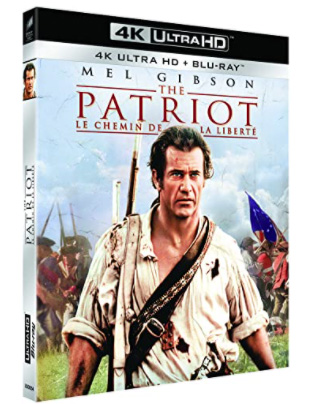
The Patriot
Synopsis
Benjamin Martin is a widowed farmer in South Carolina who has sworn off violence after the atrocities he witnessed in the French and Indian War. When his eldest son joins the Continental Army, Martin stays out of the conflict, but the arrival of the ruthless British colonel William Tavington shatters his family and his peace. Determined to protect those he loves, he forms a militia that uses guerrilla tactics against the British. His fight leads him toward the decisive battles of the American Revolution.
The Making of the Film
The Patriot was directed by Roland Emmerich, best known for large-scale blockbusters such as Independence Day. It marked a departure from the science-fiction spectacle that had made his reputation, as he turned to a historical epic set during the American Revolution. The screenplay was written by Robert Rodat, who had previously written Saving Private Ryan and who brought a focus on the personal cost of war. Mel Gibson, fresh from the success of Braveheart, was cast as the reluctant hero, which linked the film to his earlier tale of rebellion against English rule. The character of Benjamin Martin was loosely inspired by several real figures of the Revolutionary War, most notably Francis Marion, nicknamed the Swamp Fox. The villainous Colonel Tavington was based in part on Banastre Tarleton, a British cavalry commander remembered for his brutality in the southern campaign. The production was released by Columbia Pictures and aimed to combine historical backdrop, family drama and large-scale battle scenes. It was an ambitious attempt to build a patriotic epic around a very human story of revenge and responsibility.
Critical Reception
Critics gave The Patriot a mixed reception. Many praised the scale of the battle scenes, the strong production values and the performances of Mel Gibson and Heath Ledger. Others criticised the film's melodrama and its tendency to simplify history, noting that the villain was drawn in broad strokes. The film also drew controversy for its depiction of British atrocities, particularly a church massacre that historians said echoed a twentieth-century event more than any episode of the American Revolution. British commentators in particular accused the film of distorting history.
Audiences responded much more warmly than critics. The film was a major commercial success, grossing more than 200 million dollars worldwide against a budget of about 110 million. It became one of the biggest hits of the summer of 2000 and remains a regular presence on television. Its portrait of a family man forced to become a soldier struck a chord with viewers, even as historians continued to debate its accuracy.
The Patriot received three Academy Award nominations: Best Cinematography for Caleb Deschanel, Best Original Score for John Williams and Best Sound. It did not win any of them. The nominations nevertheless recognised the quality of its craft, from the rich photography of the South Carolina landscape to the sweeping orchestral music. For John Williams, it was yet another nomination in a long career filled with them.
Filming anecdotes
The character of Benjamin Martin was inspired by Francis Marion, a Southern guerrilla leader known for hit-and-run tactics in the swamps of the Carolinas. Colonel Tavington draws on the real Banastre Tarleton, whose cavalry earned a fearsome reputation during the war. The film was shot largely in South Carolina, which allowed the production to recreate the landscapes of the Revolutionary War with a convincing sense of place. The church-burning scene, one of the most controversial in the film, was widely compared to the massacre at Oradour-sur-Glane in France in 1944, a comparison that fuelled debate about the film's use of history.
Themes explored
At its heart, The Patriot is a story about the cost of violence and the way war reaches into the most private corners of family life. Benjamin Martin begins as a man who wants to avoid conflict, haunted by his past, and is gradually pulled back into it by personal loss. The film explores fatherhood, showing a man who tries to protect his children and who sees them sacrificed to the cause he resisted. Revenge is a powerful engine, but the film also asks whether vengeance can ever bring peace. The story celebrates the ideal of freedom, while showing the human price paid by those who fight for it. The contrast between Martin and Tavington shows two ways of waging war, one rooted in personal conscience and the other in cruelty. The film also highlights the diversity of those who fought in the Revolution, including free Black men and militia farmers. Through its mix of family drama and battle epic, it asks what it means to be a patriot when the cost is so high.
Ending explained
In the film's final act, Martin leads his militia to join the Continental forces at Yorktown, where the decisive confrontation of the war takes place. During the battle, Martin finally confronts Colonel Tavington, the man responsible for the worst blows to his family. He kills Tavington in a final duel, which brings a violent form of justice to the story. The American and French forces then defeat the British, and Lord Cornwallis is forced to surrender. After the war, Martin returns to his land and begins to rebuild his home. The closing images show a community rebuilding after conflict, suggesting that the nation's birth has been paid for with personal sacrifice. The ending balances the triumph of victory with the memory of those who did not survive. It confirms that Martin's most important victory is not political but personal, as he reclaims a life that war had taken from him.
Meaning of the title
The Patriot is a deliberately ambiguous title. It suggests a hero who loves his country, but the film shows a man who joins the fight reluctantly, motivated by love of family before love of nation. The question of who is a true patriot runs through the story, as various characters embody different ideas of loyalty. In the French release the film was given the subtitle Le chemin de la liberté, which stresses the idea of a journey toward freedom. The word patriot itself was used in eighteenth-century America to describe supporters of independence, and the title connects the film directly to that historical vocabulary. By calling the film simply The Patriot, the filmmakers claim a place in the tradition of American historical epics. At the same time, the title invites viewers to ask whether patriotism can justify the violence shown on screen. The simplicity of the title hides a more complicated moral reflection. In that sense, it works as both a banner and a question.
Original Soundtrack
John Williams composed the score for The Patriot, which earned him an Academy Award nomination for Best Original Score. His music combines stirring, heroic themes with a more intimate, melancholy tone that reflects the film's family story. The orchestral writing underlines the sweep of the American landscape and the intensity of the battle scenes. Williams had already scored many American historical subjects, and his work here continues that tradition with noble and emotional melodies. The score helps give the film its epic dimension, particularly in the moments when Martin leads his men into combat. It also provides quieter passages that emphasise grief and loss. Many viewers consider the music one of the film's strongest assets.
Similar Films
If you enjoyed The Patriot, the obvious companion is Braveheart, Mel Gibson's own epic about a rebellion against English rule. Gladiator, released the same year, offers another story of a man driven by loss and the desire for justice. The Last of the Mohicans, set during the French and Indian War, shares a similar historical backdrop and romantic spirit. Saving Private Ryan, written by the same screenwriter Robert Rodat, also explores the human cost of war. Glory tells the story of the first Black regiment in the American Civil War. The Last Samurai offers another tale of a soldier transformed by a foreign conflict. Rob Roy mixes historical adventure and personal revenge in eighteenth-century Scotland. Together these films form a rich tradition of historical war epics.