

 Français
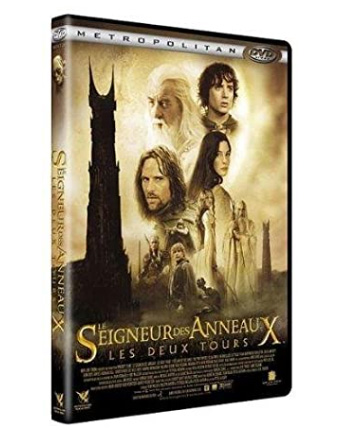
The Lord of the Rings: The Two Towers
Synopsis
The Fellowship has been broken, and its members are scattered across Middle-earth. Frodo and Sam continue toward Mordor, guided by the treacherous creature Gollum. Aragorn, Legolas and Gimli set out to rescue Merry and Pippin, only to be drawn into the war between the kingdom of Rohan and the armies of Saruman. As the forces of darkness gather, the battle for Helm's Deep may decide the fate of the free peoples.
The Making of the Film
The Two Towers is the second chapter of Peter Jackson's adaptation of J.R.R. Tolkien's trilogy, shot at the same time as the other two films. The book is the most fragmented of the three, as it follows separate groups of characters, which made it difficult to adapt as a single narrative. Jackson, Fran Walsh and Philippa Boyens decided to weave the storylines together in alternating sequences, so the film would keep its rhythm. They also changed some elements of the book, such as expanding the role of Arwen and creating the Elves' arrival at Helm's Deep. Gollum became a major focus, thanks to the possibilities of motion capture technology. The production team had to design a new fortress, Helm's Deep, as the central location for the climactic battle. They wanted the film to be darker and more intense than the first, reflecting the growing threat. The filmmakers sought to balance spectacle and character development in a story where the Fellowship is divided.
Reviews and reception
Professional critics' summary
Critics were enthusiastic, many considering the film to be even more impressive than its predecessor. They praised the Battle of Helm's Deep as one of the greatest battle sequences ever filmed. The creation of Gollum, brought to life by Andy Serkis, was hailed as a breakthrough in digital performance. A few reviewers noted that the middle chapter lacks a real beginning or end, but they agreed that it was spectacular nonetheless.
Audience reception
The film was a massive success, earning more than 930 million dollars worldwide. Audiences were delighted by the new characters, such as Theoden, Eowyn and Treebeard. Gollum became a fan favourite almost instantly, and his dual personality inspired countless quotes and impressions. The film cemented the trilogy as a global event.
Awards
The Two Towers received six Academy Award nominations, including Best Picture. It won two Oscars, for Best Visual Effects and Best Sound Editing. It also received many awards from other organisations, including BAFTA. Andy Serkis's performance as Gollum generated great debate about whether motion capture acting should be recognised by the Academy.
Filming anecdotes
Director's inspirations
Peter Jackson drew on classic war films and historical battles to design the siege of Helm's Deep. He wanted the sequence to convey a feeling of hopelessness, with a small force facing an enormous enemy. The design of the Ents was inspired by Tolkien's descriptions and by the illustrations of Alan Lee. Jackson also wanted Gollum to be both pitiful and menacing, in the tradition of tragic monsters in cinema.
Production difficulties
The Battle of Helm's Deep was filmed mostly at night over several months, in cold and rainy conditions. The crew had to coordinate hundreds of stunt performers and a huge fortress set built in a quarry near Wellington. Creating Gollum involved a groundbreaking combination of motion capture and traditional animation. The production also dealt with the challenge of making Treebeard and the Ents look convincing on screen.
Anecdote about a particular scene
The moment when Gandalf the White reappears to Aragorn, Legolas and Gimli is one of the most celebrated in the series. The charge of the Rohirrim at dawn, with Gandalf and Eomer, is considered a high point of the trilogy. Another famous sequence shows Gollum's inner dialogue, which was performed by Andy Serkis alone on set. The scene was so effective that it has been studied as a masterclass in acting.
Originally planned casting
Andy Serkis was cast as Gollum after he impressed the filmmakers with his vocal and physical performance. Bernard Hill played King Theoden and Miranda Otto played Eowyn, both bringing new depth to the cast. Brad Dourif played Grima Wormtongue, while Christopher Lee returned as Saruman. John Rhys-Davies provided the voice of Treebeard in addition to playing Gimli.
Themes explored
The film explores the nature of hope in the face of impossible odds. The defence of Helm's Deep shows that courage can emerge even when defeat seems certain. It examines the theme of duality through Gollum and Smeagol, showing how a good person can be consumed by obsession. The story also looks at the cost of war, as ordinary people, including women and children, are forced to fight. Another central idea is the importance of alliances, as Men, Elves, Dwarves and Ents unite against a common enemy. The film also emphasises the value of loyalty, particularly through Sam's devotion to Frodo. Above all, it reminds us that there is still good in the world worth fighting for.
Ending explained
The film ends with several storylines converging. At Helm's Deep, the defenders are saved at dawn by the arrival of Gandalf and the Riders of Rohan, who crush Saruman's army. Meanwhile, the Ents destroy Isengard, ending Saruman's power. Frodo and Sam, having been guided by Gollum, are heading for the stairs of Cirith Ungol. In a moving speech, Sam reminds Frodo that there is some good in this world and that it is worth fighting for. The final shot is of Gollum, who now plans to betray the hobbits, creating suspense for the next film. The conclusion therefore balances a victory on one front with a looming threat on another. It leaves the audience eager for the final chapter.
Meaning of the title
The Two Towers refers to the two fortresses of evil, which Tolkien intentionally left somewhat ambiguous. In the film, they are understood to be Saruman's tower of Orthanc and Sauron's tower of Barad-dur, which together represent the forces of darkness. The title therefore highlights the alliance between the two powers that threaten Middle-earth. It also reflects the divided structure of the story, in which the characters are separated and face different challenges. The towers symbolise corrupted power and the dangers of ambition. The title suggests a world caught between two great forces, with the free peoples standing in the middle. It sets the stage for the epic confrontation to come.
Original Soundtrack
Howard Shore composed the score, building on the themes of the first film while adding new ones for Rohan and Gollum. The music for Rohan, with its Nordic character, became one of the most beloved of the trilogy. The song Gollum's Song, performed by Emiliana Torrini, plays over the end credits. The score is admired for its power and emotional range.
News
The world of Tolkien continues to expand, with the animated film The War of the Rohirrim released in 2024, set in the history of Rohan. A new live-action film, The Hunt for Gollum, is in development with Andy Serkis directing and Peter Jackson producing. It is announced for 2027 and will focus on the creature that fascinated audiences in The Two Towers.
Similar Films
The Fellowship of the Ring and The Return of the King complete the trilogy. The Hobbit films return to Middle-earth with an earlier adventure. Gladiator and Kingdom of Heaven share the epic scale and large-scale battles. Beowulf and 300 are other examples of heroic spectacle.