

 Français
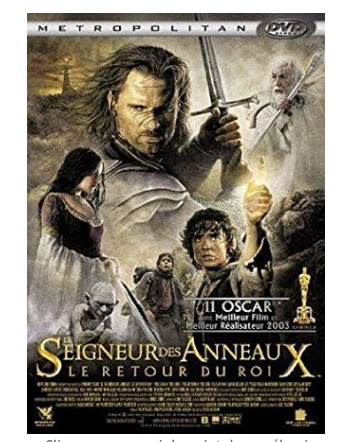
The Lord of the Rings: The Return of the King
Synopsis
As Frodo and Sam approach Mordor guided by the treacherous Gollum, the armies of Gondor face the full force of Sauron's assault on Minas Tirith. Gandalf, Aragorn and their allies prepare for a final battle that may decide the fate of Middle-earth. Aragorn must accept his destiny and claim the throne of Gondor, while Frodo struggles to carry the Ring to Mount Doom. Hope hangs by a thread as the two stories converge toward an epic conclusion.
The Making of the Film
The Return of the King is the third and final part of Peter Jackson's adaptation of J.R.R. Tolkien's novel. It was filmed at the same time as the first two films, between 1999 and 2000, but the production continued with additional filming for several years afterward. During post-production, Jackson and his team spent months reworking the story, adding new scenes after seeing how the first two films were received. The script by Jackson, Fran Walsh and Philippa Boyens had to condense the final volume while giving every major character a satisfying arc. Some elements of the book, such as the Scouring of the Shire, were left out in order to keep the focus on the main climax. The team believed the film should end with the Grey Havens, in order to close the emotional arc of Frodo. The pressure was high, as the film had to live up to two well-loved predecessors. Jackson's dedication and the studio's trust helped transform the third chapter into a monumental finale.
Reviews and reception
Professional critics' summary
Critics were overwhelmingly positive, hailing the film as a triumphant conclusion to the trilogy. They praised the spectacular battle of the Pelennor Fields, the emotional depth of the performances and the visual effects. Many reviewers considered it to be one of the greatest fantasy films ever made. The only recurring criticism concerned the length of the ending, with several farewells that some found excessive.
Audience reception
The film was a huge commercial success, earning more than 1.1 billion dollars worldwide. Audiences around the world queued to see the final chapter of the trilogy, and many watched the three films in marathon sessions. The ending, with its emotional farewells, moved many viewers to tears. It became a cultural touchstone for a whole generation.
Awards
The Return of the King won all eleven Academy Awards for which it was nominated, including Best Picture and Best Director. This tied the record held by Ben-Hur and Titanic for the most Oscars won by a single film. The film also won Best Original Song for Into the West, performed by Annie Lennox. It was a historic triumph for fantasy cinema, which had rarely been recognised by the Academy.
Filming anecdotes
Director's inspirations
Jackson was inspired by the epic cinema of David Lean and by classic war films to stage the battles on a grand scale. He also studied historical sieges to give Minas Tirith a realistic defensive structure. The emotional finale draws on Tolkien's theme of loss and the passing of an age. Jackson wanted the ending to feel like a true farewell, in keeping with the novel's bittersweet tone.
Production difficulties
The Battle of the Pelennor Fields required thousands of digital soldiers, giant elephants known as Oliphaunts and hundreds of hours of animation. The team developed software called Massive to simulate each warrior's behaviour independently. Filming the Paths of the Dead and Mount Doom involved extensive green-screen and set work. In addition, the production had to complete a huge amount of post-production work in a short time to meet its release date.
Anecdote about a particular scene
One of the most moving scenes is when the entire kingdom of Gondor bows to the four hobbits at Aragorn's coronation. The Beacons of Gondor sequence, in which fires are lit across the mountains to call for aid, is widely loved for its visual grandeur. Another well-known moment is Eowyn's confrontation with the Witch-king, where she reveals that she is a woman. Andy Serkis also delivered a memorable performance as Gollum, thanks to motion capture technology.
Originally planned casting
The core cast remained consistent throughout the entire trilogy, which allowed the actors to develop a strong bond. Viggo Mortensen was an essential presence as Aragorn, having replaced the original actor at the very beginning. Miranda Otto played Eowyn and Karl Urban took on the role of Eomer. Sean Astin, Elijah Wood and Ian McKellen were all praised for their performances.
Themes explored
The film focuses on destiny and the courage to accept it, particularly through Aragorn's journey to kingship. It explores sacrifice, as Frodo and Sam push beyond their limits to complete their mission. Friendship is again central, with Sam's famous declaration that he cannot carry the Ring but he can carry Frodo. The movie also reflects on the corrupting influence of power, shown by the fall of Denethor and the downfall of Gollum. Hope and despair are in constant tension, from the darkness of Mordor to the dawn of victory. Another theme is the end of an era, as the age of the Elves fades and the age of Men begins. It also examines the cost of war, showing the grief behind every victory. Finally, it celebrates the idea that even the smallest person can change the course of the future.
Ending explained
At Mount Doom, Frodo finds himself unable to destroy the Ring, claiming it for his own. Gollum attacks him and bites off his finger, then falls into the lava with the Ring, which destroys Sauron and brings down his tower. Frodo and Sam are rescued by the Eagles and later reunited with their friends. Aragorn is crowned king and marries Arwen, beginning a new age of peace for Middle-earth. The hobbits return to the Shire, but Frodo, forever marked by his burden, cannot fully recover. In the final scenes, he sails with Gandalf, Bilbo and the Elves to the Undying Lands. Sam returns to his family, bringing the story full circle. The ending is a bittersweet farewell, showing that victory comes at a personal cost.
Meaning of the title
The Return of the King refers to Aragorn, the heir of Isildur who reclaims the throne of Gondor. His return symbolises the restoration of order and hope after the long reign of darkness. In Tolkien's novel, the title also hints at the healing of the world after Sauron's defeat. It echoes ancient legends in which a lost king comes back to save his people. The title also creates a counterpoint to The Lord of the Rings, since the true ruler arrives after the false one is defeated. It marks the culmination of Aragorn's journey from Strider, a wandering ranger, to a rightful king. The phrase captures the sense of destiny and renewal that runs through the entire film.
Original Soundtrack
Howard Shore's score for The Return of the King won the Academy Award for Best Original Score. The song Into the West, written by Shore, Fran Walsh and Annie Lennox, won the Oscar for Best Original Song. The music perfectly accompanies the grand battles and the emotional farewells. It is considered to be one of the finest film scores of the 2000s.
News
The world of Tolkien continues to expand, with the animated film The War of the Rohirrim released in 2024. A new live-action film, The Hunt for Gollum, is in development with Andy Serkis directing and Peter Jackson producing, and it is announced for 2027. The saga remains one of the most beloved in cinema history.
Similar Films
The first two parts, The Fellowship of the Ring and The Two Towers, are the natural companions. The Hobbit trilogy offers a prequel to the story. Gladiator and Braveheart share a similar epic tone and large-scale battle scenes. Ben-Hur and Troy are other grand historical spectacles worth watching.