

 Français
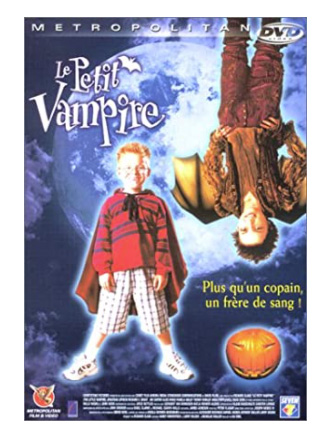
The Little Vampire
Synopsis
Nine-year-old Tony Thompson moves with his family from California to Scotland, where his father is building a golf course on the estate of Lord McAshton. Lonely and picked on at school, he befriends Rudolph, a young vampire from a family that drinks only animal blood and dreams of becoming human again. To fulfil that dream, they must recover a magical amulet before the comet returns, all while avoiding the ruthless vampire hunter Rookery. Tony agrees to help his new friend, and their adventure takes them from ancient tombs to the skies over Scotland.
The Making of the Film
The Little Vampire is loosely based on the children's book series Der kleine Vampir by the German writer Angela Sommer-Bodenburg, which has charmed young readers since the late 1970s. The film was directed by Uli Edel, a German filmmaker known for works as varied as Christiane F. and Last Exit to Brooklyn. The screenplay was written by Karey Kirkpatrick, who had worked on James and the Giant Peach, and Larry Wilson, one of the writers of Beetlejuice. It was a German, Dutch and American co-production, made by Cometstone Pictures and Stonewood Communications, with New Line Cinema handling the release in the United States. The producer Richard Claus supervised the project, which aimed to bring the beloved books to an international audience. The film moved the action to Scotland and featured an American boy as the hero, which gave it a transatlantic flavour. Jonathan Lipnicki, who had become a popular child star after Jerry Maguire and Stuart Little, took the leading role. The film premiered at the Edinburgh Film Festival in August 2000 and was released in Germany in September and in the United States in October.
Critical Reception
Critics gave the film a mixed reception, with a score of 56 percent on Rotten Tomatoes and 45 out of 100 on Metacritic. Several reviewers found the plot muddled and the tone uneven, moving awkwardly between cute comedy and gothic fright. Roger Ebert awarded it two stars out of four, saying that all the pieces were in place but did not fit together. The New York Times, by contrast, was warm toward the film, praising its wit and sense of mischief. The BBC gave it three stars, saying that the central idea and Lipnicki's charm were sometimes almost enough.
The film was a commercial disappointment, earning about 28 million dollars against a budget of 35 million. Audiences polled by CinemaScore were kinder than critics, giving it an average grade of B plus. Younger viewers in particular enjoyed the friendship between Tony and Rudolph and the running gag about vampire cows. The author of the original books, Angela Sommer-Bodenburg, found the film beautiful, atmospheric and funny, but regretted its ending, in which the vampires become human, since the tragedy of the vampires in her books lies in their inability to do so.
In 2001 the film won the German Film Award for Best Children's Film. Jonathan Lipnicki was nominated at the Saturn Awards for Best Performance by a Younger Actor. Lipnicki and Rollo Weeks were also both nominated at the Young Artist Awards. These honours reflected the appeal of the film's young cast.
Filming anecdotes
The film was shot in Scotland, using a series of striking locations including Dunimarle Castle in Fife, Dundas Castle and Dalmeny House near Edinburgh, and Gosford House in East Lothian. The school that Tony attends in the film is Low Port Primary School in Linlithgow. Rudolph's family were designed as vegetarian vampires who feed on the blood of cows, which led to one of the film's most original images, the flying vampire cows. The character of Gregory, Rudolph's older brother, is notable for communicating only through vampire noises, a charming comic touch. A 3D animated film, The Little Vampire 3D, released in 2017, was loosely based on the live-action film and brought back Jim Carter and Alice Krige as Rookery and Freda.
Themes explored
At its core, The Little Vampire is a story about friendship across differences, in which a lonely boy and a young vampire discover that they have more in common than they thought. The film speaks about belonging and the difficulty of being the new kid in a foreign place. It also deals with prejudice, since the vampires are feared by humans who barely know them. The vampire family's wish to become human raises questions about identity and the desire to be accepted. Rookery, the hunter, embodies fanaticism and the danger of seeing others only as threats. The film also looks at family and loyalty, with the Sackville-Bagg clan sticking together despite their differences. Tony's courage grows throughout the story, as he learns to stand up to the school bullies and to protect his friend. Beneath the gothic trappings, the film is a gentle fable about tolerance and acceptance.
Ending explained
In the climax, Tony and Rudolph manage to recover the amulet while Rookery, chasing them in his truck, becomes entangled with a blimp and drives off a cliff. They bring the amulet to the vampire clan at the ritual site, but Rookery returns riding the blimp and interrupts the ceremony. The vampires cannot stand against his glowing cross, so Tony's parents, Bob and Dottie, step in to defend them and push the hunter off a cliff. Tony then completes the ritual by wishing for the vampires to become human. Rudolph and his family disappear as the comet passes, leaving Tony unsure whether the spell has worked. Some time later, at the village market, Tony spots the family, now human, moving into a house in the village. At first they do not seem to recognise him, but when Tony whistles the signal they had shared, their memories return and the friends are reunited.
Meaning of the title
The title The Little Vampire refers to Rudolph, the child vampire who becomes the hero's friend. The adjective little points to the film's family audience and to its gentle spirit, which contrasts with the more fearsome image of vampires in horror cinema. It reflects the title of the original German books, Der kleine Vampir, which also focus on a young and unusually friendly vampire. The word little also hints at vulnerability, since Rudolph is weakened and hunted by Rookery. The title suggests a mixture of cuteness and menace, which is exactly the tone the film tries to strike. For young readers and viewers, it promises a reversal of expectations, in which the monster is the friendly one. The singular form of the title puts the spotlight on the bond between the two boys, rather than on the whole vampire clan. In that sense, it is a title that focuses on friendship rather than on fear.
Similar Films
If you enjoyed The Little Vampire, the first suggestion is the original book series Der kleine Vampir by Angela Sommer-Bodenburg, which inspired the film. The 2017 animated film The Little Vampire 3D offers another version of the story, with the same characters voiced by Jim Carter and Alice Krige. Young Dracula is a British television series that also follows a young vampire family in a modern setting. Hotel Transylvania offers a similarly lighthearted take on monsters. Casper, with its friendly ghost, is another story of a lonely child befriending a supernatural being. The Addams Family and its sequels combine gothic atmosphere and family humour. Beetlejuice, co-written by one of the film's screenwriters, is a darker comedy about the living and the dead. Together, these titles show how family-friendly monster stories have evolved.