

 Français
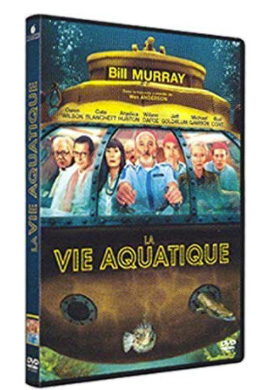
The Life Aquatic with Steve Zissou
Synopsis
Steve Zissou is an aging oceanographer and documentary filmmaker whose career has faded after a series of failures. When his partner is killed by a mysterious creature called the jaguar shark, he decides to assemble his eccentric crew for one final expedition to hunt it down. The journey is complicated by the arrival of a young man who may be his son, a pregnant journalist and a rival oceanographer. Part adventure, part comedy, part melancholic family drama, the film follows a man in search of meaning.
The Making of the Film
The Life Aquatic with Steve Zissou was directed by Wes Anderson, who co-wrote the screenplay with Noah Baumbach. The character of Zissou was inspired by the famous oceanographer and filmmaker Jacques Cousteau. Bill Murray plays the lead, with Owen Wilson, Cate Blanchett, Anjelica Huston, Willem Dafoe and Jeff Goldblum in supporting roles. Much of the film was shot in Italy, including at the Cinecittà studios in Rome, where a full-scale ship was built. The sea creatures were created using stop-motion animation by Henry Selick, who had directed "The Nightmare Before Christmas". The film was released at the end of 2004.
Reviews and Reception
Summary of Professional Reviews
Critics gave the film a mixed reception. Many admired its distinctive visual style, its deadpan humor and Bill Murray's melancholy performance. Others found it less emotionally engaging than Anderson's previous films and felt that its quirks were too mannered. Over time, however, critical opinion has grown more favorable.
Audience Reception
The film was a box-office disappointment, earning far less than its budget. Over the years, it has developed a devoted cult following, who praise its inventive design, its soundtrack and its blend of comedy and sadness. Many fans consider it one of Anderson's most underrated works.
Filming Anecdotes
Director's Inspirations
Anderson drew on the documentaries of Jacques Cousteau, which he admired for their adventurous spirit. He also wanted to explore the idea of a man whose public image no longer matches his private life. The film's cross-section ship, shown in a dollhouse-like view, became one of its most memorable visual ideas.
Production Challenges
Building the full-scale ship, the Belafonte, and shooting in Italy turned out to be technically and logistically demanding. The production also had to coordinate live actors with hand-made stop-motion sea creatures. These choices gave the film a unique texture, but they also made it expensive and complicated to complete.
Themes Explored
The film is a melancholic comedy about aging, failure and the search for meaning. It explores the relationship between fathers and sons, represented by Zissou and the young man who might be his child. Ambition and nostalgia shape Zissou's need to prove himself one last time. The story also examines the idea of a found family, as the crew of eccentric characters becomes a surrogate home. Grief and revenge drive the hunt for the jaguar shark, but the journey is more important than the goal. Beneath its whimsical surface, it is a film about accepting the limits of one's life.
Ending Explained
After a series of mishaps, the crew finally encounters the jaguar shark, which turns out to be a beautiful and peaceful creature. Zissou, moved by the sight, abandons his desire for revenge. The film ends with the premiere of his new documentary and a final, quiet moment aboard the submarine. The conclusion offers reconciliation and acceptance rather than triumph.
Meaning of the Title
"The Life Aquatic" is the name of Zissou's documentary series, which turned him into a minor celebrity. The title suggests a life lived at sea, away from the ordinary world. It also hints at the idea that the character is deeply immersed in his own mythology.
Soundtrack
The film is famous for the performances of Brazilian singer Seu Jorge, who appears on screen singing David Bowie songs in Portuguese on an acoustic guitar. The score was composed by Mark Mothersbaugh, whose playful electronic music adds to the film's unique tone. Together, they form one of the most distinctive soundtracks of Wes Anderson's career.
Similar Films
- The Royal Tenenbaums (2001): another Wes Anderson film about a dysfunctional family.
- Moonrise Kingdom (2012): a quirky adventure with a deadpan tone.
- Rushmore (1998): Anderson's comedy about an eccentric dreamer.
- The Darjeeling Limited (2007): a journey of three brothers.