

 Français
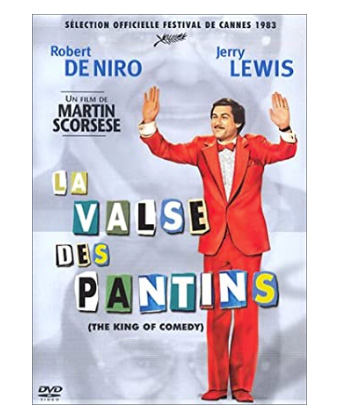
The King of Comedy
Synopsis
Rupert Pupkin is an aspiring stand-up comedian who lives with his mother and dreams of becoming a star. He is obsessed with the famous talk-show host Jerry Langford, whom he sees as his ticket to fame. After a failed attempt to impress Jerry, Rupert and the unstable fan Masha hatch an outrageous plan to kidnap him. The scheme leads Rupert to the spotlight he has always craved, but at a very high price.
The Making of the Film
The King of Comedy was written by Paul D. Zimmerman, a film critic and journalist who wrote the script in the 1970s after becoming fascinated by celebrity culture and obsessive fans. Robert De Niro read the screenplay and brought it to Martin Scorsese, who at first was not sure he wanted to direct it. After making Raging Bull, Scorsese decided that the story's dark view of fame was worth exploring. De Niro starred as Rupert Pupkin, and the comedian Jerry Lewis was cast as Jerry Langford, a role that was reportedly turned down by other famous talk-show figures. Sandra Bernhard made a memorable debut as the obsessed Masha. The film was shot in New York City in 1981 and released in 1982. It was designed as a black comedy about the dark side of celebrity.
Reviews and reception
Summary of professional reviews
Critics were divided when the film came out, with some praising its bold tone and others finding it too uncomfortable. Over time, it has been reappraised as one of the most perceptive films about fame and obsession. De Niro's performance as Rupert is often described as one of his best.
Audience reception
The film was a commercial failure, earning only about 2.5 million dollars in the United States on a budget of about 19 million. Audiences were put off by its awkward humor and its unlikable protagonist. Years later, it found a devoted audience as a cult classic. It is now considered a key film for understanding modern celebrity culture.
Awards and nominations
The film was shown at the Cannes Film Festival, where it received attention but no major prize. Jerry Lewis received a BAFTA nomination for his performance. The film was also recognized by critics' associations in later years. Its greatest honor is its status as an influential classic.
Filming anecdotes
Director's inspirations
Scorsese was inspired by the idea of fame as a kind of illness, a theme he had touched on in Taxi Driver. He and De Niro wanted to portray a character who is both pathetic and frightening. The film's look is deliberately flat and realistic, which makes the fantasy sequences stand out.
Production difficulties
The film was shot on location in New York, often in crowded streets, which required careful planning. De Niro prepared by spending time with stand-up comedians and studying obsessive fans. Scorsese was also in a difficult personal period during the production.
Anecdote about a particular scene
One of the film's most unsettling scenes is Rupert's imaginary conversation with Jerry in his basement, where he performs for cardboard cutouts of celebrities. Another is the final stand-up routine, which blurs the line between comedy and confession. Sandra Bernhard's scenes as Masha are among the film's most intense.
Original casting plans
The part of Jerry Langford was reportedly offered to the talk-show host Johnny Carson, who declined, before the role went to Jerry Lewis. Lewis gave a restrained and dramatic performance that surprised many viewers.
Themes explored
The film is about the hunger for fame and the way modern culture rewards attention at any cost. It looks at obsession and the blurry line between fan and stalker. It also explores delusion, as Rupert lives in a fantasy world in which he is already a star. The movie satirizes the media's power to make and break reputations. Loneliness and the need for validation are central. It is both a comedy and a disturbing warning.
Ending explained
After kidnapping Jerry, Rupert forces a television network to broadcast his monologue in exchange for his release. He is arrested but becomes a celebrity overnight, and after serving a short sentence, he is welcomed as a star. The final scene shows him introduced as the king of comedy to a cheering audience. The ending is ambiguous, leaving viewers wondering whether it is real or another one of Rupert's fantasies. It is a bitter satire on how society treats notoriety.
Meaning of the title
The title refers to Rupert's fantasy of being crowned the king of comedy, the title he longs to take from the talk-show host. It is also a sarcastic comment on the way the media confers royalty on its performers. The crown becomes a symbol of the desire for status and recognition. The title is playful and ironic.
Original Soundtrack
The soundtrack, supervised by Robbie Robertson, mixes rock and pop songs with Ray Charles's Come Rain or Come Shine, among others. It helps to set a tone of urban loneliness and dreamlike energy. The music gives the film a cool, understated atmosphere.
News
The film's reputation has grown considerably, and it is often cited as a forerunner of films like Joker, in which Robert De Niro plays a talk-show host. It is frequently shown in retrospectives of Scorsese's work.
Similar Films
- Taxi Driver (1976): another Scorsese film about an isolated man.
- Network (1976): a satire of television and media.
- Nightcrawler (2014): a dark look at ambition in the media world.
- Joker (2019): a film that pays homage to Scorsese's classics, with De Niro.
- Being There (1979): a comedy about fame and mistaken identity.