

 Français
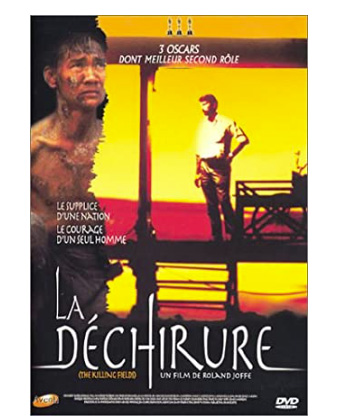
The Killing Fields
Synopsis
During the final years of the Vietnam War, American journalist Sydney Schanberg reports from Cambodia as the country falls into political and military chaos. He works closely with Cambodian journalist Dith Pran, whose knowledge and courage become essential to their coverage. When the Khmer Rouge takes control of Phnom Penh, foreign journalists are evacuated, but Pran is trapped in the country. He is forced to endure the brutal policies of the new regime while Schanberg tries to discover what has happened to his friend. Their story becomes a powerful account of survival, loyalty and the human cost of political violence.
The film is based on the real experiences of American journalist Sydney Schanberg and Cambodian photojournalist Dith Pran during the Cambodian Civil War and the Khmer Rouge period. Schanberg wrote about their experiences in his 1980 New York Times Magazine article The Death and Life of Dith Pran. The screenplay was adapted by Bruce Robinson, who transformed the journalistic account into a drama about friendship and survival. Director Roland Joffé wanted to show the Cambodian tragedy through the experiences of individuals rather than through a purely political overview. The project also aimed to draw international attention to atrocities that many Western audiences knew little about. Its historical background required careful research and a sensitive approach to events that were still recent and deeply traumatic. The result combines political journalism, personal drama and a reconstruction of one of the darkest periods in modern Cambodian history.
The film received widespread critical acclaim for its emotional force, performances and historical importance. Critics particularly praised Haing S. Ngor, whose portrayal of Dith Pran brought extraordinary intensity to the story. Sam Waterston was also recognized for his performance as Sydney Schanberg, although some reviewers debated how much attention the film gives to the American journalist compared with the Cambodian experience. The cinematography and production design were widely admired for recreating the atmosphere of Cambodia during the 1970s. Audiences were deeply affected by the film, which helped introduce the history of the Khmer Rouge to a much wider international public. The film received seven Academy Award nominations and won three, including Best Supporting Actor for Haing S. Ngor, Best Cinematography and Best Film Editing. It also won major awards from the British Academy of Film and Television Arts. Its reputation has endured as an important work of historical cinema.
The production was notable for its effort to recreate Cambodia despite being filmed largely in Thailand. Roland Joffé and his team worked with Cambodian refugees and people who had direct experience of the period. Haing S. Ngor was not a professional actor before being cast as Dith Pran; he had himself survived the Khmer Rouge regime and brought personal experience to the role. His casting gave the film an exceptional emotional authenticity, although the memories involved made the work demanding. The crew faced logistical challenges in recreating crowded streets, refugee movements and the destruction caused by war. The production also had to balance dramatic storytelling with respect for the real people whose lives inspired the film. The result was a film whose visual realism and performances were central to its impact.
Themes Explored
The film examines friendship, loyalty and the moral responsibilities of journalism. Schanberg and Pran share a professional partnership that develops into a profound personal bond. Their separation reveals the unequal dangers faced by foreign correspondents and local journalists. The story also explores political extremism, forced labor, displacement and the destruction of ordinary social life. Survival becomes both a physical struggle and a test of human dignity. By focusing on one friendship, the film makes the consequences of mass violence personal and understandable.
Ending Explained
After years of imprisonment, forced labor and repeated danger, Dith Pran manages to escape from Cambodia and reaches a refugee camp in Thailand. Sydney Schanberg finally finds him there, and the two men are reunited. Their embrace is an emotional release after the long separation, but it cannot erase the suffering that Pran has endured. The ending also raises questions about Schanberg's earlier decisions and his responsibility toward the colleague who helped him report the story. Their reunion is therefore both joyful and painful. It represents survival and friendship, while acknowledging that the consequences of the Khmer Rouge period will remain with its victims. The final moments emphasize the human connection that has survived despite extraordinary violence.
Meaning of the Title
The title refers to the mass killing sites associated with the Khmer Rouge regime in Cambodia. These locations became symbols of the systematic violence, executions and terror inflicted on the population. The expression is direct and deliberately stark, reflecting the film's refusal to soften the historical reality. It also gives the story a wider meaning beyond the experiences of its two central characters. Their personal journey takes place within a national tragedy in which countless people suffered and died.
Original Soundtrack
The score was composed by Mike Oldfield, whose atmospheric music gives the film an emotional and reflective dimension. The soundtrack combines electronic textures with orchestral elements, helping establish the tension of the early war scenes and the sadness of the later sequences. John Lennon's song Imagine is also used memorably, creating a contrast between the ideal of peace and the violence shown on screen. The music contributes significantly to the film's emotional impact without overwhelming its historical subject.
Viewers interested in historical dramas about war, journalism and survival may also appreciate Hotel Rwanda, Schindler's List, The Pianist, The Year of Living Dangerously, First They Killed My Father and A Private War. These films examine the experiences of individuals caught in political violence and historical upheaval.