

 Français
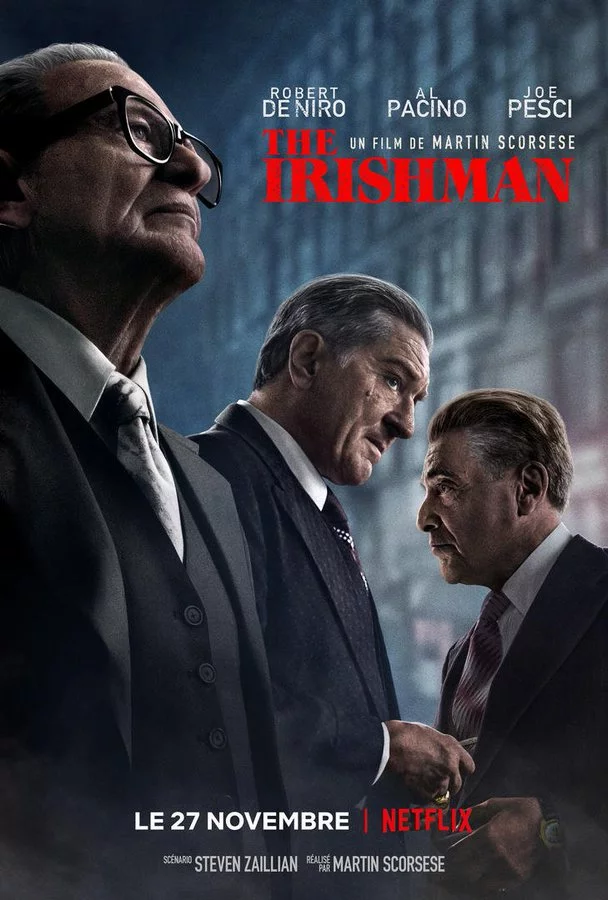
The Irishman
Synopsis
Frank Sheeran, an ageing hitman, looks back on his life as a trusted associate of the Pennsylvania crime family led by Russell Bufalino. His story includes his friendship with the powerful union leader Jimmy Hoffa. As the decades pass, loyalty to one side begins to conflict with loyalty to the other. The film follows him from the post-war years into old age.
The Making of the Film
The film is based on Charles Brandt's 2004 book I Heard You Paint Houses, which presents Sheeran's account of his life. Steven Zaillian wrote the screenplay, and Martin Scorsese directed the film for Netflix after years of attempts to get the project off the ground. It reunited Scorsese with Robert De Niro and Joe Pesci, and was the first time Al Pacino worked with him. Many historians dispute the book's central claims about Hoffa's disappearance.
Reviews and reception
Summary of professional reviews: Critics praised the film as a mature, reflective work from Scorsese, with outstanding performances by De Niro, Pacino and Pesci. The length of around three and a half hours was noted, but most felt it was justified.
Audience reception: The film was released by Netflix after a limited theatrical run and found a large audience on streaming. Viewers were particularly struck by the film's quiet final act.
Awards won: The film received ten Academy Award nominations, including Best Picture, Best Director, and acting nominations for Al Pacino and Joe Pesci, but did not win any.
Behind-the-scenes anecdotes
Production difficulties: The film used visual-effects technology to de-age its actors, allowing the three leads to portray their characters across several decades.
Themes explored
The film explores loyalty and betrayal, the cost of violence and the loneliness of old age. It also reflects on regret and the emptiness left by a life of crime.
Ending explained
The film ends with an elderly Frank in a care home, estranged from his daughters, asking a priest to leave the door slightly open. The image conveys his isolation and a quiet longing for connection.
Meaning of the title
"I heard you paint houses" is a phrase used to refer to killing people, with the "paint" referring to blood on the walls. The title "The Irishman" refers to Frank Sheeran's heritage.
Soundtrack
Robbie Robertson's score, along with a selection of period songs, helps anchor the film in its many time periods.
Similar films
Fans of this film might enjoy Goodfellas, Casino, The Godfather Part II, Once Upon a Time in America or The Departed.