

 Français
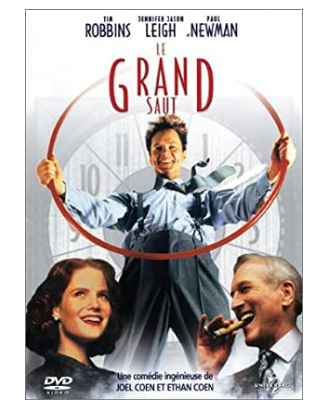
The Hudsucker Proxy
Synopsis
In 1958, Norville Barnes, a naive business-school graduate from Muncie, Indiana, takes a job in the mailroom of Hudsucker Industries just as its founder leaps to his death from the top floor. Sidney J. Mussburger, the scheming executive in charge, installs the greenhorn as president, convinced that his incompetence will sink the share price and let the board buy up the company on the cheap. Instead, a simple circle scribbled on a sheet of paper becomes the hula hoop and sparks a nationwide craze. As Amy Archer, a sharp-tongued reporter, closes in on the truth, Norville's dizzying rise begins to look like a very long fall.
The Making of the Film
The Hudsucker Proxy had been on Joel and Ethan Coen's minds for more than a decade before it reached the screen. They wrote the first version of the script in the early 1980s with their friend Sam Raimi, long before they had the clout to finance something this ambitious. The idea was a loving riff on the Hollywood comedies of the 1930s and 1940s, in which an unassuming dreamer is thrown into the jaws of big business. Frank Capra's populist fables and the whirlwind dialogue of Preston Sturges and Howard Hawks served as obvious touchstones, particularly for the fast-talking reporter Amy Archer. The Coens also borrowed from a darker tradition, imagining a corporate skyscraper whose vast offices and clanking machinery owe as much to Fritz Lang and Franz Kafka as to Capra. For years the script stayed on the shelf because its period sets and visual effects were simply too costly. It was only after the critical success of Barton Fink that producer Joel Silver and Warner Bros. gave the brothers the means to build the film they had imagined. The result was the biggest budget the Coens had worked with up to that point, and a chance to turn a long-cherished screenplay into a full-blown fable about ambition and invention.
Reviews and Reception
Critics were divided when the film opened in the spring of 1994. Many admired its dazzling craftsmanship, from Roger Deakins's luminous cinematography to the towering Art Deco sets that make Hudsucker Industries feel like a cathedral of commerce. Others felt that the Coens had put style ahead of heart, arguing that the pastiche of old Hollywood comedy kept the audience at arm's length. Tim Robbins's wide-eyed innocence and Paul Newman's gleefully ruthless executive drew warm praise, as did Jennifer Jason Leigh's dazzling impersonation of a 1940s screwball heroine. Over the years the film has been reassessed far more generously, and it is now often described as one of the Coens' most underrated works.
With the public, the film simply never took off. It earned only a few million dollars in the United States, a disastrous result for a production of this scale. Audiences who expected a conventional comedy seemed unsure what to make of its stylized, cartoon-like world. Home video and television changed that story, and the film slowly built a loyal cult following among fans of the Coens and lovers of classic Hollywood pastiche. Today, viewers often single out the hula hoop montage, the clock tower sequence and the brisk, quotable dialogue as reasons to return to it.
The Hudsucker Proxy was selected to compete for the Palme d'Or at the 1994 Cannes Film Festival, where the top prize went to Pulp Fiction. The Los Angeles Film Critics Association honored the film for its production design, a fitting tribute to one of its most striking assets. Beyond these distinctions, it did not become a major awards-season contender. Its reputation has grown through lasting affection far more than through trophies.
Filming Anecdotes
The Coens openly built the film as a homage to the great studio comedies of the 1930s and 1940s. Capra's tales of ordinary men crushed by powerful institutions inspired Norville's journey, while Hawks's His Girl Friday shaped the rhythm of Amy Archer's rapid-fire exchanges. Jennifer Jason Leigh's accent is a deliberate nod to the heroines of screwball comedy. Fritz Lang's Metropolis inspired the monumental, almost oppressive scale of the corporate sets. The brothers also played with the circle as a visual motif, echoing it in the hula hoop, the clock faces, the buttons and the swirling camera moves.
At the time, it was the most expensive production the Coens had undertaken, and the pressure that came with a studio budget was new to them. The film required elaborate sets, miniatures and visual effects to bring its giant skyscraper to life. Its stylized tone proved hard to sell to audiences, and the film struggled commercially after its release in March 1994. The brothers went on to make more modest films afterwards, such as Fargo, which brought them back to critical and commercial triumph.
The most celebrated sequence is the opening, in which company founder Waring Hudsucker, played by Charles Durning, steps onto the ledge of the boardroom window and leaps from the top floor. Another highlight is the moment when time freezes as Norville contemplates his own fall, with the clock keeper Moses halting the machinery of the tower. The hula hoop montage, in which the invention conquers the whole country in a swirl of circles, is another standout. Each of these scenes shows the Coens' taste for elaborate staging and visual wit.
Over the course of development, several famous names were reportedly considered for the main roles, including Tom Cruise, Winona Ryder and Clint Eastwood. In the end, the brothers chose Tim Robbins as the wide-eyed Norville, Jennifer Jason Leigh as the savvy reporter Amy and Paul Newman as the villainous Mussburger. Newman's presence brought a touch of old Hollywood gravitas, while his role as a scheming executive let him play against his famously warm image.
Themes Explored
At its core, The Hudsucker Proxy is a satire of corporate greed and the machinery of American capitalism. The board of Hudsucker Industries treats a human being as a mere instrument for manipulating a stock price, and the film delights in showing how little regard the powerful have for the dreamers beneath them. Norville's invention of the hula hoop, a toy with no obvious purpose, raises the question of what really creates value in a business world obsessed with numbers. The film also explores innocence and its corruption, as Norville's sincerity gives way to arrogance once success arrives. Honesty and deception are at war throughout, most visibly in Amy Archer's double life as a reporter posing as a secretary who falls for her target. The circle, repeated in the hoop, the clocks, the buttons and the revolving doors, evokes a world of cycles in which fortune rises and falls. Fate and time hang over everything, from the clock tower that dominates the building to the supernatural intervention that rescues the hero. Finally, the film pays tribute to the optimism of classic Hollywood comedy, asking whether a decent person can survive in a world built on scheming.
Ending Explained
The final act begins when Norville, exposed as a pawn and humiliated by the very people he trusted, climbs onto the ledge of the Hudsucker building and prepares to jump, just as the company's founder once did. At that moment, time stops in the clock tower, thanks to Moses, the mysterious keeper of the clock. The ghost of Waring Hudsucker appears and offers Norville a way out, reminding him that his humble invention was always worth more than the schemes of the men who tried to use him. Back on earth, Mussburger's plot collapses and Norville is reunited with Amy. The ending is deliberately fantastical, a wink at the redemptive finales of the classic comedies the Coens admire. The closing image of a circle brings the story full circle, literally.
Meaning of the Title
The word proxy refers to someone appointed to act on behalf of another, and in the world of finance it also describes the power to vote shares in a shareholder's name. That is exactly Norville's role: a front man installed by the board to carry out a plan he does not even understand. The company name Hudsucker lends itself to a pun, evoking the Hudson River and New York while hinting at the word sucker, the dupe at the heart of the story. The title therefore captures the film's ironic double meaning, since the supposed puppet ends up as the one who truly shapes the company's destiny.
Original Soundtrack
Carter Burwell, a regular Coen collaborator, composed a grand, orchestral score that fits the film's larger-than-life corporate fable. It draws on the sweeping themes of Aram Khachaturian's ballet music, which gives the film a majestic, slightly absurd solemnity. The music underlines the contrast between the towering architecture and the small, hopeful man at its center.
Similar Films
- Meet John Doe (1941), Frank Capra
- Mr. Deeds Goes to Town (1936), Frank Capra
- Sullivan's Travels (1941), Preston Sturges
- His Girl Friday (1940), Howard Hawks
- The Apartment (1960), Billy Wilder
- Brazil (1985), Terry Gilliam