

 Français
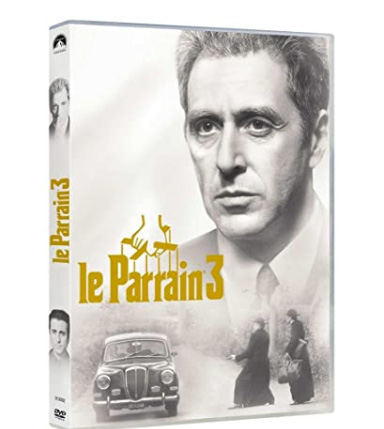
The Godfather Part III
Synopsis
In 1979, an aging Michael Corleone is seeking redemption and legitimacy for his family. He tries to transform the Corleone empire into a legal business by investing in the Vatican's finances. However, new enemies emerge from within the corrupt world of banking and the Church. Meanwhile, he trains his hot-headed nephew Vincent as his successor and tries to protect his daughter Mary.
The Making of the Film
The Godfather Part III arrived sixteen years after the second film, when Francis Ford Coppola was persuaded to return to the story. Coppola and Mario Puzo wrote the screenplay, drawing on real scandals involving the Vatican Bank and the collapse of the Banco Ambrosiano. The story was framed as an epilogue about Michael's guilt and his longing to be forgiven. Al Pacino, Diane Keaton and Talia Shire returned, while Andy García joined the cast as Vincent. Robert Duvall did not return after a dispute over salary, so the character of Tom Hagen was replaced by a new figure played by George Hamilton. Sofia Coppola took on the role of Mary after Winona Ryder withdrew shortly before shooting. The film was released at Christmas 1990 with great anticipation.
Reviews and reception
Summary of professional reviews
Critics gave mixed reviews. Many admired the film's ambition, the cinematography and the performances of Pacino and García, but felt that it did not match the first two films. Sofia Coppola's performance was widely criticized. Over time, the film has been reappraised more positively.
Audience reception
The film earned about 136 million dollars worldwide, a respectable but not exceptional result. Audiences who came to see the conclusion of the saga were divided. Some viewers consider it a moving tragedy, while others find it unnecessary. It remains an essential part of the trilogy for fans.
Awards and nominations
The film received seven Academy Award nominations, including Best Picture, Best Director and Best Supporting Actor for Andy García. It did not win any of them. Sofia Coppola received negative awards for her acting, though she later became an acclaimed director.
Filming anecdotes
Director's inspirations
Coppola wanted to explore Michael's need for redemption and the burden of guilt. He was inspired by real-life events and by the idea of a man who realizes too late what he has lost. The film's operatic structure echoes Italian opera.
Production difficulties
The production was marked by last-minute changes, including the casting of Mary and the absence of Duvall. The script was being revised during filming, and Coppola was working under tight deadlines. Shooting took place in Italy and in New York.
Anecdote about a particular scene
The final sequence at the opera house in Palermo, with Michael's tragic loss, is the film's emotional peak. It alternates between a performance of Cavalleria Rusticana and the planned assassination. The last image of Michael alone in a Sicilian courtyard is one of the most haunting in the trilogy.
Original casting plans
Winona Ryder was originally cast as Mary but withdrew because of exhaustion and illness. Coppola then cast his daughter Sofia in her place. Robert Duvall refused to return for the film because he felt his salary was not equal to Al Pacino's.
Themes explored
The film is about guilt, redemption and the impossibility of escaping one's past. Michael seeks to repair his soul by leaving crime behind, but the world he built will not let him. It explores corruption in powerful institutions, notably the Vatican and international finance. The story also deals with family and succession, as Michael tries to pass on his legacy. Love and loss are central, particularly in his relationship with his daughter. It is a tragedy about the consequences of choices.
Ending explained
At the opera, an assassin attempts to kill Michael, but Mary is struck by the bullet. She dies in her father's arms, and Michael lets out a silent scream of grief. Years later, an old and lonely Michael dies in a Sicilian courtyard, with no family around him. The film ends on a bleak note, suggesting that he was punished for his sins. In 2020, Coppola released a re-edited version called The Godfather, Coda: The Death of Michael Corleone, with an altered beginning and ending.
Meaning of the title
The title marks the third and final chapter of the Corleone saga. The word godfather points both to Michael's role as head of the family and to his spiritual position. By calling it Part III, the film positions itself as the conclusion of the trilogy. The title also suggests the cycle of power and the passing of the torch.
Original Soundtrack
Carmine Coppola composed the score, building on the themes by Nino Rota. The film's music includes the famous intermezzo from Cavalleria Rusticana, which accompanies the final scenes at the opera. The song Promise Me You'll Remember, performed by Harry Connick Jr., received an Oscar nomination. Together, they give the film a tragic, operatic quality.
News
In 2020, Coppola released a recut version of the film titled The Godfather, Coda: The Death of Michael Corleone. The re-edit changed the film's opening and closing to reflect his original intentions.
Similar Films
- The Godfather (1972): the first part of the saga.
- The Godfather Part II (1974): the second chapter and often considered the best.
- Scarface (1983): the rise and fall of a criminal.
- Heat (1995): a crime drama with Al Pacino.
- The Irishman (2019): an elegiac look at the life of a mobster.