

 Français
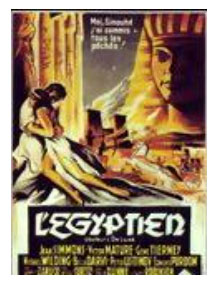
The Egyptian
Synopsis
Set in ancient Egypt during the opulent eighteenth dynasty under the revolutionary reign of Pharaoh Akhenaten, an abandoned baby found floating in a reed boat grows up to become a brilliant royal physician named Sinuhe. Alongside his pragmatic childhood friend Ktahep, Sinuhe rises through society to become the personal doctor to the pharaoh, witnessing the dramatic religious upheaval as Akhenaten outlaws all traditional gods in favor of a single deity of light. Along his journey, Sinuhe falls under the spell of a ruthless, golden-hearted Babylonian courtesan named Nefer, who repeatedly ruins him financially and emotionally. Ultimately, this sweeping historical epic explores religious fanaticism, moral corruption, and the eternal search for truth.
The Making of the Film
Director Michael Curtiz adapted Mika Waltari's monumental 1945 international bestselling historical novel to create a lavish, Technicolor cinematic spectacle. The project was conceived as an extravagant historical epic exploring ancient religious revolution, human vanity, and political corruption. Curtiz drew inspiration from archaeological artifacts, classical Hollywood biblical epics, and Waltari's deeply philosophical text. The production prioritized massive handcrafted ancient Egyptian temple sets, stunning CinemaScope cinematography, and an elite star-studded cast.
Critical Reception
Critics offered mixed reviews upon release, praising its staggering visual opulence, gorgeous CinemaScope cinematography, and Edmund Purdom's commanding lead performance. Reviewers noted that Michael Curtiz successfully captured the sweeping scale and exotic atmosphere of Waltari's massive historical novel. Some film critics, however, felt that the narrative felt stiff and melodramatic in its romantic subplots. Despite mixed initial reviews, historical epic enthusiasts embraced its grand visual splendor and philosophical ambitions.
Audiences flocked to theaters, turning the historical epic into a solid box-office success and a feast for the eyes during the golden age of widescreen biblical dramas. Viewers worldwide praised the dazzling ancient Egyptian costumes, massive temple sets, and Peter Ustinov's delightful comic relief as the loyal servant Ktahep. It found a welcoming audience among fans of grand historical spectacles. Many praised its ambitious attempt to tackle ancient theological revolution on screen.
Although major mainstream cinematic awards bypassed the historical epic release, it earned a well-deserved Academy Award nomination for Best Color Cinematography for Leon Shamroy. Edmund Purdom's breakout lead performance received praise from studio executives and film fans. The film's stunning art direction and costume design were also celebrated by industry guilds. These milestones helped cement its reputation as a lavish, memorable entry in 1950s historical cinema.
Behind-the-Scenes Stories
Michael Curtiz was heavily inspired by the global literary phenomenon of Waltari's novel, wanting to bring ancient Egyptian history to life with unprecedented visual authenticity. He worked closely with leading Egyptologists to ensure the architectural designs of temples, royal palaces, and mummification rituals were historically grounded. The visual style utilized vibrant Technicolor palettes, expansive CinemaScope framing, and massive practical soundstage sets. The director also insisted on rigorous physical rehearsals for the sprawling crowd scenes.
Making the film involved a major last-minute casting change when original star Marlon Brando dropped out due to contractual disputes, prompting studio executives to urgently cast British newcomer Edmund Purdom in the demanding lead role of Sinuhe. Shooting took place across massive soundstages at 20th Century Fox in Hollywood under tightly managed production schedules. Gene Tierney and newcomer Bella Darvi brought intense glamour and dramatic friction to their respective femme fatale roles. Despite the immense logistical pressure of replacing a major star just before filming, the technical crew successfully delivered a polished widescreen epic.
During the filming of the elaborate ancient religious rituals and temple destruction sequences, the massive crew of extras brought grand scale to the historical drama. Peter Ustinov infused his scenes with spontaneous humor, providing a welcome lighthearted contrast to the heavy philosophical themes. Crew members reported feeling awestruck by the sheer scale of the handcrafted pyramid and temple sets built on the studio backlot. The profound dedication of the cast gave the historical epic its enduring visual grandeur.
Casting directors conducted an exhaustive search for an aristocratic leading man who could project both medical intellect and tragic vulnerability. Edmund Purdom was secured for the lead role of Sinuhe following Marlon Brando's departure. Jean Simmons, Victor Mature, and Gene Tierney were secured for major supporting roles. The legendary addition of Bella Darvi as Nefer completed the dramatic ensemble.
Themes Explored
The film heavily explores religious fanaticism, monotheistic revolution versus polytheistic tradition, and the moral corruption of power. It examines the destructive nature of obsession, greed, and unrequited love for a manipulative courtesan. Another core motif is the search for truth, healing, and spiritual redemption. It also touches upon ancient class divides, loyalty, and mortality.
Ending Explained
The film concludes with the aging physician Sinuhe, now living in desolate exile along the banks of the Nile following the fall of Akhenaten and the restoration of the old gods, writing his secret memoirs as a confession of his sins and a testament to his search for truth. Looking out over the sacred river, he finally finds inner peace, accepting his mortal fate with quiet dignity. The final haunting shots show his manuscript resting beside him as the sun sets over the desert. This poignant, somber finish wraps up the epic historical journey with philosophical closure.
Meaning of the Title
The title refers directly to the central protagonist, Sinuhe, who is known throughout history simply as "The Egyptian," symbolizing a universal everyman caught in the sweeping tides of ancient empire and theological revolution. It echoes the title of classical ancient Egyptian literary texts. The straightforward phrasing sets a monumental, historical tone for the epic drama. It encapsulates the solitary physician at the center of a changing world.
Similar films include The Ten Commandments, Ben-Hur, Cleopatra, and Land of the Pharaohs, which feature ancient historical epics, monumental temple sets, and theological drama.