

 Français
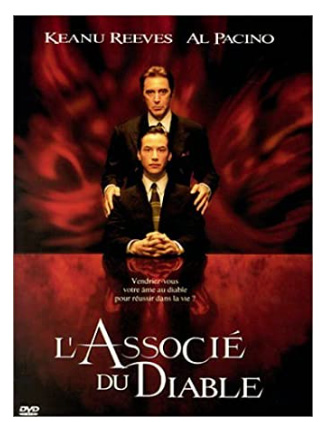
The Devil's Advocate
Synopsis
Kevin Lomax is a talented young Florida lawyer who has never lost a case, even when he knows his clients are guilty. He accepts an attractive offer from a prestigious New York law firm, where he and his wife Mary Ann quickly become surrounded by wealth, power and disturbing events. The firm is led by the charismatic John Milton, whose interest in Kevin seems far more personal than professional. As Mary Ann begins to lose her sense of security, Kevin discovers that his new employer may be hiding a terrifying secret.
The film is based on the 1990 novel of the same name by Andrew Neiderman. Its central idea combines the world of corporate law with the traditional figure of the Devil, imagining a powerful legal firm whose clients are protected regardless of their guilt. The story uses John Milton as a deliberate reference to the English poet who wrote Paradise Lost, a work that explores rebellion, temptation and the nature of evil. Several adaptations of the novel were considered before Taylor Hackford directed the project. The screenplay transforms the supernatural premise into a contemporary story about ambition, moral compromise and the seductive appeal of success. Rather than presenting evil only as something frightening, the film makes it attractive, intelligent and persuasive.
The film received mixed to positive reviews, with many critics appreciating its unusual mixture of legal thriller, psychological drama and supernatural horror. Al Pacino was frequently singled out for his energetic and theatrical performance as John Milton. Keanu Reeves received a more divided response, with some reviewers finding his portrayal effective and others considering it less convincing than Pacino's. Charlize Theron was also praised for giving Mary Ann an increasingly disturbing emotional dimension. Some critics felt that the film was too long and that its visual excess occasionally overwhelmed its ideas. Audiences were nevertheless attracted by its provocative premise, recognizable stars and memorable confrontations. The film became a commercial success and developed a lasting reputation among supernatural thrillers. It received a Saturn Award nomination for Best Horror Film, while its performances and visual style helped it remain a popular late-1990s genre film.
Taylor Hackford approached the supernatural story through the visual language of a modern corporate thriller. The production uses New York architecture, luxurious interiors and imposing offices to make the world of the law firm feel almost unreal. Al Pacino was given considerable freedom to shape the flamboyant personality of John Milton, creating a character who can move effortlessly between charm, humor and menace. The courtroom scenes were designed to establish Kevin Lomax as an exceptionally persuasive lawyer before the story gradually reveals the moral cost of his talent. The film also relies on visual references to religious imagery and classical representations of temptation. Its final sequences combine practical locations, elaborate sets and visual effects to create an increasingly hallucinatory atmosphere.
Themes Explored
The film examines ambition and the price of professional success. Kevin believes that winning is proof of his talent, but gradually discovers that success can become a form of moral surrender. The story explores temptation, vanity, pride and the manipulation of human desires. It also questions the relationship between free will and responsibility: people may be influenced by powerful forces, but they remain responsible for the choices they make. Marriage and loyalty are placed under pressure as Kevin becomes increasingly absorbed by his career. The film ultimately presents evil as something that often succeeds by offering people exactly what they believe they want.
Ending Explained
At the end of the film, Kevin refuses to accept the role that John Milton has prepared for him. Rather than following the path of ambition and becoming the instrument of his father, he chooses to sacrifice his professional reputation and reject the temptation. He shoots himself, apparently ending the plan that Milton had designed around him. The story then returns to the beginning of the narrative, revealing that Kevin has another opportunity to make a different decision. When a journalist approaches him with the possibility of a major public victory, Kevin initially accepts the attention but ultimately turns away from the temptation of fame. Milton appears once more, suggesting that vanity remains a weakness through which he can reach people. The ending therefore offers hope without pretending that temptation has disappeared.
Meaning of the Title
The title refers to the expression devil's advocate, which traditionally describes someone who argues against a position in order to test its strength. In the film, the expression acquires a literal and sinister meaning through John Milton, who acts as a persuasive advocate for evil. His legal profession allows him to defend people whose guilt is obvious, while his personal philosophy encourages Kevin to justify increasingly immoral decisions. The title also suggests that evil rarely presents itself openly as evil. Instead, it argues, persuades and offers apparently reasonable explanations for selfish choices.
Original Soundtrack
The score was composed by James Newton Howard, whose music combines orchestral tension, dark textures and religiously suggestive elements. The soundtrack helps transform the law firm into an increasingly oppressive environment, reinforcing the contrast between its luxurious appearance and its disturbing reality. The film also uses contemporary songs to connect its supernatural story with the atmosphere of late-1990s New York. Howard's dramatic orchestral writing is particularly effective during the scenes in which Kevin begins to understand the true nature of his employer.
Viewers interested in supernatural thrillers and stories about moral temptation may also enjoy Angel Heart, The Ninth Gate, The Omen, Rosemary's Baby and Constantine. These films explore the presence of evil in apparently ordinary environments and often place their protagonists in situations where ambition, desire and fear become dangerous forces.