

 Français
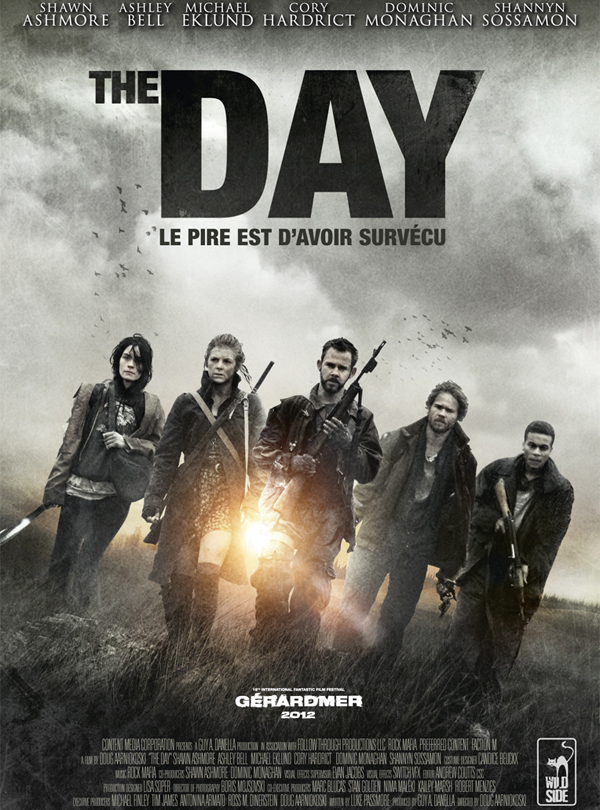
The Day
Synopsis
Ten years after the collapse of civilization, a small group of survivors walks the back roads in search of food and shelter. They are armed and weary, and they have learned to trust almost no one. When they arrive at an abandoned farmhouse, they believe they have finally found a safe place. But they soon realize that they are being hunted by a band of cannibalistic raiders.
The Making of the Film
The Day is a Canadian post-apocalyptic thriller directed by Douglas Aarniokoski from a screenplay by Luke Passmore. The story belongs to the tradition of survival horror in which a small group is besieged in a remote location. Aarniokoski, who had previously made Highlander: Endgame and other genre films, wanted to create a tense, stripped-down film about people at the end of the world. The cast included Shawn Ashmore, Ashley Bell, Dominic Monaghan, Shannyn Sossamon and Cory Hardrict. The film premiered in the Midnight Madness section of the 2011 Toronto International Film Festival. WWE Studios later acquired distribution rights and released it with Anchor Bay.
Reviews and reception
Summary of professional reviews
Critics gave the film mixed to negative reviews. Many noted that the performances were solid and that the siege sequences were effective, but they felt that the dialogue and the melodrama dragged the film down. Comparisons were often made with Mad Max 2 and other post-apocalyptic classics.
Audience reception
The film had a very limited release in the United States in August 2012 and earned only about 21,000 dollars at the box office. It reached most of its audience on home video. Genre fans who watched it often praised its bleak mood and its abrupt ending. It remains a small, little-known title in the survival-horror category.
Awards and nominations
The Day did not receive notable awards. Its main achievement was being selected for the Toronto International Film Festival's Midnight Madness program, which brought it attention among genre fans.
Filming anecdotes
Director's inspirations
Aarniokoski has said that he wanted to make an old-fashioned siege film in a post-apocalyptic setting, like the horror classics of the 1970s and 1980s. The film also draws on westerns, with its small group defending a farmhouse. He focused on tension and grim realism.
Production difficulties
The production was a modest one, shot in Canada with a small crew and a limited budget. The desolate landscapes had to be created with careful location scouting and color grading. Working with weapons and stunts on a tight schedule was a challenge.
Anecdote about a particular scene
The central siege of the farmhouse takes up most of the second half of the film and is its most memorable section. The film is also known for an abrupt and bleak twist near the end. A shorter R-rated version circulated in the United States, with some alternate footage in the first half hour.
Themes explored
The film is about survival and the erosion of trust in a world without rules. The characters must decide whether to help a stranger or protect themselves. It explores the idea that the most dangerous enemies may be other humans. Loss and trauma haunt the survivors, who are constantly reminded of what they once had. Leadership and loyalty are tested under pressure. The tone is bleak and unforgiving.
Ending explained
After a violent siege, the survivors fight off the attackers, but the cost is high. The question of whether Mary can be trusted is answered in an abrupt and cruel twist. The film refuses to offer a comforting resolution, in keeping with its harsh view of the world. The ending leaves the audience with a sense of despair and uncertainty.
Meaning of the title
The title refers to the day that civilization collapsed, which the characters still call the Day. It suggests a single moment that divided the world into before and after. The simple title also gives the film a mythic, ominous feel. It reinforces the idea that the survivors are trapped in the aftermath.
Similar Films
- The Road (2009): a father and son struggle to survive in a ruined world.
- Mad Max 2: The Road Warrior (1981): a classic siege story in a post-apocalyptic wasteland.
- Stake Land (2010): survivors fight vampires in a collapsed America.
- Carriers (2009): friends try to survive a deadly virus.
- The Divide (2011): a group trapped in a basement after a nuclear attack.