

 Français
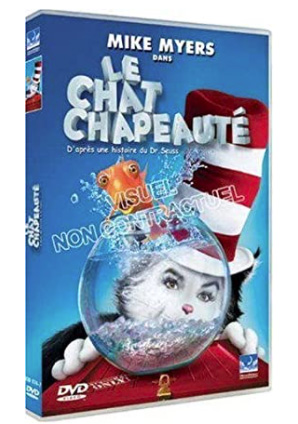
The Cat in the Hat
Synopsis
On a gloomy, rainy day, two bored children, Conrad and Sally, are left alone at home while their mother is away. Suddenly, a tall, mischievous cat in a red-and-white striped hat appears and promises to make the day more fun. His chaos soon spirals out of control, with his two troublemaking helpers, Thing One and Thing Two, wrecking the house. The children must find a way to clean up the mess before their mother returns.
The Making of the Film
The film is a live-action adaptation of Dr. Seuss's classic children's book The Cat in the Hat, first published in 1957. Director Bo Welch, who had previously worked as a production designer, created a vibrant, surreal world that echoed Seuss's distinctive illustrations. Mike Myers took on the role of the Cat, wearing extensive prosthetics and makeup. The screenplay expanded the very short book into a feature-length story, adding new characters and subplots. The film was released in November 2003.
Reviews and Reception
Summary of Professional Reviews
Critics were largely scathing, accusing the film of replacing Seuss's gentle charm with crude humor and frenetic energy. Many felt that Mike Myers's performance was overbearing and that the story lost the simplicity of the original. A few reviewers admired its colorful production design.
Audience Reception
The movie earned a considerable amount of money at the box office, but it was not well loved by viewers or by fans of the book. Parents were often put off by some of its edgier jokes. The negative reaction was so strong that Dr. Seuss's widow decided to refuse any further live-action adaptations of his works.
Filming Anecdotes
Director's Inspirations
Bo Welch wanted to create a world that looked as though it had been drawn by Dr. Seuss, with exaggerated shapes and pastel colors. He used his background in set design to build elaborate, whimsical environments.
Production Difficulties
Mike Myers had to spend many hours each day in the makeup chair to be transformed into the Cat. The elaborate sets, special effects and costumes made the shoot complicated and expensive.
Themes Explored
The Cat in the Hat is about the tension between order and chaos, and the joy of letting go of rules. The Cat represents spontaneity and mischief, challenging the children's rigid routines. The film also explores responsibility, as Conrad and Sally must learn to handle the consequences of their adventure. Family and honesty are part of the story, particularly the children's relationship with their overworked mother. In the end, it is a playful reminder that fun and responsibility can coexist.
Ending Explained
After a series of wild misadventures, the children and the Cat race to put the house back in order before their mother returns. With the help of a clever cleaning machine, they restore everything just in time. The kids learn to appreciate each other and the value of imagination, while the Cat disappears as mysteriously as he arrived. The ending is a cheerful return to normalcy, with a hint of lingering magic.
Meaning of the Title
The title comes from the main character, a talking cat who always wears a tall, striped hat. The name instantly evokes Dr. Seuss's whimsical book and its famous central figure. The hat is his trademark, symbolizing his wild and unpredictable nature.
Similar Films
- How the Grinch Stole Christmas: another live-action Dr. Seuss adaptation.
- Horton Hears a Who!: a more successful animated Seuss story.
- The Lorax: another colorful Seuss adaptation.
- Mrs. Doubtfire: a family comedy about chaos at home.