

 Français
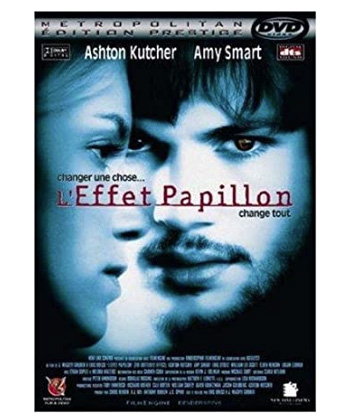
The Butterfly Effect
Synopsis
Evan Treborn has experienced disturbing blackouts since childhood, leaving gaps in his memory and confusing events in his life. As an adult, he discovers that reading his old journals allows him to return mentally to important moments in his past. He begins changing decisions and events in an attempt to improve the lives of the people he loves. However, every alteration creates unexpected consequences, often making the present even more painful. Evan must decide whether he can ever create a better future without destroying the lives connected to his own.
The film was written and directed by Eric Bress and J. Mackye Gruber, who built the story around the scientific metaphor known as the butterfly effect. In chaos theory, the expression describes how a very small change in one situation can produce enormous consequences elsewhere. The filmmakers transformed this abstract idea into a psychological science-fiction thriller about memory, trauma and alternate realities. Their screenplay explores the possibility that changing one apparently insignificant event can radically transform an entire life. The story also draws on familiar ideas from time-travel fiction, but places emotional relationships at the center of its narrative. Ashton Kutcher became involved in a role that was notably darker than many of his earlier screen performances. The film was developed as a relatively low-budget production and became a major commercial success after its release.
The film received mixed reviews from professional critics. Some appreciated its ambitious premise, unsettling atmosphere and willingness to explore disturbing consequences rather than presenting time travel as an uncomplicated adventure. Others criticized its complicated narrative, uneven character development and occasionally excessive reliance on shocking situations. Ashton Kutcher attracted attention for taking on a serious dramatic role, while Amy Smart was also recognized for the emotional demands of her performance. Audience reactions were more enthusiastic, particularly among viewers who enjoyed discussing the different timelines and possible interpretations. The film developed a strong following among fans of science-fiction thrillers and became a frequent subject of debate because of its different endings. It performed well at the box office despite its modest production budget. Although it did not become a major awards contender, its commercial success led to several follow-up films and helped establish its place in early-2000s popular science fiction.
The production required the filmmakers to maintain continuity between several versions of the same characters and events. The actors therefore had to portray people whose personalities and circumstances changed depending on the timeline. Ashton Kutcher prepared for the role by approaching Evan as a psychologically troubled young man rather than as a conventional action hero. The filmmakers also created several endings, allowing different versions of the story to reach distinct emotional conclusions. The theatrical ending is more hopeful than the darker alternative ending that became widely discussed among viewers. These different versions encouraged audiences to reconsider the film after seeing it. The title itself was chosen to connect the personal consequences of Evan's decisions with the larger scientific metaphor.
Themes Explored
The film examines memory, guilt and the desire to repair the past. Evan believes that changing one event can save the people he loves, but each intervention creates new forms of suffering. The story questions whether a person can ever control the consequences of their actions. Childhood trauma and the long-term effects of abuse are central to the characters' lives. It also explores the relationship between love and self-sacrifice, asking whether protecting someone sometimes means accepting that their life cannot be controlled. The butterfly effect becomes a metaphor for the unpredictable connections between individual choices and the lives of others.
Ending Explained
In the theatrical ending, Evan finally realizes that his attempts to change the past have repeatedly caused suffering for Kayleigh and the people around them. He decides to return to the moment when they first met as children and deliberately prevents their relationship from developing. By choosing to avoid Kayleigh, he removes the chain of events that led to their shared trauma and later tragedies. In the present, they pass one another as strangers, suggesting that both have been given the opportunity to build different lives. The ending is bittersweet because Evan sacrifices the relationship he wanted in order to protect her. It also suggests that accepting painful limits may sometimes be more responsible than trying to rewrite reality. Alternative versions of the film offer much darker conclusions, reinforcing the uncertainty surrounding Evan's power.
Meaning of the Title
The title refers to the butterfly effect, a concept from chaos theory describing how small changes in initial conditions can lead to very different outcomes. In the film, Evan's attempts to alter apparently minor moments create dramatic consequences for the future. The butterfly is therefore a symbol of the fragile connections between events. The title also reflects the central paradox of the story: even actions motivated by love can produce unexpected suffering. It summarizes the idea that no moment exists in complete isolation from the rest of a person's life.
Original Soundtrack
The score was composed by Michael Suby and combines electronic textures, atmospheric passages and dramatic musical cues. Its sound contributes to the film's unsettling atmosphere, especially when Evan experiences a blackout or returns to an earlier moment. The soundtrack also includes alternative rock songs that connect the story to the emotional landscape of early-2000s youth culture. The music supports the film's shifts between nostalgia, anxiety and psychological horror.
Viewers who enjoy complex science-fiction thrillers about time, memory and alternate realities may also appreciate Donnie Darko, Memento, 12 Monkeys, Primer, Source Code and Mr. Nobody. These films similarly explore how identity and personal relationships can be transformed by changes in the perception of time.