

 Français
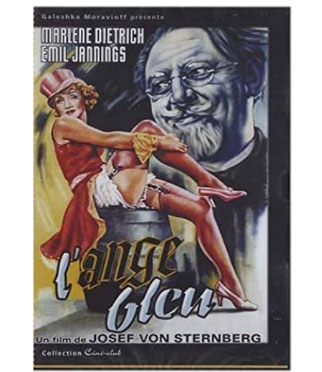
The Blue Angel
Synopsis
The Blue Angel (released in German as Der blaue Engel) is a monumental, tragic German psychological drama directed by Josef von Sternberg. Set in Weimar-era Germany, the story follows Professor Immanuel Rath, a stern, rigid, and respectable aging high school English professor who maintains absolute moral authority over his unruly students. When Rath discovers that his students are frequenting a sleazy local cabaret called The Blue Angel to ogle a provocative, sultry French singer named Lola Lola, he visits the club intending to reprimand them. Instead, the professor falls instantly, obsessively, and ruinously in love with Lola Lola, abandoning his academic career, dignity, and sanity to marry her. The film offers a stark descent into psychological degradation.
The Making of the Film
Producer Erich Pommer and UFA studios hired director Josef von Sternberg to helm Germany's first major synchronized sound feature film, adapting Heinrich Mann's 1905 novel 'Professor Unrat'. Sternberg discovered cabaret singer Marlene Dietrich performing in a Berlin revue and cast her as Lola Lola, instantly transforming her into an international superstar. The production was filmed simultaneously in separate German-language and English-language versions. Emil Jannings starred as the tragic Professor Rath.
Critical Reception
Professional critics greeted the film upon its Berlin premiere with overwhelming critical acclaim, praising its daring psychological depth, moody expressionist cinematography, and Marlene Dietrich's mesmerizing breakout performance. Reviewers lauded Josef von Sternberg's visionary direction for utilizing innovative sound design and atmospheric cabaret sets to mirror human obsession. Critics recognized Dietrich's rendition of 'Falling in Love Again' as an instant cinematic milestone. It became a historic masterpiece of international cinema.
Audiences flocked to theaters in massive numbers, turning the tragic drama into a massive commercial and cultural phenomenon worldwide. Viewers were hypnotized by Marlene Dietrich's sultry persona, top hat, and fatal allure. Word-of-mouth recommendations cemented its status as an immortal classic of Weimar cinema. Its artistic influence on film noir and character-driven tragedy is absolute.
The film achieved major historical recognition, frequently ranked among the greatest German films ever made and preserving Marlene Dietrich's legendary cinematic legacy.
Behind-the-Scenes Stories
Director Josef von Sternberg drew inspiration from German expressionist art, Weimar cabaret nightlife, and Heinrich Mann's satirical novel. Coordinating the smoky, crowded cabaret musical numbers required innovative microphone placement and acoustic sound mixing during the dawn of sound cinema. During the filming of the agonizing final classroom humiliation scenes, Emil Jannings delivered a devastating physical performance simulating absolute psychological ruin. Before Marlene Dietrich was cast, several established German stage actresses were considered for Lola Lola.
Themes Explored
Obsession, Degradation, Cabaret, Weimar Germany, Ruin, Passion, Pride
Ending Explained
The tragic final scene shows the ruined, elderly former professor returning alone to his old school classroom in the middle of the night, dying at his old desk in absolute despair.
Meaning of the Title
The title 'The Blue Angel' names the decadent cabaret club where the tragic romance unfolds, symbolizing temptation, illusion, and moral decay.
Original Soundtrack
Friedrich Hollaender composed legendary cabaret songs, including the immortal anthem 'Falling in Love Again (Can't Help It)' performed iconically by Marlene Dietrich.
Sunset Boulevard, Vertigo, Cabaret, The Blue Angel (German version)