

 Français
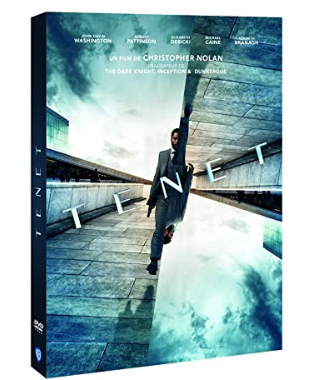
Tenet
Synopsis
This mind-bending science fiction spy thriller follows a secret operative known only as the Protagonist who is recruited into a mysterious global organization called Tenet. Tasked with preventing World War III, he must master the concept of "temporal inversion"—an entropy-reversing technology that allows objects and people to move backward in time. Partnering with a cynical agent, he navigates an international arms-race conspiracy spanning multiple continents and converging on a massive temporal pincer movement. It is a dazzling, cerebral puzzle box of high-stakes cinematic engineering.
The Making of the Film
The project originated from director Christopher Nolan's decades-long fascination with espionage thrillers and the theoretical physics of time inversion and entropy. Nolan spent years meticulously drafting the complex screenplay, blending traditional James Bond-style globe-trotting action with quantum mechanics. Inspiration was drawn from classic spy fiction, classical time-loop paradoxes, and practical filmmaking philosophy. The creative team aimed to construct a blockbuster thriller that relied as heavily as possible on real practical stunts rather than digital visual effects.
Critical Reception
Critics offered generally favorable reviews, praising the film's astonishing technical ambition, thrilling action set pieces, and immersive sound design. Reviewers noted that Nolan successfully pushed the boundaries of traditional blockbuster cinema by executing jaw-dropping practical sequences, such as crashing a real Boeing 747. However, some critics found the dense exposition and inverted plotting emotionally distant or overwhelmingly complex. Despite polarized reactions to its labyrinthine structure, its sheer cinematic audacity was widely celebrated.
Audience reception was uniquely shaped by its theatrical release during the global pandemic, yet it achieved impressive box office resilience worldwide. Fans on public rating platforms praised the ingenious reverse-action choreography, mesmerizing puzzle-box plotting, and Ludwig Göransson's thumping musical score. Viewers who enjoyed decoding complex narrative structures found immense replay value in tracking the dual forward-backward timelines. It earned a reputation as a thrilling, intellectually demanding cinematic puzzle.
Awards season brought major recognition in technical categories, culminating in an Academy Award win for Best Visual Effects. Industry guilds also praised the film's outstanding sound mixing, editing, and stunt coordination. Critics' associations highlighted its groundbreaking approach to practical action filmmaking in an era dominated by CGI. These accolades cemented its status as a visionary technical achievement in modern science fiction.
Behind-the-Scenes Stories
The director drew aesthetic inspiration from classic Cold War spy thrillers, brutalist architecture, and quantum physics diagrams to establish a sleek, austere visual tone. Every international location, from Mumbai high-rises to Estonian opera houses, was chosen to emphasize cold corporate menace and geometric precision. The production team collaborated with theoretical physicists to establish consistent narrative rules for entropy inversion. These artistic choices created a gripping, highly immersive espionage world.
Production presented extreme logistical and technical hurdles, requiring the cast and crew to execute unprecedented practical action sequences involving forward and backward motion simultaneously. Stunt coordinators and actors had to learn entirely new physical movement styles to convincingly fight and drive in reverse-inversion states. Shooting across seven international countries during shifting geopolitical and weather conditions demanded rigorous planning. Furthermore, Christopher Nolan insisted on crashing a real vintage cargo plane into an airport hangar rather than utilizing computer graphics.
-
Behind-the-Scenes Stories
During the filming of the complex inverted highway car chase, the stunt crew engineered custom vehicles capable of driving backward at high speeds while traffic moved forward around them. To maintain genuine spatial disorientation, the lead actors performed extensive physical fight choreography facing opposing temporal vectors. The crew utilized massive IMAX cameras mounted in tight spaces to capture the visceral impact of every explosion and collision. This rigorous dedication resulted in breathtaking, unforgettable action sequences.
Casting focused on securing international talent capable of projecting stoic intelligence, physical prowess, and sharp emotional ambiguity. John David Washington was chosen for his commanding athleticism and intellectual gravitas as the Protagonist. Supporting roles featured acclaimed actors like Robert Pattinson and Kenneth Branagh, who brought sophisticated charm and terrifying menace. This targeted casting strategy anchored the high-concept physics puzzle in gripping human drama.
Themes Explored
The narrative deeply explores themes of determinism, free will, and humanity's responsibility to future generations against ecological and existential collapse. It examines the philosophical implications of time, causality, and the illusion of linear progression. Additionally, it highlights loyalty, sacrifice, and the unbreakable bonds of professional trust. Ultimately, the film reflects on legacy, survival, and mastering the unpredictable chaos of the universe.
Ending Explained
The climax reveals a massive temporal pincer movement where two military forces—one moving forward and one inverted—simultaneously assault an underground bunker to prevent a destructive algorithm from activating. Neil sacrifices himself by unlocking a sealed gate in reverse, taking a fatal bullet for the Protagonist before walking backward into his pre-ordained death. With the threat neutralized, the Protagonist realizes he is actually the ultimate founder of the entire Tenet organization, completing a closed causal loop.
Meaning of the Title
The title is a famous Latin palindrome (SATOR AREPO TENET OPERA ROTAS) that encodes the core themes of reversal, symmetry, and circular time loops in the film.
Original Soundtrack
The thumping, industrial musical score by Ludwig Göransson received widespread critical acclaim for blending distorted metallic sounds, heavy bass, and backward-running audio frequencies.
Similar Films
Films sharing similar mind-bending temporal mechanics and espionage thrills include Inception (2010), Primer (2004), and The Matrix (1999).