

 Français
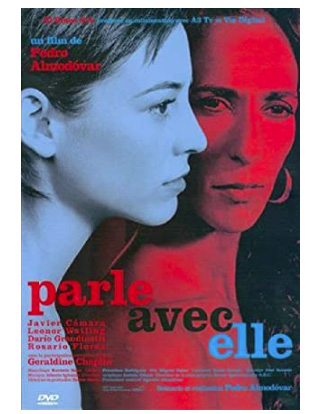
Talk to Her
Synopsis
Talk to Her follows two men whose lives become connected through their relationships with women in comas. Marco, a journalist, is devastated when his girlfriend Lydia, a bullfighter, suffers a serious injury. At the same clinic, he meets Benigno, a nurse who cares for Alicia, a young ballet student who has been unconscious for several years. The two men develop an unusual friendship as they spend time beside the women they love. Their different attitudes towards affection, communication and devotion gradually lead the story towards a deeply unsettling conclusion.
The Making of the Film
Pedro Almodóvar conceived Talk to Her as a story about communication, loneliness and the complicated ways people express love. The director wanted to explore relationships in which ordinary dialogue becomes impossible, while gestures, memories and imagination take on greater importance. The screenplay grew from his interest in people who speak to others even when they cannot receive an answer. Almodóvar also wanted to examine male friendship, a subject that had not occupied the same central position in many of his earlier films. The two principal characters offer contrasting approaches to emotional attachment: Marco is sensitive to the independence of others, while Benigno lives inside a deeply distorted understanding of intimacy. The film combines melodrama, dark humour and reflections on cinema itself. Its structure includes a fictional silent-film sequence, which allows Almodóvar to explore how stories can communicate emotions that ordinary language cannot express. The result is one of the director's most distinctive examinations of desire, compassion and moral responsibility.
Critical Reception
Professional Reviews
Talk to Her received widespread critical acclaim. Reviewers praised Pedro Almodóvar's precise direction, his emotional complexity and his ability to combine humour with disturbing subject matter. The performances of Javier Cámara and Darío Grandinetti were particularly admired for their subtlety and emotional depth. Critics also highlighted the film's visual composition, carefully structured narrative and remarkable use of music and dance. Some reviewers found its treatment of sexual violence and consent deeply provocative, but many considered this discomfort essential to its moral complexity. The film has since been regarded as one of Almodóvar's major works.
Audience Reception
The film reached audiences well beyond Spain and became an important international success for Almodóvar. Viewers often praised its unusual friendship story and its willingness to address difficult emotional questions. Its mixture of tenderness, comedy and tragedy created strong reactions, particularly because the central relationships resist simple moral interpretations. Some spectators found the subject matter challenging, while others appreciated the film's refusal to offer easy answers. Its international reputation has remained strong, and it is frequently included in discussions of the director's finest achievements.
Awards
Talk to Her won the Academy Award for Best Original Screenplay in 2003, bringing Pedro Almodóvar major international recognition. It also received an Oscar nomination for Best Director. The film won several European Film Awards in 2002, including Best Film, Best Director and Best Screenwriter. Its success at the European awards confirmed its importance in contemporary European cinema. The film also received numerous nominations and honours from critics' associations and international festivals. These distinctions helped establish it as one of the most acclaimed films of the early 2000s.
Behind the Scenes
Director Inspirations
Almodóvar drew on his longstanding interest in melodrama, female characters and the emotional power of cinema. He was also interested in the idea that speaking to someone who cannot respond may still have meaning for the person doing the talking. The director incorporated dance and silent cinema as forms of communication that exist beyond conventional dialogue. The presence of Pina Bausch and her choreography gives the film a particularly strong connection to contemporary dance. Almodóvar also used references to classic cinema to create parallels between fictional stories and the characters' emotional lives.
A Particular Scene
The film opens with a performance of Café Müller, choreographed by Pina Bausch. The dancers move through a space filled with chairs while another performer tries to clear their path. This sequence introduces the film's interest in vulnerability, care and the difficulty of communicating with another person. It also establishes the importance of dance as an emotional language. Another memorable passage is the silent-film sequence The Shrinking Lover, which plays a crucial role in the film's exploration of fantasy and intimacy. These sequences demonstrate how Almodóvar uses images and performance to communicate ideas that cannot be reduced to dialogue.
Production and Music
The film features a rare filmed appearance by choreographer Pina Bausch and her company performing Café Müller. Almodóvar also incorporated musical performances by Caetano Veloso, including a memorable rendition of a Brazilian song. The soundtrack brings together classical music, popular songs and original compositions. Alberto Iglesias composed the original score, continuing his important creative collaboration with the director. The production carefully integrated dance, music and cinematic references into the dramatic structure rather than treating them as decorative interludes.
Themes
Communication is the central theme of Talk to Her. The film asks whether love can exist without dialogue, mutual understanding or the possibility of receiving an answer. It contrasts Marco's respect for emotional independence with Benigno's increasingly disturbing confusion between devotion and possession. Loneliness is another major theme, affecting both men in different ways. The story also examines the vulnerability of people who are unable to defend themselves or express their wishes. Almodóvar explores the boundary between compassion and obsession, showing how apparently caring behaviour can conceal a refusal to recognise another person's autonomy. Cinema and storytelling become additional forms of communication, allowing characters to share experiences through images and narratives. Dance similarly expresses emotions that words cannot adequately describe. The film ultimately challenges viewers to distinguish genuine empathy from the desire to control another person.
Ending Explained
The ending brings the two central stories together while refusing to offer a simple resolution. Benigno is imprisoned after the truth about his actions becomes clear, and his death leaves Marco to confront the consequences of their friendship. Alicia eventually wakes from her coma, creating the possibility of a new beginning after years of unconsciousness. Marco and Alicia meet at the ballet, but the film does not establish that they will immediately form a romantic relationship. Their encounter is presented as an opening rather than a completed love story. The final moments suggest that communication and emotional connection may become possible again, even after profound suffering. However, Alicia's recovery does not erase the violation she experienced or turn Benigno's behaviour into an act of love. The ending deliberately leaves the audience with questions about responsibility, memory and the limits of human understanding.
Meaning of the Title
The title Talk to Her refers to the act of speaking to a woman who cannot respond. Benigno believes that talking to Alicia is essential to caring for her, and he treats conversation as a way of maintaining a relationship despite her unconscious state. The title also reflects Marco's gradual discovery that words can help people process grief and loneliness. It suggests that communication is not only about receiving an answer but also about recognising another person as an individual. At the same time, the title becomes unsettling because speaking to someone does not give a person the right to decide what that person wants. The film therefore questions the difference between expressing affection and respecting another person's autonomy. Its simple title contains the central tension between communication, intimacy and consent.
Original Soundtrack
Alberto Iglesias composed the original score, creating a delicate musical atmosphere that supports the film's emotional shifts. The soundtrack is particularly notable for its integration of classical music, dance and contemporary Brazilian songs. Caetano Veloso's performances provide some of the film's most memorable musical moments. The use of Henry Purcell's music and Pina Bausch's choreography also gives the film a strong connection to the performing arts. Music is not merely background accompaniment: it functions as another language through which the characters and the audience experience emotion.
Similar Films
- All About My Mother (1999), another Pedro Almodóvar film about loss, identity and complex human relationships.
- The Skin I Live In (2011), which explores obsession, identity and the limits of human control.
- Three Colours: Blue (1993), a drama about grief, isolation and the difficult process of rebuilding a life.
- The Diving Bell and the Butterfly (2007), a film about consciousness and communication in the face of extreme physical limitations.