

 Français
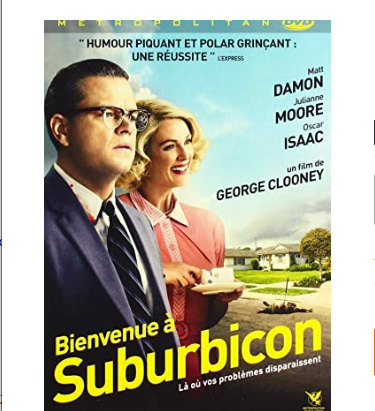
Suburbicon
Synopsis
Set in 1959, Suburbicon appears to be a peaceful, idyllic suburban American neighborhood where families enjoy the height of the post-war American Dream. However, beneath the manicured lawns and smiling faces lies a dark underbelly of hypocrisy, betrayal, and calculated violence. Gardner Lodge finds his family targeted in a brutal home invasion that shatters his seemingly quiet life, setting off a chaotic chain of blackmail and murder. Simultaneously, racial tensions flare up as a Black family moves into the neighborhood, exposing the community's deep-seated bigotry while everyone is distracted by Gardner's schemes.
The Making of the Film
Director George Clooney and his frequent collaborator Grant Heslov adapted an unproduced screenplay originally written by the Coen brothers in the 1980s. The filmmakers were drawn to the script's satirical take on Eisenhower-era suburban hypocrisy and racial prejudice, deciding to weave the historical civil rights struggle into the fictional crime plot. The production focused on recreating a vibrant, colorful 1950s aesthetic that contrasts sharply with the grim moral corruption occurring behind closed doors. The project aimed to critique timeless themes of American bigotry and greed.
Critical Reception
Professional reviews were largely negative, with critics pointing out an uneven tone that awkwardly juggled dark farce with a serious, real-world civil rights narrative. Reviewers felt that the two parallel storylines did not integrate effectively, diluting the impact of both the suburban crime satire and the historical racism commentary. Despite a talented cast led by Matt Damon and Julianne Moore, the film failed to impress mainstream reviewers.
Public reception was similarly lukewarm, as audiences found the dark comedy disjointed and difficult to engage with emotionally. Box office returns were disappointing, and word-of-mouth remained low following its theatrical release. Viewers noted that the tonal whiffling made it one of Clooney's more challenging directorial efforts.
Awards recognition was virtually nonexistent, as the film missed out on major guild or festival nominations due to its poor critical reception. It remains remembered primarily as an ambitious stylistic experiment that misfired with critics.
Shooting anecdotes
Director George Clooney drew inspiration from classic suburban noir films and historical documentaries chronicling American racial integration struggles in the 1950s.
Production faced intricate set-building requirements to construct an immaculate, technicolor 1950s subdivision that would slowly deteriorate visually as the plot unraveled into chaos.
During the filming of a violent basement confrontation, Matt Damon performed intense stunt choreography that required multiple takes to capture the dark comedic timing.
Initial casting discussions took place years prior when the Coen brothers originally intended to direct the project themselves before passing the reins to Clooney.
Themes explored
The film explores suburban hypocrisy, greed, systemic racism, post-war American mythology, and moral decay. It contrasts the manufactured perfection of 1950s communities with violent criminal conspiracies and bigotry. It also highlights how communities scapegoat others while ignoring internal corruption.
Explanation of the ending
The ending reveals the complete destruction of Gardner's family and criminal plans, leaving him dead from his own poisoned plots while the neighborhood remains oblivious to its own moral rot. It closes on a quiet, haunting note focusing on the resilient spirit of the Black family next door.
Meaning of the title
The title is a portmanteau combining 'suburb' and 'icon' (or a fictional utopian suffix), mocking the false advertising of an idyllic suburban paradise hiding dark secrets.
The jazzy, classic Hollywood-style score composed by Alexandre Desplat received widespread critical praise for perfectly mimicking 1950s thriller tropes while accentuating the film's dark satire.
Fargo, L.A. Confidential, Blue Velvet, Pleasantville