

 Français
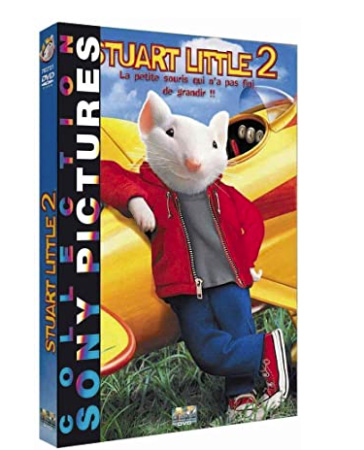
Stuart Little
Synopsis
The Little family of New York decides to adopt a child and unexpectedly brings home Stuart, a kind and well-mannered mouse. Their son George is initially embarrassed by his new brother, and the family cat Snowbell is horrified by the idea of living with a mouse. As Stuart wins over his new family, a gang of alley cats and a pair of impostors plot to take him away. Little by little, he proves that size has nothing to do with courage.
The Making of the Film
Stuart Little is based on the beloved 1945 children's novel by E.B. White, the author of Charlotte's Web. White said that the idea came from a dream in which he saw a little man the size of a mouse. The book had been a classic for decades, but it had never been adapted for the big screen until the end of the 1990s. Producer Douglas Wick and Columbia Pictures saw the potential to combine live action with a computer-animated hero. The screenplay was written by M. Night Shyamalan and Greg Brooker, who gave the story a contemporary comic tone while preserving its gentleness. Rob Minkoff, who had co-directed The Lion King, was chosen to direct and bring his experience in animation. The main challenge was to create a mouse that would look real and expressive. Michael J. Fox lent his voice to Stuart, giving him warmth and optimism. The result was a family film that balanced sweetness and humour.
Reviews and reception
Professional critics' summary
Critics were largely positive, praising the film's charm, its technical achievement and the voice work. Many noted that the computer-generated Stuart blended seamlessly with the live-action cast. Michael J. Fox and Nathan Lane were singled out for their performances. Some reviewers found the plot a little thin, but they admired the film's gentleness and humour.
Audience reception
The film was a hit with families, earning around 300 million dollars worldwide. Children loved the tiny hero and the funny cat Snowbell. Its success led to two sequels and an animated television series. It has remained a favourite for family viewing.
Awards
The film received an Academy Award nomination for Best Visual Effects. It also earned nominations at the BAFTA Awards and other ceremonies for its effects. It won several awards for family entertainment. The visual effects were recognised as groundbreaking for the time.
Filming anecdotes
Director's inspirations
Rob Minkoff wanted the film to retain the gentle spirit of E.B. White's writing while adding comedy and action. He drew on classic family films in which a small hero overcomes great odds. The design of Stuart was based on a real mouse, but with human-like expressions that made him lovable. His animation background helped him to direct the digital characters as if they were true actors.
Production difficulties
One of the biggest challenges was integrating computer-generated characters with live-action scenes. The actors had to interact with stand-ins and imaginary co-stars, which required strong imagination. Stuart's fur, with its thousands of individual hairs, had to react to light and movement convincingly. The animators used new software to give the characters realistic fur and expressions.
Anecdote about a particular scene
The toy boat race in Central Park is the most spectacular sequence in the film. It features Stuart sailing a tiny yacht in a regatta, with a rival boat and a close finish. Another memorable moment is the scene in which Stuart is accidentally put into a washing machine. The cat Snowbell's many sarcastic comments also provide some of the best humour.
Originally planned casting
Michael J. Fox voiced Stuart, a role that suited his youthful and sincere tone. Geena Davis and Hugh Laurie played the parents, while Jonathan Lipnicki was the son George. Nathan Lane voiced Snowbell, stealing many scenes. Chazz Palminteri and Steve Zahn provided the voices of the alley cats.
Themes explored
The film is about acceptance and the idea that families can be built in unconventional ways. Stuart is a mouse in a human home, which illustrates the challenge of fitting in. It also highlights the importance of courage and kindness, which are not determined by size. Another theme is loyalty, particularly shown by the transformation of Snowbell from enemy to ally. The story touches on adoption and the question of belonging. It encourages children to be proud of who they are. It also shows how prejudice can fade when people learn to know one another. Overall, it is a warm story about love and acceptance.
Ending explained
Stuart wins a model boat race and his family stands by him, despite attempts by the gang and the fake parents to take him away. The cat Snowbell, who has grown fond of Stuart, helps to expose the impostors. Eventually, Stuart is reunited with the Littles, who tell him that they love him. After the adventure, Stuart realises that he wants to find his friend Margalo, a bird who has flown away. With the blessing of his family, he sets off in his small car to look for her. The film ends on a hopeful note, echoing the open road of the original novel. It leaves the audience with a sense of warmth and possibility.
Meaning of the title
The title Stuart Little is the name of the hero, a tiny mouse. The word little emphasises his size, which is both a challenge and a source of charm. The name was taken directly from E.B. White's novel, which had been loved by generations of readers. It highlights the irony that, despite being small, Stuart has the heart of a hero. The title also suggests that the story will be gentle and child-friendly. It plays on the idea that big adventures can happen to small people. It is a simple, memorable name that perfectly suits the film.
Original Soundtrack
Alan Silvestri composed the score, using light orchestral music to give the story a cheerful and heartwarming feel. The film also features songs, including a lively theme performed by Martin Page. The music complements the humour and the emotional moments without overwhelming them. It helps to give the film its warm identity.
Similar Films
Stuart Little 2 and Stuart Little 3 continue the character's adventures. Babe and Charlotte's Web are other family films with talking animals. Paddington and Garfield also mix real settings with animated characters. Alvin and the Chipmunks and Cats and Dogs are comparable comedies for children.