

 Français
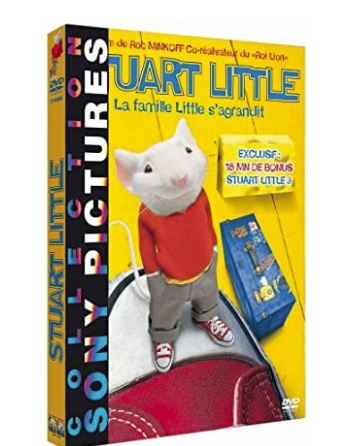
Stuart Little 2
Synopsis
Stuart is feeling small and sometimes left out by his family, who are busy with their own concerns. One day he meets Margalo, a little bird who has been injured and needs help. He quickly befriends her, but he does not know that she is working for a villainous falcon. When Margalo disappears, Stuart sets off on a daring adventure to rescue his friend, with the help of the cat Snowbell and his own tiny plane.
The Making of the Film
After the success of the first Stuart Little, a sequel was quickly put into development. The filmmakers wanted to expand the world of the Little family and to give Stuart a new emotional challenge. Writer Bruce Joel Rubin, who had written Ghost and Jacob's Ladder, wrote the screenplay, aiming for a story that would be thrilling and tender at the same time. The character of Margalo, a bird from E.B. White's book, was brought in as a central figure. Rob Minkoff returned to direct and to supervise the visual effects. The team wanted to build on the first film's technical achievements with more complex action scenes. They also decided to use the sky as the main setting for the climax. The result was a short, brisk and charming adventure.
Reviews and reception
Professional critics' summary
Critics were positive, many considering the sequel better than the original. They praised its quick pace and its short running time, which makes it a lively family film. The voice cast, especially James Woods as the Falcon, drew compliments. A few critics found the story slight, but they admired the visual effects.
Audience reception
The film earned around 170 million dollars worldwide, a successful result for a family film. Families responded well to the film's sense of adventure and fun. Children in particular loved the flying sequences and the villain. It has become a favourite for family movie nights.
Awards
The film was nominated for awards recognising family entertainment and visual effects. It received praise for the improved animation of Stuart and the other animal characters. It did not win major prizes, but it was a critical success within its genre. Its enduring appeal is its main legacy.
Filming anecdotes
Director's inspirations
Minkoff wanted the film to feel like a classic adventure with a touch of aviation excitement. He was inspired by silent-era aerial films and by the 1930s serials. The idea of a small hero facing a large predator allowed him to play with scale. He aimed to keep the story clear and fast, in keeping with the style of children's literature.
Production difficulties
The flying sequences were complicated to produce, as they required full computer-generated backgrounds. The animators created a more detailed version of Stuart and used new technology for the birds' feathers. The live-action scenes also had to be perfectly coordinated with the digital effects. The production was completed on a tight schedule, which required careful organisation.
Anecdote about a particular scene
The aerial dogfight between Stuart's tiny plane and the Falcon is the high point of the film. The scene combines thrilling chases with humour and suspense. Another favourite moment shows Snowbell trying to act as a hero. The scenes in the family's kitchen also offer many gags for young viewers.
Originally planned casting
Michael J. Fox, Geena Davis, Hugh Laurie and Jonathan Lipnicki all returned for the sequel. Melanie Griffith voiced Margalo, adding warmth and mystery to the character. James Woods voiced the villain Falcon with delightful menace. Nathan Lane once again stole scenes as the sarcastic cat Snowbell.
Themes explored
The film explores the feeling of being overlooked and the desire to prove oneself. Stuart doubts his place in his family, which resonates with many children. Friendship is another key theme, and Stuart's loyalty to Margalo drives the story. The film also touches on the idea of trust, as Margalo must decide whether to remain loyal to the Falcon or to her new friend. It teaches that bravery is about doing the right thing, even when you are afraid. The story shows how families can overcome communication problems. It also celebrates imagination and the joy of flying. Ultimately, it is a story about self-belief and friendship.
Ending explained
Stuart discovers that Margalo is working for the Falcon, who has forced her to steal. He sets out to rescue her and confronts the Falcon in a battle in the sky. With the help of Snowbell and his little plane, Stuart manages to defeat the predator. Margalo, grateful for his help, chooses to remain loyal to him. The film ends with Stuart returning home, where his family welcomes him. He has learned that he is an important part of the family, no matter his size. The conclusion shows that friendship and courage can overcome any danger.
Meaning of the title
Stuart Little 2 is a straightforward title that identifies the film as the second chapter of the story. Keeping the name of the hero ensures that audiences recognise the character. The number 2 promises more adventures and more laughs. The word little remains an important detail, since Stuart's size is central to the plot. In this film, the hero's small stature is both a handicap and a strength. The title ties the film closely to the first one and to the book that inspired it. It is simple, but it sells the idea of a sequel perfectly.
Similar Films
Stuart Little and Stuart Little 3: Call of the Wild complete the trilogy. Babe: Pig in the City and Charlotte's Web are other animal stories for children. Flushed Away and The Tale of Despereaux feature brave rodent heroes. Cats and Dogs and Garfield offer similar comedy with animals.