

 Français
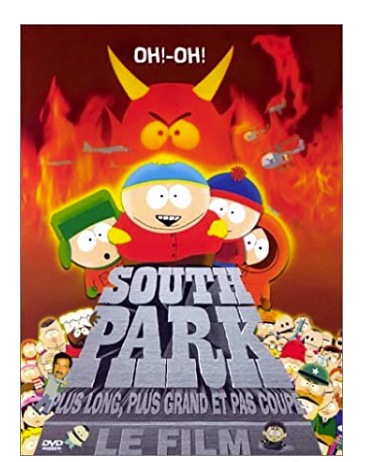
South Park: Bigger, Longer & Uncut
Synopsis
When Stan, Kyle, Cartman and Kenny sneak into an R-rated film starring the Canadian comedy duo Terrance and Phillip, they come home with a vocabulary of foul language. Outraged parents blame Canada and demand that the country be punished, which sparks a war between the United States and Canada. Meanwhile, Kenny dies and ends up in Hell, where Satan and his lover Saddam Hussein are plotting to take over the world. The boys must save the day, with the help of a few surprising allies.
The Making of the Film
The film grew out of the success of the animated television series South Park, created by Trey Parker and Matt Stone and launched in 1997. After the show became a cultural phenomenon, a feature film became the logical next step, and the creators saw a chance to push their satire further. Parker, who loved Broadway musicals and Disney films, wanted the movie to be a musical full of catchy songs. He worked with composer Marc Shaiman to create the film's music, which parodies traditional musical numbers. The story was a response to the controversy that the show itself provoked, with parents worried about its influence on children. The idea of a war with Canada allowed them to satirise the American obsession with censorship. Parker and Stone voiced most of the characters themselves, as they did for the show. They produced a film that was both crude and surprisingly clever.
Reviews and reception
Professional critics' summary
Critics were very positive, praising the film for its wit, its catchy songs and its biting satire. Many reviewers were surprised by how well the film worked as a real musical. The humour was described as vulgar but intelligent, with a strong moral message about free speech. Some critics said that the extreme language could be too much, but they appreciated the film's ambition.
Audience reception
The film earned more than 80 million dollars worldwide, a strong result for an animated feature aimed at adults. Fans of the series loved seeing their favourite characters on the big screen, while newcomers were drawn in by the film's reputation. Over the years, it has become a cult classic and is regularly cited among the best animated comedies. Its songs remain popular, and many are still performed in live shows.
Awards
The song Blame Canada was nominated for the Academy Award for Best Original Song, to the amusement of its creators. The film also won recognition from several critics' groups and was nominated for other music and comedy awards. The Oscar nomination remains the highlight of its awards history.
Filming anecdotes
Director's inspirations
Trey Parker has said that he was inspired by Disney musicals such as The Little Mermaid and Beauty and the Beast. He wanted to build a story with big songs that move the plot forward, but with a satirical edge. He was also inspired by his own experience of censorship, since the television show was constantly challenged. The film's structure mirrors the classic hero's journey, but with deliberately outrageous twists.
Production difficulties
The film ran into trouble with the American film rating board, which first gave it an NC-17 rating because of its content. The filmmakers had to make several rounds of cuts to reach an R rating, and they joked about the process in interviews. They also had to finish the film in a very short time, since they wanted it to match the look of the series. The animation was produced using the same cut-out style as the show, but with a higher level of detail.
Anecdote about a particular scene
The number Blame Canada, in which the town's mothers sing about the supposed evils of their northern neighbours, became a highlight. The cheerfully offensive songs performed by Terrance and Phillip were a source of controversy. Another memorable moment is the song Mountain Town, which opens the film in the style of a classic Disney number. The scene in Hell, which features Saddam Hussein as Satan's lover, is one of the most notorious.
Originally planned casting
Trey Parker and Matt Stone voiced the main characters, as in the series. Mary Kay Bergman, who had voiced many female characters, performed her last work in the film before her death. Isaac Hayes returned as Chef and sang the song Simultaneous. George Clooney also contributed a small voice role as a doctor.
Themes explored
The film is a satire of censorship, parental hypocrisy and the double standards around violence and language. It points out that adults accept violence in entertainment while being shocked by swear words. Another theme is war and the way governments manipulate public fear to justify conflict. It also examines the power of free speech, showing that attempts to silence people only increase curiosity. The story pokes fun at the American habit of finding scapegoats. It also explores friendship and loyalty among the boys. Another recurring theme is the contrast between innocence and corruption, which is played for dark comedy. In the end, it argues that freedom of expression must be protected.
Ending explained
In Hell, Satan is tired of being mistreated by Saddam Hussein and wants out of the relationship. The boys, with the help of the mothers' movement and Terrance and Phillip, race to stop the war before the prophecy is fulfilled. Kenny, who has been trapped in Hell, makes a selfless sacrifice that allows Satan to finally take a stand against Saddam. Saddam is banished, and Kenny is rewarded with a place in Heaven. When his hood falls, we see his face for the first time. The world returns to normal, and the boys go back to their ordinary lives. The ending delivers a final dose of satire and a surprisingly sweet message about sacrifice and love
Meaning of the title
The title Bigger, Longer & Uncut is a joke borrowed from the language of adult entertainment advertising, promising more of everything. It is a playful way of announcing that the film will be larger in scale and unrestricted by television censorship. The phrase also ironically mocks the struggle the filmmakers had with the rating board. It stresses that the movie is a longer and more daring version of the series. The words uncut and bigger also refer to the film's outrageous ambitions. The title is therefore both a promise and a provocation. It sums up the spirit of South Park, which never backs away from controversy.
Original Soundtrack
The soundtrack is one of the most celebrated aspects of the film, with music composed by Marc Shaiman and Trey Parker. The songs parody musical theatre, from romantic ballads to rousing group numbers. Blame Canada received an Oscar nomination, and many fans consider Mountain Town and What Would Brian Boitano Do to be classics. The mix of catchy melodies and outrageous lyrics is the heart of the film.
News
The television series South Park continues to air, and in recent years it has expanded with special episodes on streaming platforms. Trey Parker and Matt Stone have continued to produce satirical content and made a major deal with Paramount to extend the series. The film remains a high point of their career and a favourite among fans.
Similar Films
Team America: World Police, also by Trey Parker and Matt Stone, is another satirical comedy. Beavis and Butt-Head Do America offers a similar blend of crude humour and parody. The Book of Mormon, the Broadway show by the same creators, is a musical comedy with a similar spirit. The Simpsons Movie and Family Guy are other animated comedies that push the limits.