

 Français
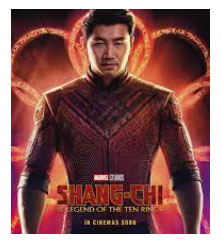
Shang-Chi and the Legend of the Ten Rings
Synopsis
Shang-Chi grew up trained by his father Wenwu, the leader of the Ten Rings, to become an assassin. He left that life behind and now lives quietly in San Francisco under a new name. When his past catches up with him, he is forced to confront his father and the family he walked away from. To survive, he must learn to master his own powers.
The Making of the Film
Shang-Chi and the Legend of the Ten Rings is a Marvel Studios film directed by Destin Daniel Cretton, who had made Short Term 12 and Just Mercy. The character was created in the 1970s for Marvel comics, and the film was the studio's first to be built around an Asian lead superhero. Simu Liu starred as Shang-Chi, with Tony Leung as Wenwu, Awkwafina as Katy, Meng'er Zhang as Xialing and Michelle Yeoh as Ying Nan. The film was shot in Australia, with the action choreographed in the style of classic Hong Kong martial arts cinema. It was released in September 2021 with an exclusive theatrical window, which was a risk during the pandemic.
Critical Reception
Summary of professional reviews
Critics were largely positive. They praised the fight choreography, the emotional depth of Tony Leung's performance and the film's blend of Marvel spectacle with martial arts traditions. Some felt that the third act relied too much on a large computer-generated battle.
Public reception
The film was a hit, earning more than 430 million dollars worldwide, a notable result during the pandemic. Audiences, especially Asian and Asian American viewers, celebrated its representation.
Behind-the-Scenes Stories
Director's inspirations
Cretton and his team drew inspiration from Hong Kong action films and from wuxia cinema, as well as from the work of Jackie Chan. The influence of these traditions is clear in the fluid, acrobatic fight scenes.
Anecdote about a particular scene
The fight on a moving bus in San Francisco is one of the film's most celebrated sequences. It was designed with the help of the stunt team, who were influenced by Jackie Chan's style of using everyday objects in combat.
Themes Explored
The film is about family, legacy and the weight of a parent's expectations. Shang-Chi must decide whether to follow the path laid out by his father or to define himself. It also looks at grief and at the way love can lead a man to terrible choices. Identity and belonging are central, particularly for characters who live between two cultures. The film also celebrates courage, friendship and the idea that strength comes from accepting who you are.
Ending Explained
In the final battle, Shang-Chi and his allies defeat the dark creature that has been manipulating Wenwu, and Wenwu sacrifices himself to save his son. Shang-Chi inherits the Ten Rings and takes his place as a hero. In a mid-credits scene, he and Katy meet Wong, Bruce Banner and Captain Marvel, which connects the film to the wider Marvel universe.
Meaning of the Title
The title refers to the Ten Rings, the powerful weapons worn by Wenwu, and to the legend that surrounds them. It signals that the film is about the legacy of the rings and the family that wields them.
Original Soundtrack
The score was composed by Joel P. West, who mixed orchestral music with traditional Chinese instruments. The soundtrack also included a compilation album of songs by Asian and Asian American artists.
Similar Films
For other superhero films with strong family stories, try Black Panther, Doctor Strange and Iron Man. Crouching Tiger, Hidden Dragon and Hero are classic martial arts epics that inspired the film. Kung Fu Hustle and Ip Man are other great examples of the genre.