

 Français
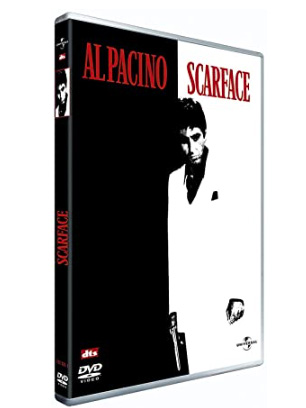
Scarface
Synopsis
Tony Montana is a Cuban refugee who arrives in Miami during the Mariel boatlift of 1980. Ambitious, ruthless and determined to escape poverty, he quickly becomes involved in the city's growing cocaine trade. Working for powerful drug traffickers, Tony gradually builds his own criminal empire and accumulates enormous wealth. However, his success is accompanied by paranoia, addiction and increasingly violent behavior. His relationship with Elvira Hancock and his complicated bond with his sister Gina become strained as his ambition consumes every aspect of his life. At the height of his power, Tony discovers that the world he has built is becoming impossible to control.
The Film's Origins
Scarface was conceived as a contemporary reinterpretation of the 1932 gangster film of the same name, originally directed by Howard Hawks. Actor Al Pacino became interested in the earlier film after watching it in Los Angeles and believed that its central story could be adapted to a modern American setting. He discussed the idea with producer Martin Bregman, who helped develop the project. Screenwriter Oliver Stone was hired to create a new version of the story, relocating the criminal world from Prohibition-era Chicago to the cocaine trade of Miami during the early 1980s. Sidney Lumet was initially attached as director and suggested emphasizing the political and social context of Cuban immigration. After creative disagreements, Lumet left the project and Brian De Palma took over. Stone continued developing the screenplay, drawing on contemporary drug trafficking and the atmosphere of Miami at the time. Al Pacino wanted to portray a character whose ambition and brutality would make him both fascinating and frightening. The film was not intended as a direct account of one real criminal, although its world was influenced by actual events and criminal organizations. The result became one of the most controversial and influential gangster films in American cinema.
Critical Reception
Scarface received largely negative reviews from professional critics upon its initial release. Many considered its violence excessive and criticized its long running time and highly theatrical performances. Some reviewers also objected to the film's language and its graphic portrayal of drug trafficking. However, Al Pacino's performance was widely recognized as powerful and memorable. Giorgio Moroder's electronic soundtrack and Brian De Palma's visual style also attracted attention. Over time, critical opinion changed considerably, and the film became widely regarded as a major gangster classic.
Although its initial reception was divided, the film performed reasonably well commercially. Its popularity increased significantly through television broadcasts, video releases and later generations of viewers. Tony Montana became an iconic character, particularly among admirers of crime cinema and popular culture. The film's dialogue, visual imagery and depiction of excess have been repeatedly referenced in music, fashion and entertainment. Its influence remains particularly strong in hip-hop culture.
Scarface did not receive major Academy Award nominations, but it earned recognition from several other organizations. Al Pacino was nominated for a Golden Globe for Best Actor in a Drama. Steven Bauer received a Golden Globe nomination for Best Supporting Actor. Giorgio Moroder was nominated for an Academy Award for Best Original Score. The film's reputation has grown considerably since its release, and it is now considered one of Brian De Palma's most recognizable works.
Behind-the-Scenes Stories
Brian De Palma and Oliver Stone wanted to create a contemporary gangster epic that reflected the growing influence of the cocaine trade in the United States. Stone conducted research into drug trafficking and the political environment surrounding Cuban immigration to Miami. His screenplay combined real social circumstances with an exaggerated fictional criminal career. Al Pacino also studied Cuban speech patterns and consulted people familiar with the cultural background of his character. The result was a performance that became central to the film's identity.
The production encountered significant difficulties because of its controversial subject matter and the reaction of some Miami residents. Several local authorities feared that the film would reinforce negative stereotypes about the city and its Cuban community. Consequently, much of the production was filmed in Los Angeles, with locations adapted to resemble Miami. The filmmakers also faced concerns and threats connected to the criminal environment depicted in the story. The large sets and elaborate final sequences required substantial logistical coordination.
The final mansion shootout is one of the most famous sequences in gangster cinema. The filmmakers constructed an elaborate environment to portray Tony Montana's extravagant lifestyle and his violent downfall. The sequence required complex choreography, numerous performers and carefully coordinated special effects. Al Pacino reportedly injured his hand during filming after coming into contact with a heated prop weapon. The production also used a large number of practical effects to give the confrontation its intense and chaotic atmosphere.
Several actresses were considered for the role of Elvira Hancock, including Glenn Close. Michelle Pfeiffer eventually secured the part after impressing the filmmakers. John Travolta was considered for the role of Manny Ribera before Steven Bauer was selected. Al Pacino based aspects of his performance on several sources, including the physical presence of boxer Roberto Durán. The combination of Pacino, Pfeiffer and Bauer helped establish the film's distinctive ensemble.
Themes Explored
Scarface explores ambition, greed and the destructive pursuit of wealth and power. Tony Montana believes that money and influence will allow him to escape the limitations of his early life. His success initially appears to fulfill this ambition, but it gradually isolates him from everyone around him. The film examines the relationship between violence and authority, showing how criminal power depends on intimidation and fear. Immigration and social mobility also play important roles, as Tony seeks to establish himself in a society where he feels excluded. His inability to trust others becomes increasingly destructive. The relationship with his sister Gina reveals the conflict between family affection and possessive control. Drug addiction contributes to his psychological deterioration and his inability to recognize danger. The film also criticizes the excesses of consumer culture through Tony's obsession with luxury, expensive possessions and public displays of wealth. His rise demonstrates how ambition can become self-destructive when detached from moral responsibility. Ultimately, Scarface presents the pursuit of absolute power as an illusion that eventually destroys the person who seeks it.
Ending Explained
The ending of Scarface depicts the violent collapse of Tony Montana's criminal empire. After killing his former associate Manny and alienating the people closest to him, Tony becomes increasingly isolated. His relationship with Elvira has already fallen apart, while his sister Gina becomes caught in the consequences of his paranoia and possessiveness. A group of armed attackers eventually invades his mansion. Despite his enormous arsenal and apparent confidence, Tony is overwhelmed by the attackers. He is eventually shot and falls into the swimming pool beneath the statue bearing the words The World Is Yours. This final image creates a powerful contrast between his ambition and his actual fate. The slogan that once represented limitless opportunity now appears deeply ironic. Tony achieved wealth and influence but lost his family, his friends and ultimately his life. His downfall is not simply the result of external enemies but of his own decisions and inability to control his desires. The ending reinforces the film's criticism of greed and unchecked ambition. The world may appear to belong to Tony, but his empire was never truly secure.
Meaning of the Title
The title Scarface refers to the facial scar that distinguishes Tony Montana and symbolizes the violence of his criminal existence. The nickname also connects the 1983 film to the original 1932 Scarface, whose protagonist was likewise marked by a facial injury. The scar becomes a visible reminder of the dangerous world in which Tony operates. It also contributes to his intimidating public image. The title suggests that violence is not merely something the protagonist commits but something that becomes permanently written onto his identity. It therefore captures the transformation of an ambitious immigrant into a feared criminal figure.
Original Soundtrack
Scarface features a highly distinctive electronic soundtrack composed by Italian musician and producer Giorgio Moroder. Its synthesizer-driven sound reflects the atmosphere of Miami during the early 1980s and gives the film a recognizable musical identity. The score combines electronic textures, dramatic melodies and dance-oriented rhythms. Push It to the Limit, performed by Paul Engemann, became particularly famous through the film's montage showing Tony's rapid rise to wealth and power. Other notable tracks include Tony's Theme and She's on Fire. The soundtrack reinforces the film's themes of ambition, excess and the seductive attraction of wealth. Moroder's music has since become closely associated with the visual identity of Scarface. It is widely regarded as one of the most memorable electronic film soundtracks of the 1980s.
Films with similar themes include The Godfather, The Godfather Part II, Goodfellas, Casino, Carlito's Way, American Gangster, Once Upon a Time in America and The Departed. These films explore organized crime, ambition, corruption, violence, loyalty and the destructive consequences of pursuing power.