

 Français
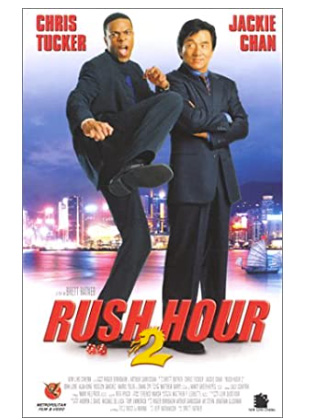
Rush Hour 2
Synopsis
Detective James Carter and Chief Inspector Lee are enjoying a holiday in Hong Kong when a bombing at the American embassy draws them into another international investigation. The explosion is connected to a criminal organisation involved in counterfeiting money and international trafficking. Their investigation leads them to Ricky Tan, a powerful criminal figure with a complicated history involving Lee's family. Carter's irrepressible humour and Lee's disciplined fighting skills create a familiar combination of comedy and action. As the investigation moves from Hong Kong to Las Vegas, the two detectives must overcome increasingly dangerous obstacles and prevent a major criminal operation.
The The Making of the Film
Following the commercial success of Rush Hour in 1998, New Line Cinema quickly became interested in developing a sequel. Director Brett Ratner returned to continue the partnership between Jackie Chan and Chris Tucker, whose contrasting personalities had been central to the first film's popularity. Screenwriter Jeff Nathanson was brought in to develop a new international adventure that would allow the characters to operate in Hong Kong, Jackie Chan's cultural and cinematic home. The production expanded the scale of the original story by introducing a counterfeiting conspiracy and a more elaborate criminal organisation. The filmmakers wanted to preserve the buddy-cop structure while offering new locations, larger action sequences and more ambitious comedy. Jackie Chan's martial arts expertise remained central to the design of the action scenes. Chris Tucker's energetic improvisational style provided the comic counterbalance. The project was conceived as a continuation of the original partnership rather than a complete reinvention of the franchise. Its mixture of international settings, physical comedy and fast-paced action became one of its defining characteristics.
Critical Reception and Audience Response
Professional Critical Reviews: Professional critics generally gave the sequel mixed reviews, although many acknowledged its entertainment value. Jackie Chan's physical comedy and martial arts sequences were frequently praised for their precision and creativity. Chris Tucker received attention for his energetic performance and rapid-fire dialogue. Some critics considered the Hong Kong setting an effective improvement because it allowed the film to make greater use of Chan's background. Others felt that the sequel relied too heavily on familiar jokes and repeated the structure of the original.
Audience Reception: The film was a major commercial success and attracted audiences who enjoyed the chemistry between its two leading actors. Viewers particularly appreciated the combination of Hong Kong action cinema and American buddy-cop comedy. Its memorable confrontations, comic misunderstandings and international locations helped it become a popular summer release. The relationship between Carter and Lee remained the central attraction for many fans. The sequel also strengthened the popularity of the Rush Hour franchise internationally.
Awards and Recognition: The film received recognition primarily through commercial success and audience popularity rather than major industry awards. Its action choreography and Jackie Chan's physical performances contributed to the franchise's reputation. The production was also notable for maintaining the commercial appeal of the original partnership. Its box-office performance demonstrated that audiences were interested in seeing Carter and Lee return for further adventures.
Behind-the-Scenes Anecdotes
Director's Inspirations: Brett Ratner continued the buddy-cop tradition of combining two characters with completely different temperaments. The film also draws heavily on Jackie Chan's Hong Kong action background, particularly the integration of physical comedy into martial arts choreography. The directors wanted to create a more international adventure while retaining the humorous relationship that made the original successful. The Hong Kong setting provided opportunities to incorporate local architecture, action traditions and cultural references.
Production Challenges: Filming in Hong Kong required coordination between the international production team and local crews. The action scenes had to accommodate Jackie Chan's demanding physical choreography while remaining accessible to mainstream audiences. Chris Tucker's dialogue-heavy scenes also required careful timing to maintain the rhythm of the comedy. The production moved between several locations, including Hong Kong and Las Vegas, increasing logistical complexity. The combination of stunts, comedy and large-scale action required extensive planning and rehearsal.
A Memorable Scene: The fight sequence involving a massage parlour is particularly memorable because it combines Jackie Chan's martial arts skills with elaborate physical comedy. Carter attempts to understand and imitate Lee's fighting techniques, creating a contrast between their approaches to danger. The final confrontations also make extensive use of improvised-looking movements and environmental objects. These scenes illustrate the franchise's distinctive approach to action, where humour and choreography are inseparable.
Originally Considered Casting: Jackie Chan and Chris Tucker returned as Lee and Carter, preserving the central partnership of the franchise. John Lone was selected to portray Ricky Tan, the principal antagonist. Ziyi Zhang joined the cast as Hu Li, adding another martial arts performer to the action sequences. Don Cheadle also appeared in a supporting role, while Roselyn Sánchez played Isabella Molina. The returning leads were essential to the project's identity, and the sequel was specifically designed around their established comic chemistry.
Themes Explored
The film explores friendship between people from different cultures and backgrounds. Lee and Carter repeatedly demonstrate that cooperation is more effective than individual pride. Trust becomes particularly important as they investigate a criminal organisation involving international connections. Loyalty to family and personal history also influence Lee's decisions. The story examines corruption and the abuse of power through its portrayal of criminal networks and dishonest officials. Cultural misunderstandings provide much of the comedy while also illustrating the characters' differences. Courage and adaptability are essential because the detectives constantly face unfamiliar situations. Ultimately, the film celebrates friendship, mutual respect and the ability to work together despite personal differences.
Explanation of the Ending
In the final confrontation, Carter and Lee manage to expose the criminal operation and prevent the counterfeiting scheme from succeeding. Their investigation reveals the extent of Ricky Tan's involvement and the dangers associated with the organisation. The two detectives survive the increasingly elaborate traps through a combination of Lee's fighting ability and Carter's improvisation. Hu Li's role in the criminal operation becomes particularly important during the final action sequences. Once the immediate threat has been neutralised, the partnership between Carter and Lee is stronger than before. Their contrasting personalities remain intact, but they have once again demonstrated that they work remarkably well together. The conclusion preserves the humorous spirit of the franchise while leaving room for further adventures.
Meaning of the Title
The title Rush Hour 2 identifies the film as the second instalment in the Rush Hour action-comedy series. The expression rush hour traditionally refers to the busiest periods of daily traffic, but it also suggests urgency, confusion and pressure. These ideas reflect the detectives' increasingly chaotic investigations and their constant movement between dangerous situations. The number two establishes the direct connection with the original film while promising another adventure featuring the same characters. The title is deliberately simple and immediately recognisable.
Original Soundtrack
The original score was composed by Lalo Schifrin, whose work provides continuity with the musical identity of the first film. His compositions combine orchestral action writing with rhythmic elements that complement the fast-moving comedy. The score supports the martial arts sequences without overwhelming the physical performances. It also helps distinguish moments of suspense from the more relaxed interactions between Carter and Lee. The soundtrack reinforces the international atmosphere of the adventure and contributes to the familiar Rush Hour style.
Similar Films
Rush Hour (1998): The original film introducing the partnership between Carter and Lee.
Rush Hour 3 (2007): The third adventure of the two detectives, this time involving an international conspiracy in Paris.
Shanghai Noon (2000): A buddy action comedy combining martial arts, cultural misunderstandings and friendship.
Bad Boys II (2003): An action comedy built around two detectives with contrasting personalities.
Lethal Weapon 4 (1998): A buddy-cop adventure combining humour, friendship and elaborate action sequences.