

 Français
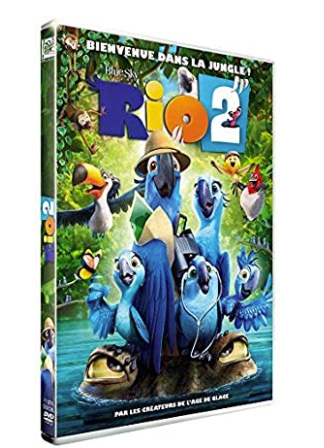
Rio 2
Synopsis
Blu and Jewel are now a family, living happily in Rio with their three children. When they learn that a flock of blue macaws still exists in the Amazon rainforest, they decide to explore the wild with their family. There, Jewel is reunited with her long-lost father, Eduardo, while Blu struggles to fit in with the rugged birds. Meanwhile, loggers are threatening the forest, and old enemies are plotting revenge.
The Making of the Film
After the success of the first Rio, a sequel was almost inevitable, and Carlos Saldanha returned to direct it. He wanted to take the characters out of the city and into the Amazon rainforest, which was a vast new world to explore. The story follows Blu's attempt to adapt to the wild, creating a comedic contrast with his domesticated upbringing. It also deals with Jewel's past, as she meets her father and the rest of her tribe. The screenplay was written by Don Rhymer, Carlos Kotkin, Jenny Bicks and Yoni Brenner, with Saldanha supervising. The film was designed as a bigger and more colourful adventure. The idea of an environmental message was built into the story, as the forest faces destruction. As in the first film, music was at the core of the project.
Reviews and reception
Professional critics' summary
Critics gave the film mixed to positive reviews, praising its colourful animation and energetic musical numbers. Some felt that it was overstuffed with plotlines and characters, with too many songs. Others admired the film's focus on the Amazon and the environmental theme. The humour and the voice performances were generally well received.
Audience reception
The film was a hit with audiences, earning almost 500 million dollars worldwide. It performed especially well in Brazil and Latin America, where the series is hugely popular. Families enjoyed the combination of music and comedy. It reinforced the franchise as one of the most successful animated properties of the decade.
Awards
The film earned nominations at the Annie Awards and other animation ceremonies. It also received recognition for its soundtrack and its visual design. It was not a major awards contender, but it was well regarded by fans. Its main achievement was extending the story of its beloved characters.
Filming anecdotes
Director's inspirations
Saldanha wanted to show another side of Brazil, moving from the urban energy of Rio to the mystery of the jungle. He studied the Amazon's plants, animals and colours to give the film a rich and lush visual design. The story drew on classic family comedies where a city dweller visits relatives in the countryside. He also wanted the film to carry a message about protecting nature.
Production difficulties
Creating the Amazon environment required thousands of detailed plants and animals. The animators had to coordinate dozens of characters in complex musical numbers. The team also had to develop new tools to animate foliage and water effects. Like the first film, the production took years of detailed work.
Anecdote about a particular scene
One of the most memorable sequences is the big musical number in which the birds sing and dance in the forest. Another highlight is the football match between the birds, which mixes sport and animation. The villain Nigel returns with a song of his own, which became a fan favourite. The final confrontation with the loggers is a spectacular finale.
Originally planned casting
Jesse Eisenberg and Anne Hathaway returned as Blu and Jewel. Andy Garcia voiced Eduardo, Jewel's father, while Bruno Mars played Roberto, Blu's rival. Kristin Chenoweth voiced Gabi, a poisonous frog who is in love with Nigel. Jemaine Clement returned as Nigel, and George Lopez and Jamie Foxx also reprised their roles.
Themes explored
The film explores the importance of family and the challenge of finding where you belong. Blu must learn to adapt to a new environment and win the respect of Jewel's family. It also deals with the conflict between modern life and nature, as the loggers threaten the forest. Another theme is identity, as Jewel returns to her roots and rediscovers her heritage. The story highlights the value of community, as different species unite to protect their home. It also touches on the importance of fatherhood and parenting. The film uses humour and music to carry its environmental message. Ultimately, it celebrates the love that holds a family together.
Ending explained
In the final act, the loggers begin to destroy the forest, and the birds must unite to stop them. Blu, who has been trying to prove himself, uses his human knowledge to help the tribe. The birds, together with the other animals, succeed in stopping the machines and chasing off the loggers. Nigel, who has plotted revenge against Blu, is defeated once again. Blu gains the respect of Eduardo, and the family is welcomed into the tribe. The film ends with a celebration in the forest, with Blu and Jewel promising to protect their home. The ending reinforces the film's message of unity and respect for nature.
Meaning of the title
The title Rio 2 simply identifies the film as the second chapter of the story. Although much of the action takes place in the Amazon, Rio de Janeiro is still the characters' home and the heart of the franchise. The number 2 signals a continuation and promises more adventure and music. The title also underlines the idea of return, as the characters go back to their roots. Keeping the name Rio helped the film benefit from the popularity of the first instalment. It is a straightforward title that matches the film's family-friendly tone.
Original Soundtrack
John Powell returned to compose the score, with additional songs by Sergio Mendes, Janelle Monae and Bruno Mars. The soundtrack mixes Brazilian rhythms with pop and Broadway-style numbers. The music is one of the film's main attractions, bringing energy and emotion to each sequence. It extends the musical identity established by the first film.
News
The series did not continue after Rio 2, and a third film was never produced. Blue Sky Studios, the company behind the franchise, was closed by Disney in 2021. The two films remain popular on television and streaming platforms.
Similar Films
Rio is the natural companion to this film. Happy Feet Two and Madagascar 3 are other animated sequels with a strong musical flavour. FernGully: The Last Rainforest and Epic share the environmental message. The Lion King and Moana also combine music, family and nature.