

 Français
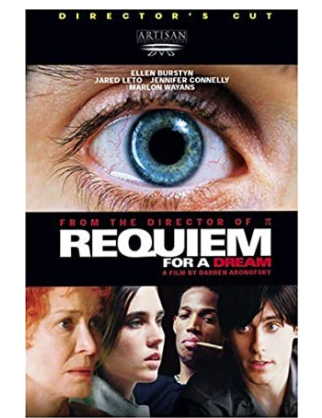
Requiem for a Dream
Synopsis
In a run-down corner of Brooklyn, a widowed mother named Sara Goldfarb becomes dependent on diet pills while dreaming of appearing on her favourite television game show. Her son Harry, his girlfriend Marion and his friend Tyrone dream of a better life and plan to get rich by dealing heroin. As summer turns to autumn and then to winter, each of them sinks deeper into addiction and despair. The film follows the four characters through a spiral of hope, obsession and ruin.
The Making of the Film
Requiem for a Dream is based on the 1978 novel of the same name by Hubert Selby Jr., the author of Last Exit to Brooklyn, whose raw depiction of addiction and urban despair had already made him a cult figure. Darren Aronofsky, who had made a name for himself with the low-budget thriller Pi in 1998, was drawn to the book and decided to adapt it for his second feature. He wrote the screenplay with Selby himself, which helped to preserve the novel's harsh spirit. The story follows four characters whose dreams, from a television appearance to a life of ease, are consumed by dependency. The film was made on a very small budget compared with the studio films of the time, which pushed Aronofsky to find inventive visual solutions. It was shot in New York, notably in Brooklyn's Coney Island and Brighton Beach, which give the film a gritty, lived-in setting. The cast, which included Ellen Burstyn, Jared Leto, Jennifer Connelly and Marlon Wayans, committed to the film's emotional intensity. The film was released in 2000 by Artisan Entertainment and quickly became one of the most discussed independent films of the year.
Critical Reception
Critics were deeply impressed by Requiem for a Dream, even if many admitted that it was a very hard film to watch. They praised Ellen Burstyn's extraordinary performance, the energy of Aronofsky's direction and the film's unflinching view of addiction. The rapid-fire editing, the split screens and the unusual camera work were widely discussed as bold and powerful. A few reviewers found the film relentlessly bleak, and some accused it of being more interested in style than in compassion. Even so, the dominant verdict was that it was a masterful and unforgettable piece of filmmaking.
When the film was rated NC-17 in the United States, Aronofsky refused to make the cuts demanded by the censors, and it was released unrated. This did not prevent it from reaching a loyal audience, and it has since become a cult classic, especially among younger viewers who discovered it on home video. Many people describe it as a film they could not watch twice, while acknowledging its extraordinary impact. It is often cited as one of the most powerful anti-drug films ever made, although Aronofsky has said that it is a film about addiction in all its forms.
Ellen Burstyn received an Academy Award nomination for Best Actress for her portrayal of Sara Goldfarb. She did not win, since the prize went to Julia Roberts for Erin Brockovich, but her performance was widely considered one of the most remarkable of her long career. Burstyn also won the Independent Spirit Award for Best Female Lead. The film's nominations and honours helped to establish Darren Aronofsky as one of the most exciting young directors of his generation.
Filming anecdotes
Aronofsky used a distinctive visual language to convey the sensations of addiction. Short, rapid shots, which he called hip-hop montages, show characters taking their drugs in a repetitive, almost mechanical rhythm. The film also uses the technique of the body-mounted camera, in which the camera is attached to an actor so that the background moves while the face stays fixed, which gives the viewer a feeling of trapped intimacy. Ellen Burstyn reportedly wore a fat suit and prosthetics for some scenes, and she spoke of the part as one of the most demanding of her career. Hubert Selby Jr., the author of the novel, collaborated on the screenplay, which helped to ensure that the film was faithful to his vision.
Themes explored
At its heart, Requiem for a Dream is a film about addiction in all its forms, from heroin and amphetamines to the quieter dependency on television and the dream of fame. Each of the four main characters pursues a dream, and each dream is corrupted by the very thing they believe will fulfil it. The film also explores loneliness, particularly in the character of Sara, whose isolation drives her to cling to the hope of appearing on television. It offers a harsh critique of the American Dream, suggesting that the promise of success and happiness can be a trap. The relationships between mother and son, and between lovers, are slowly destroyed by dependency. The story examines the role of the medical system and of consumer culture in encouraging dependency, since Sara's pills are prescribed by a doctor. Time is another important motif, with the film divided into three seasons that mark the characters' decline. The film is ultimately a tragedy about the human need to believe in something better.
Ending explained
In the final sequence, the four characters reach their lowest points almost simultaneously. Harry, whose infected arm has to be amputated, wakes up in a hospital with no future. Marion, desperate for money to buy drugs, submits to humiliation at a degrading party. Tyrone is trapped in a prison work camp, abandoned and ill. Sara, after misusing her pills, is hospitalised and subjected to electroconvulsive therapy, which leaves her emotionally empty. The editing cuts between these fates with a growing intensity, until each character curls up in a fetal position. In her last fantasy, Sara imagines herself finally appearing on her television show, a bittersweet vision of the dream she never reached. The ending offers no redemption, only the sense that the characters have been consumed by their illusions.
Meaning of the title
A requiem is a mass for the dead, a musical and religious ceremony that mourns someone who has passed away. By calling the film Requiem for a Dream, the author and the director suggest that what is being mourned is not a person but a dream, or rather several dreams. Each character's hopes, whether for fame, wealth, love or simple happiness, are destroyed along the way. The word dream also evokes the American Dream, the idea that anyone can build a better life, which the film treats with deep irony. The title announces from the start that this is a tragedy and that the ending will be sad. It also reflects the film's structure, with its seasons that move from summer to winter like the movements of a funeral piece. The musical connotation of requiem is reinforced by the powerful score that accompanies the film. In that sense, the title is both a description and a warning.
Original Soundtrack
Clint Mansell's score for Requiem for a Dream, performed by the Kronos Quartet, is one of the most celebrated film scores of its decade. The central theme, Lux Aeterna, is built on a repeating melody that gradually gains intensity, which perfectly matches the characters' descent. It has become so popular that it has been reused in countless trailers, television programmes and tributes, often far from its original context. Mansell, who had previously worked with Aronofsky on Pi, blends electronic textures with a string quartet to create a sound that is both modern and mournful. The music is deeply integrated into the film's editing, with certain sequences cut to its rhythms. The score also gives the story an almost operatic quality, which elevates the characters' tragedy. Many viewers say that they remember the music as vividly as the images. It remains a landmark of contemporary film composition.
Similar Films
If you were struck by Requiem for a Dream, the obvious starting point is Aronofsky's own Pi, a feverish thriller about obsession. His later films Black Swan and The Wrestler explore other forms of self-destruction and artistic dedication. Trainspotting, by Danny Boyle, offers a more energetic and darkly comic view of heroin addiction in Edinburgh. Leaving Las Vegas, with Nicolas Cage, is another devastating portrait of addiction and love. The Basketball Diaries follows a young athlete's descent into drug use in New York. Christiane F., a German film about a teenage girl in Berlin, tells a similar story of youthful addiction. Last Exit to Brooklyn, adapted from another Hubert Selby Jr. novel and directed by Uli Edel, shows the author's world of marginalised characters in Brooklyn. Together these films form a powerful body of work about addiction and its human cost.