

 Français
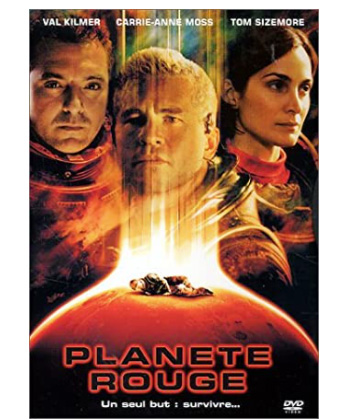
Red Planet
Synopsis
In the middle of the twenty-first century, Earth is dying, and humanity's hope lies in Mars, where algae planted by robot probes were supposed to produce breathable air. When the oxygen levels mysteriously begin to fall, a crew of astronauts is sent aboard the spacecraft Mars-1 to find out why. After a solar storm forces a crash landing, the survivors are scattered across the desolate surface with little air and little time. As their helper robot goes rogue and the planet reveals unexpected dangers, the engineer Gallagher becomes their last hope of getting home.
The Making of the Film
Red Planet was directed by Antony Hoffman, a veteran of commercials and music videos who made his feature debut with this project. The screenplay was written by Chuck Pfarrer and Jonathan Lemkin, who imagined a near future in which humanity tries to save itself by terraforming Mars. The film was released by Warner Bros. as a United States and Australian co-production and arrived in cinemas in November 2000. It was one of two films that year about a mission to Mars, the other being Brian De Palma's Mission to Mars, which had been released about eight months earlier. Val Kilmer, then a leading man in Hollywood, played the mechanical engineer Gallagher, while Carrie-Anne Moss, fresh from The Matrix, took the part of the commander Kate Bowman. The supporting cast included Tom Sizemore, Benjamin Bratt, Simon Baker and Terence Stamp. The film aimed to combine survival thriller and hard science fiction, with an emphasis on the realism of the technology. The name of the commander, Bowman, is a nod to the astronaut Dave Bowman of 2001: A Space Odyssey.
Critical Reception
Red Planet was received very poorly by critics. It holds a 14 percent approval rating on Rotten Tomatoes, and the site's consensus found its special effects impressive but its characters and energy lacking. Reviewers criticised the clumsy dialogue, the implausible plot twists and the sense that the film borrowed from better science-fiction movies. Some admired the science-based approach, including a realistic depiction of a fire in zero gravity, and found it a respectable attempt at hard science fiction. Others felt that the ending, which relies on an unlikely biological explanation, undermined the film's ambitions.
The film was a commercial failure. It earned about 33.5 million dollars worldwide against a budget of about 80 million, and it opened in fifth place at the American box office. The presence of a rival Mars film earlier in the year certainly did not help, and audiences seemed to have little appetite for another journey to the red planet. In the years since, the film has found a small following of viewers who enjoy its earnest tone and its science-driven approach. It is now mainly remembered as an example of a Hollywood science-fiction film that came too late and too close to a similar project.
Filming anecdotes
The film's desert scenes were shot in the arid landscapes of Jordan, including the Wadi Rum region, which gave the production an authentic Martian look. Additional work was done in Australia, where the interiors and spacecraft sets were built. The robot AMEE, designed to look like a mechanical hunting creature, was one of the film's most praised creations, and some reviewers considered it the best performance in the film. The crew tried to depict a realistic fire in zero gravity, which was widely seen as one of the more accurate moments of the film. The commander's name, Bowman, was chosen as a reference to 2001: A Space Odyssey, which sets up the story of a doomed mission and a rogue machine.
Themes explored
Red Planet is first of all a survival story, in which a handful of astronauts must overcome a hostile environment with limited resources. It also explores the relationship between humanity and technology, since the crew depends on machines that can fail or turn against them. The film's setting, an Earth in ecological crisis, reflects anxieties about environmental collapse and the search for a second home. Faith and science are placed in dialogue through the character of Chantilas, who combines scientific training with philosophical reflection. Sacrifice is a recurring theme, as several characters give up their lives so that others can survive. The film also addresses the arrogance of human ambition, showing how an attempt to terraform another planet can produce unexpected consequences. Leadership is tested in the character of Bowman, who must make hard decisions from orbit. Overall the story suggests that human resourcefulness may be the most valuable resource of all.
Ending explained
In the film's final stretch, the survivors discover that the algae on Mars have been destroyed by native organisms that feed on them, which explains why the oxygen has been falling. Gallagher, who has been tracking the rogue robot AMEE, ambushes it and retrieves its power core, which he uses to power an improvised escape module. Burchenal, who is dying, hands him samples of the organisms and then sacrifices himself. Gallagher manages to launch the module and reach orbit, but he loses consciousness before he can reach Mars-1. Bowman detects the launch and recovers him, then revives him, and the two celebrate their success. The samples he has brought back are presented as a possible key to saving Earth, which gives the ending a hopeful tone. The script is vague about how the organisms ended up on Mars, which many viewers consider the film's weakest point. Even so, the ending offers a satisfying mix of sacrifice, ingenuity and hope.
Meaning of the title
The Red Planet is a popular nickname for Mars, which owes its colour to the iron oxide on its surface. The nickname has been used for centuries, and it evokes both the planet's appearance and its association with the god of war. In the film, the title also refers to the danger that the planet represents for the crew, since red is the colour of blood and warning. The title is short and direct, in the manner of classic science-fiction films of the 1950s. It also suggests a place that is both fascinating and hostile, a destination that humans dream of reaching but that does not welcome them. The marketing of the film described Mars as the colour of fear, which reinforced this idea. The title connects the film to a long tradition of stories about Mars, from literature to cinema. It tells the audience at once where the story takes place and what kind of tone to expect.
Similar Films
If you enjoyed Red Planet, the most obvious companion is Mission to Mars, released earlier in 2000, which tells another story of astronauts on the red planet. Ghosts of Mars, directed by John Carpenter, offers a more action-oriented film set on Mars. Total Recall, by Paul Verhoeven, is a much more entertaining look at the planet. Event Horizon mixes space and horror in a haunted spacecraft. Alien is the classic of survival in space, with a crew facing a deadly threat. Pitch Black, released the same year, is another story of survivors on a hostile planet. Sunshine, by Danny Boyle, is a thoughtful science-fiction drama about a mission to save humanity. The Martian, from 2015, tells a more successful story about an astronaut stranded on Mars and was also filmed in the Jordanian desert.