

 Français
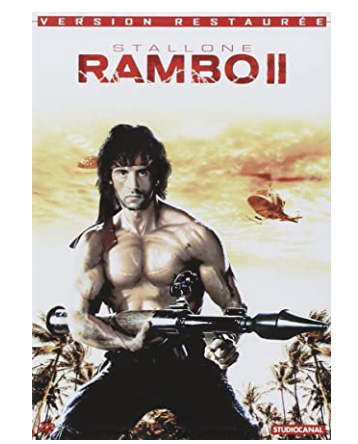
Rambo: First Blood Part II
Synopsis
John Rambo, now serving time in a prison camp, is offered a deal by Colonel Trautman: a secret mission to Vietnam to photograph a camp where American prisoners of war may still be held. Sent in alone and told not to engage the enemy, Rambo discovers that the prisoners are indeed there. When his rescue attempt is sabotaged by a cynical government official, he is left behind enemy lines. Determined to bring his comrades home, he unleashes a one-man war against Vietnamese and Soviet forces.
The Making of the Film
After the success of First Blood in 1982, the producers wanted a sequel that would be bigger and more spectacular. Sylvester Stallone and James Cameron, who was at the time an up-and-coming screenwriter, worked on the script. Cameron's draft introduced the idea of sending Rambo back to Vietnam to rescue prisoners of war, tapping into a popular American belief that some soldiers had been left behind. The story was inspired by the real-life POW/MIA controversy, which was a hot topic in the early 1980s. George P. Cosmatos, who had directed Escape to Athena, was chosen to helm the film. The aim was to transform Rambo from a tragic outsider into an unstoppable action hero. The script was reworked by Stallone, who gave it a more patriotic and heroic tone than the first film. The result was a spectacular adventure that matched the mood of mid-1980s America.
Reviews and reception
Professional critics' summary
Critics were divided, with many complaining that the sequel abandoned the emotional depth of the original in favour of explosions and gunfire. They noted the film's simplistic politics and the near-superhuman abilities of its hero. Others praised the efficient direction and the spectacular action sequences. Stallone's physical presence was widely discussed, as the actor appeared in peak shape.
Audience reception
The film was a huge commercial success, earning around 300 million dollars worldwide, far more than the first. Audiences flocked to see Rambo in action, and the character became a pop-culture icon of the decade. The film inspired toys, cartoons and countless imitations. It was widely regarded as one of the defining action films of the 1980s.
Awards
The film was not an awards contender, and it attracted several nominations at the Golden Raspberry Awards. However, it won recognition from fan audiences and in popular polls. Its box-office performance far outweighed any critical disapproval. It has since become a cultural reference point for action cinema.
Filming anecdotes
Director's inspirations
Cosmatos wanted the film to feel like a visual comic book, with heroic poses, strong colours and larger-than-life action. He was influenced by Vietnam War movies, but also by adventure films in which a lone hero takes on an army. The jungle setting provided a natural stage for the action. The film's style set the tone for a whole wave of similar action films.
Production difficulties
The film was shot in Mexico, in hot and humid jungle conditions that were tough on the cast and crew. Stallone performed many of his own stunts and spent long hours training to prepare for the role. The explosions and gunfire sequences required careful safety planning. Despite the difficulties, the production finished on schedule and delivered a polished action spectacle.
Anecdote about a particular scene
The scene in which Rambo uses his bow and explosive-tipped arrows became one of the most iconic images of the film. Another famous moment shows him emerging from the mud, ready to fight. The film also includes an extended helicopter sequence that became a model for later action movies. Even President Reagan referred to the film in a speech, which shows how widely it had entered popular culture.
Originally planned casting
Sylvester Stallone returned as Rambo, and Richard Crenna reprised his role as Colonel Trautman. Charles Napier played the opportunistic bureaucrat Murdock, while Julia Nickson was cast as Co Bao, Rambo's guide and ally. Steven Berkoff appeared as the Soviet officer Podovsky.
Themes explored
The film is built around the myth of the lone hero who succeeds where governments fail. It reflects American anxieties about the Vietnam War and the belief that prisoners were abandoned. Another central theme is betrayal by institutions, with Rambo being sent into danger by those who secretly want him to fail. It also explores the idea of redemption, as Rambo gets a second chance to win a war that was lost. The film makes heavy use of patriotism and machismo, in line with 1980s cinema. It also touches on the cost of violence, though more lightly than the first film. Loyalty to fellow soldiers is the emotional centre of the story. Overall, it is a fantasy of victory and vindication.
Ending explained
After being betrayed by Murdock, Rambo is captured and tortured, but he escapes with the help of Co Bao. He fights his way through the jungle, rescues the prisoners and steals a helicopter to fly them to safety. Co Bao is killed during the escape, which gives Rambo a personal reason to avenge her. He returns to the base and destroys Murdock's command centre. Before leaving, he confronts Murdock and tells him not to forget about the men who are still missing. In the final conversation with Trautman, Rambo says that he wants his country to love him as much as he loves it. The film closes with Rambo walking away, a lone figure who has done his duty.
Meaning of the title
The full title Rambo: First Blood Part II presents the film as a direct sequel to First Blood, and also puts the character's name in front. The studio decided to use the name Rambo because the character had become a cultural phenomenon. The words First Blood Part II keep the link with the original, and imply that the story is a continuation of the earlier conflict. In French-speaking countries the subtitle la mission was added to underline the mission aspect of the story. The title reflects the transformation of Rambo from a tragic figure into a brand name. It was a bold marketing decision that proved extremely effective.
Original Soundtrack
Jerry Goldsmith returned to compose the score, using synthesisers and percussion to give the film a distinctive sound. His heroic main theme became one of the most recognisable pieces of 1980s action music. The score underlines both the tension of the jungle sequences and the triumph of Rambo's mission. It remains a favourite among film music fans.
Similar Films
First Blood is the essential companion to this film. Missing in Action and Uncommon Valor also deal with rescuing prisoners from Vietnam. Commando and Predator offer more one-man-army action. Rambo III and Rambo: Last Blood continue the character's journey.