

 Français
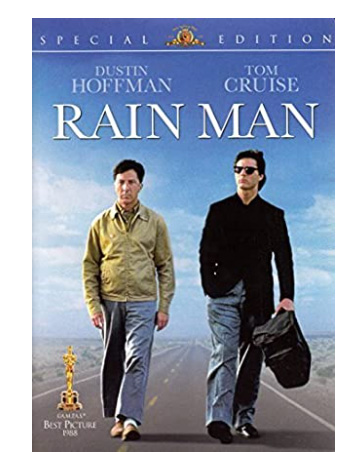
Rain Man
Synopsis
Charlie Babbitt, a selfish and fast-talking car dealer, learns that his estranged father has died and left his fortune to an unknown beneficiary. He discovers that the heir is his older brother Raymond, an autistic savant who has lived in an institution for most of his life. Charlie kidnaps Raymond, hoping to force a share of the inheritance, and the two embark on a road trip across America. Along the way, Charlie slowly learns to see his brother as a person rather than a bargaining chip.
The Making of the Film
The idea for Rain Man came from screenwriter Barry Morrow, who met Kim Peek, a man with extraordinary memory and social difficulties, in 1984. Morrow was also inspired by his friendship with Bill Sackter, a man with an intellectual disability whose story he had told on television. He realised that a story about a savant could combine humour, emotion and a deep reflection on family. Writer Ronald Bass reworked the script and added the brother-versus-brother structure that gives the film its drive. The project passed through the hands of several directors, including Martin Brest and Sydney Pollack, before Barry Levinson finally took over. Dustin Hoffman threw himself into research, meeting people on the autism spectrum and studying their routines. Tom Cruise, then a rising star, was chosen as Charlie to play opposite him. The result was a road movie that was as moving as it was funny.
Reviews and reception
Professional critics' summary
Critics widely praised the film, especially Dustin Hoffman's precise and respectful performance as Raymond. Many noted how Tom Cruise held his own against such a powerful co-star, showing real range for the first time. The script was admired for its balance between comedy and sentiment. A few reviewers argued that the portrayal of autism was too exceptional, but most agreed that the film opened an important conversation.
Audience reception
The film was a gigantic success, earning more than 350 million dollars worldwide and becoming the biggest hit of 1988 in the United States. Audiences laughed and cried along with the brothers, and many left theatres with a new awareness of autism. The film also made the word savant familiar to millions of people. It is still regularly shown on television and remains a favourite for family discussions.
Awards
Rain Man won four Academy Awards, including Best Picture, Best Director for Barry Levinson, Best Actor for Dustin Hoffman and Best Original Screenplay. It was nominated in eight categories in total. The film also took the Golden Bear at the Berlin International Film Festival. Hoffman's win was his second Oscar for Best Actor.
Filming anecdotes
Director's inspirations
Barry Levinson wanted the film to feel like a classic road movie, in which the journey slowly transforms the characters. He focused on small, everyday moments, such as meals and car rides, to reveal the bond between the brothers. Levinson also insisted that Raymond should never be played for cheap laughs but with dignity. He relied on long, patient takes to let the actors build their chemistry.
Production difficulties
The production was troubled in its early stages, with directors coming and going and the script being rewritten several times. Shooting across several states meant a heavy travel schedule for the crew. Hoffman's demanding preparation also led to disagreements with the director about how far the character should go. Once Levinson had settled the approach, the shoot ran more smoothly.
Anecdote about a particular scene
The card-counting sequence in a Las Vegas casino is the most famous scene in the film. Raymond uses his extraordinary memory to win at blackjack, and Charlie sees the potential for a fortune. The scene is also an early example of how the film uses Raymond's gift as a source of tension. Another touching moment shows the two brothers dancing together in a hotel room.
Originally planned casting
Dustin Hoffman was involved in the project long before filming and helped shape the character of Raymond. Tom Cruise came on board as Charlie Babbitt, a role that required him to be unlikable at first and sympathetic later. Valeria Golino played Susanna, Charlie's girlfriend, who sees the change in him before he does.
Themes explored
At its core, Rain Man is about the bond between brothers and the discovery of unconditional love. It explores how our idea of success can blind us to what really matters. The film also draws attention to autism and savant syndrome, turning a little-known condition into a human story. Another theme is the legacy of childhood, since both brothers have been shaped by a cold and distant father. Money and greed are shown as destructive forces, at least until Charlie changes. The film also touches on the right of every person to be treated with respect and dignity. It looks at the difficulty of communication, and how love can exist without many words. In the end, it suggests that real wealth lies in human connection.
Ending explained
After the long road trip, Charlie starts to care deeply about his brother and fights for custody of Raymond. In a meeting with doctors, he realises that the inheritance no longer matters to him. Raymond is given the chance to choose, but he cannot express a decision in the way Charlie hopes. In the end, the doctors decide that Raymond is better off returning to the institution. Charlie accepts the decision and says goodbye to his brother at the train station. He promises to visit him, showing that the road trip has changed him forever. The ending is bittersweet, as it refuses an easy happy outcome while still offering hope.
Meaning of the title
The title comes from Charlie's childhood memories. When he was little, he could not pronounce the name Raymond properly and called his older brother Rain Man. The revelation that Raymond was the comforting figure who sang to him as a child arrives as an emotional turning point. The title therefore carries a hidden tenderness, linking the present to the past. It also gives the film a poetic and mysterious ring that arouses curiosity. For the audience, it becomes a symbol of how our earliest bonds persist. In a few words, the title sums up the quiet power of the story.
Original Soundtrack
Hans Zimmer composed the score, one of the first major projects of his career. His blend of electronic textures and warm melodies gave the film a distinctive sound, especially in the road trip scenes. The music remains understated, supporting the emotion without ever overwhelming the performances. It helped to launch Zimmer's international career.
Similar Films
Forrest Gump and The Accountant also feature characters with unusual minds. Good Will Hunting looks at the burden and the gift of genius. The Rain Man road-trip structure is echoed in Planes, Trains and Automobiles and Little Miss Sunshine. My Left Foot and The Theory of Everything are other acclaimed dramas about remarkable people.