

 Français
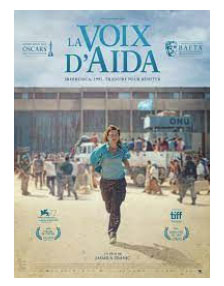
Quo Vadis, Aida?
Synopsis
In July 1995, the Bosnian town of Srebrenica falls to the Serbian army, and thousands of civilians seek shelter at the nearby United Nations base. Aida, a teacher who works as a translator for the UN, tries desperately to save her husband and two sons from the fate that awaits the men outside. As she fights against time and bureaucracy, she sees how little protection the international community is willing to offer. The film is a harrowing drama based on real events.
The Making of the Film
Quo Vadis, Aida? was written and directed by Jasmila Žbanić, a Bosnian filmmaker who lived through the war in Sarajevo. Her aim was to tell the story of the Srebrenica massacre, the worst atrocity in Europe since the Second World War, from the perspective of an ordinary woman rather than a soldier or a politician. The film is a co-production among several European countries, and Jasna Đuričić plays Aida. Žbanić carried out extensive research and spoke to survivors, and she recreated the events with a great deal of care. The film premiered at the Venice Film Festival in 2020 and was released in several countries in 2021.
Critical Reception
Summary of professional reviews
Critics were overwhelmingly positive. They praised the film's restraint, its tension and Jasna Đuričić's extraordinary performance, which carries the story. Many described it as a devastating and necessary work that makes the viewer feel the powerlessness of the situation.
Public reception
The film was seen mainly in festivals and arthouse cinemas, where audiences responded with great emotion. It has been discussed in the Balkans and beyond as an important piece of historical memory.
Awards received
The film received an Academy Award nomination for Best International Feature Film. It also won several major prizes at the European Film Awards, including Best Film and Best Actress for Jasna Đuričić.
Themes Explored
The film is about the failure of the international community to protect civilians and about the human cost of political indecision. Aida's position as a translator puts her between the victims and those who hold their fate in their hands. It also shows the desperation of a mother and wife who is trying to save her family. Complicity, denial and the importance of bearing witness run through the story. The film refuses spectacle in favor of a quiet, relentless realism.
Ending Explained
After the massacre, the film jumps forward to the postwar years. Aida has returned to Srebrenica, where she finds that her husband and sons were among the victims, and she goes back to teaching. In the final scene, she watches a school performance in which children, including some from the families of perpetrators, take part. The ending is quiet and deeply moving, since it shows both the survival of a community and the impossibility of forgetting.
Meaning of the Title
Quo vadis is a Latin phrase meaning where are you going. It is associated with a famous biblical story in which the apostle Peter asks Jesus this question. In the film, the title becomes a question addressed to Europe and to the world: where are you going when you stand by in the face of atrocity?
Similar Films
For other powerful films about war and civilians, try Hotel Rwanda, Schindler's List and No Man's Land. Jasmila Žbanić's earlier film Grbavica deals with the legacy of the Bosnian War. Beasts of No Nation and Come and See are other harrowing portraits of conflict.