

 Français
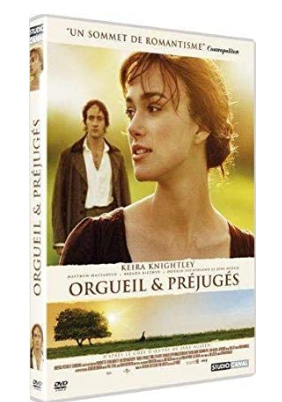
Pride & Prejudice
Synopsis
In rural England at the end of the eighteenth century, the lively and independent Elizabeth Bennet lives with her four sisters and their parents, who are anxious to see their daughters married well. When the wealthy and amiable Mr. Bingley moves into the neighbourhood with his proud friend Mr. Darcy, Elizabeth takes an instant dislike to the aloof newcomer. Misunderstandings, family embarrassments and a charming but deceitful officer complicate the relationship between the two. As they overcome their first impressions, Elizabeth and Darcy must confront their own pride and prejudice.
The Making of the Film
Pride & Prejudice is based on the 1813 novel by Jane Austen, one of the most beloved works of English literature. The film was the feature debut of Joe Wright, a young director who had previously worked in television. The screenplay was written by Deborah Moggach, who condensed the novel's many characters and episodes into a two-hour film. Wright wanted a version that felt fresh and alive, so he chose to set the story in the 1790s rather than the Regency period, which allowed for earthier, less formal costumes. He also cast actors who were closer in age to the characters than many earlier adaptations had done, with Keira Knightley, then still in her early twenties, as Elizabeth. Matthew Macfadyen played Mr. Darcy, with Brenda Blethyn and Donald Sutherland as the Bennet parents, and Judi Dench as the formidable Lady Catherine. The film was shot on location in England, with Chatsworth House in Derbyshire serving as Darcy's estate, Pemberley. It was released in 2005 and aimed to bring Austen's story to a new generation of viewers.
Critical Reception
Critics greeted Pride & Prejudice with warm praise. Many admired its visual beauty, its lively pace and the way it captured the romance and humour of Austen's story. Keira Knightley's spirited performance as Elizabeth received particular acclaim, and Matthew Macfadyen's more vulnerable Darcy was also appreciated. Some purists complained about its liberties with the novel, including its more muddy, rural look and its condensation of the plot. In general, though, the film was regarded as a stylish and engaging adaptation that stood on its own.
Audiences embraced the film, and it grossed around 120 million dollars worldwide, a strong result for a costume drama. It was especially popular with younger viewers who had not seen earlier versions. Its romantic scenes, such as Darcy's early morning walk across the misty field, have become iconic. The film has remained a favourite among fans of Austen and costume drama, even as new adaptations have appeared.
Pride & Prejudice received four Academy Award nominations: Best Actress for Keira Knightley, Best Original Score for Dario Marianelli, Best Art Direction and Best Costume Design. It did not win any of them, but the nominations underlined the quality of its performances and craftsmanship. Joe Wright also received the BAFTA for Outstanding Debut by a British Writer, Director or Producer. The film's success helped establish him as one of Britain's most promising directors.
Filming anecdotes
Joe Wright set the film in the 1790s, which meant that costumes and settings had a more rustic feel than in earlier screen versions. Chatsworth House, one of England's grandest stately homes, was used as Pemberley, giving the film its most spectacular location. Groombridge Place in Kent was used as the Bennet family home, which gave the film a lived-in and slightly chaotic look. The film's long, flowing shots, particularly in the ballroom scene, were carefully choreographed to create a sense of movement and intimacy. The American release of the film had a different ending from the British one, with an extra scene in which Elizabeth and Darcy are seen together at Pemberley, with Darcy addressing her as Mrs. Darcy.
Themes explored
At its heart, Pride & Prejudice is a story about the way first impressions can mislead us, and about the need to overcome pride and prejudice in order to find true love. Elizabeth and Darcy begin as opponents, each prejudiced by social expectation and personal pride, and they must learn to see each other clearly. The film also explores class and marriage, depicting a society in which women's futures depend on finding a suitable husband. Family plays an important role, with the Bennet sisters and their parents providing both comedy and tension. Independence and self-respect are central to Elizabeth's character, since she refuses to marry for security alone. The story also deals with reputation and scandal, particularly in the episode involving Lydia. Wit and conversation are the weapons of the film's heroine, who uses humour to resist convention. Beneath its romance, the film is a gentle critique of the social conventions of its time.
Ending explained
In the final act, Elizabeth and Darcy are brought together again after the crisis caused by Lydia's elopement, in which Darcy has quietly helped to save the family's reputation. Elizabeth discovers his generosity and realises that she has misjudged him. When Darcy proposes a second time, she accepts, and the film shows their reconciliation in an early morning field, in a scene filled with mist and emotion. Mr. Bennet, who has always been close to his favourite daughter, gives his blessing with tears in his eyes. Jane and Bingley, the other couple of the story, also find their happiness. The American version closes with an additional scene in which the couple are seen at Pemberley, tenderly teasing each other. The ending confirms that love and understanding have triumphed over pride and social division. It leaves the audience with the warm satisfaction of a romance that has been fully earned.
Meaning of the title
The title Pride & Prejudice names the two flaws that stand between Elizabeth and Darcy. Pride is the quality of Darcy, who believes himself above the company of the neighbourhood, and also of Elizabeth, who is proud of her own judgement. Prejudice is the quality of Elizabeth, who judges Darcy too quickly on the basis of first impressions, and of Darcy, who is prejudiced against her family's social standing. Austen's original title for the novel was First Impressions, but she changed it, reportedly inspired by a phrase from Fanny Burney's novel Cecilia. The ampersand used in the film's title gives it a more modern, informal look than the original. The two nouns, set side by side, summarise the novel's central lesson. They also promise a story in which the characters will have to overcome their own limits. The title has become so famous that it is almost synonymous with romance in the English tradition.
Original Soundtrack
Dario Marianelli's score for Pride & Prejudice is one of the most admired aspects of the film and earned him an Academy Award nomination for Best Original Score. His music, which is dominated by piano and strings, captures the lively spirit and the intimate emotion of the story. The pianist Jean-Yves Thibaudet performed the piano pieces, which gives the score a graceful and elegant touch. The music is used to underline key scenes, such as the ballroom dances and the walks through the countryside. Marianelli's melodies often have a playful rhythm that matches Elizabeth's wit, while softer themes reflect her deeper feelings. The score helped to define the film's romantic tone and has been widely appreciated by listeners. Many fans of the film consider the music to be one of its most beautiful and memorable elements.
Similar Films
If you enjoyed Pride & Prejudice, the 1995 BBC television series with Colin Firth is the other great screen version of the novel and a perfect companion. Sense and Sensibility, directed by Ang Lee, offers another elegant Austen adaptation with a strong cast. Emma, in its various adaptations, presents a more comic side of Austen's world. Persuasion, Austen's last novel, tells a quieter and more mature love story. Atonement, also directed by Joe Wright, is a more tragic romance with Keira Knightley. Jane Eyre, from the Brontë novel, offers another story of a strong-willed heroine and a brooding hero. Becoming Jane imagines the young Austen's own romantic experiences. Together these titles show the enduring appeal of the English costume drama.