

 Français
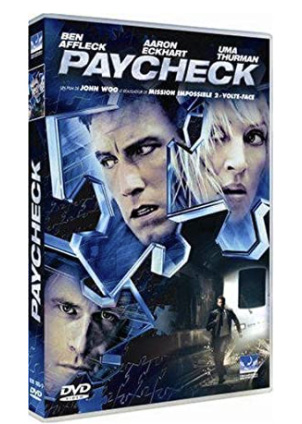
Paycheck
Synopsis
Michael Jennings is a brilliant engineer who is hired by powerful companies to work on top-secret projects. After each job, his memory is erased to protect corporate secrets, and he is paid handsomely. After his latest three-year assignment, he discovers that he has given up his huge paycheck and instead has an envelope of seemingly random objects. As he realizes that he is being hunted, he must use those objects to piece together what he did and stop a catastrophe.
The Making of the Film
Paycheck is loosely based on a short story by Philip K. Dick, the author behind Blade Runner and Minority Report. The story, first published in 1953, explores themes of memory and corporate secrecy that were ahead of their time. Director John Woo, famed for his stylized action in Hong Kong and Hollywood, brought his trademark flair to the adaptation. Ben Affleck starred as Michael Jennings, with Uma Thurman as his love interest. The film was released in December 2003.
Reviews and Reception
Summary of Professional Reviews
Critics were mostly unimpressed, finding the film uneven and its plot overly convoluted. Many pointed out that it lacked the depth and philosophical edge of Philip K. Dick's writing. John Woo's action sequences were sometimes praised, but several reviewers felt that his style was wasted on a weak script.
Audience Reception
The film had a lukewarm box-office result and did not become a major hit. Some viewers enjoyed it as a fast-paced sci-fi thriller, while others found it forgettable. It has gained a small following among fans of both Philip K. Dick and John Woo.
Filming Anecdotes
Director's Inspirations
John Woo was attracted to the story's themes of memory, identity and the idea of an ordinary man caught in a vast conspiracy. He hoped to blend that with the dynamic action and slow-motion style that made him famous.
Anecdote About a Particular Scene
The motorcycle chase through a series of tunnels and the dramatic action sequence in which the hero uses ordinary objects from his envelope are among the film's most memorable moments. They show Woo's talent for turning everyday items into instruments of suspense.
Themes Explored
Paycheck is about memory and the way it shapes our identity. It explores the dangers of corporate power and the ethics of technology, especially the idea of a machine that can see the future. The film also looks at free will versus destiny, as Michael must decide whether to follow the path laid out for him. Trust and betrayal are central to the plot. Underneath the action lies an interesting question: what are we without our memories?
Ending Explained
By the end, Michael uses the objects in his envelope to outwit his enemies and destroy the machine that can see the future. The device, he realizes, is too dangerous to exist. In the process, he reconnects with Rachel, restoring the one relationship that had been erased. The ending reflects the film's main idea that people can choose their own path even when it seems predetermined.
Meaning of the Title
The title refers to the enormous paycheck that Michael gives up at the beginning of the story. It also carries irony, since the real payment he receives is far more valuable than money: it is the chance to change the future. The word reflects the film's concern with the value of work, secrecy and sacrifice.
Similar Films
- Minority Report: another Philip K. Dick adaptation about the future.
- Total Recall: a thriller about stolen memories.
- Eternal Sunshine of the Spotless Mind: a romantic drama about erased memories.
- The Bourne Identity: an action thriller about a man without a past.