

 Français
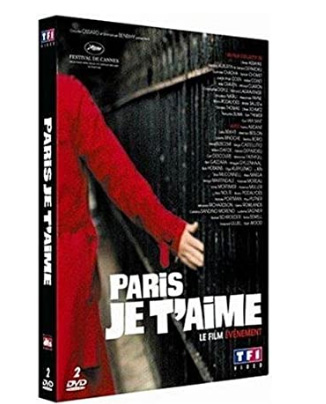
Paris, je t'aime
Synopsis
Paris, je t'aime is a collection of short films, each set in a different neighbourhood of the French capital and each telling a story about love in one of its many forms. A lonely man falls for a stranger in the Marais, a tourist faces a quarrel in a metro station, and a young father struggles in the suburbs. Elsewhere, a mime, a mother and a group of unlikely lovers find unexpected moments of tenderness. The stories vary in tone from comic to tragic, together composing a mosaic portrait of the city and its inhabitants.
The Making of the Film
Paris, je t'aime was conceived by the producer Emmanuel Benbihy, who had the idea of bringing together many directors to create short films about love, each set in a different arrondissement of Paris. The project quickly attracted some of the most distinguished names in international cinema, each of whom was given a few minutes to tell a story. Among the directors were Gus Van Sant, Joel and Ethan Coen, Alfonso Cuarón, Alexander Payne, Tom Tykwer, Olivier Assayas, Walter Salles, Wes Craven and Sylvain Chomet. The producer wanted the film to reflect the diversity of Paris, both in its geography and in the people who live there. The cast was just as international, with actors such as Natalie Portman, Steve Buscemi, Juliette Binoche, Willem Dafoe, Nick Nolte and Gena Rowlands. Each short film was made independently, in a very short shooting schedule, with great creative freedom. The project premiered at the Cannes Film Festival in 2006 and was released soon afterwards. Its success inspired a series of similar projects in other cities, starting with New York, I Love You.
Critical Reception
Critics gave Paris, je t'aime a mixed but generally warm reception. They admired the ambition of the project and the pleasure of seeing so many great directors working in such a short format. As with any anthology, the quality varied from one segment to another, with some more memorable than others. Many reviewers singled out the Coen brothers' comic episode with Steve Buscemi, Alfonso Cuarón's long single take and Alexander Payne's moving closing segment. Others found the film uneven and felt that a few of the shorts were too slight. Overall it was seen as a charming and enjoyable portrait of the city.
The film was a notable success for an anthology, and it was particularly popular with audiences who love Paris and the romantic image of the city. Many viewers enjoyed the variety of tones and the opportunity to discover the work of different directors in a single film. It has become a favourite of cinephiles, who like to debate which segments are the best. The film's success led to sequels in the same format, including New York, I Love You in 2008 and Rio, Eu Te Amo in 2014.
Filming anecdotes
Each of the directors was given only a couple of days to shoot a segment of about five minutes in a specific neighbourhood, which meant that the film was made quickly and with a lot of improvisation. Alfonso Cuarón's contribution, set in the Parc Monceau and starring Nick Nolte and Ludivine Sagnier, was filmed in a single continuous shot. The Coen brothers' segment in the Tuileries metro station, with Steve Buscemi as a hapless tourist, is one of the film's funniest moments. Alexander Payne's closing segment, set in the fourteenth arrondissement and narrated in broken French by an American postal worker played by Margo Martindale, is often seen as the film's emotional high point. The tight schedule pushed the directors to work in a spontaneous, almost improvised style.
Themes explored
At its heart, Paris, je t'aime is a celebration of love in all its forms, from fleeting encounters to lifelong devotion. It shows love as something that can appear anywhere, at any time, and in the most unexpected places. The film also celebrates the city of Paris itself, which is presented as a character, with its streets, its monuments and its diverse inhabitants. The segments explore different kinds of love, including romantic, parental, platonic and even supernatural. Loneliness is another theme, with several characters seeking connection in a crowded city. The film also touches on the experience of foreigners and immigrants in Paris, showing the city as a meeting point for different cultures. Humour and melancholy are balanced throughout, which gives the film its bittersweet tone. Overall, it presents the city as a place where emotions, and stories, are always waiting to be discovered.
Ending explained
Because Paris, je t'aime is an anthology, it does not have a single ending, and each of the short films finds its own conclusion. Some end with a gentle romantic moment, others with a comic twist and others with a note of sorrow. The film's closing segment, by Alexander Payne, follows Carol, a lonely American postal worker visiting Paris, who sits in a park and reflects on her trip in her own imperfect French. She expresses a sense of happiness and belonging that she did not expect to find. The film then brings back images from the preceding stories, which links them in a final montage. This closing sequence reinforces the film's central idea that love is part of the fabric of the city. It ends on a note of quiet joy, as the audience is left with a collage of the many faces of Paris. The film thus closes not with a conclusion, but with a feeling.
Meaning of the title
The title Paris, je t'aime is French for Paris, I love you, and it works as a direct declaration of love to the city. It is the title of the film in all its releases, since the phrase is instantly understood even by people who do not speak French. The phrase je t'aime is one of the most famous in the French language and is associated with romance. By addressing the city directly, the title suggests that the film is a love letter and that Paris is its true beloved. It also hints at the plural nature of love, since each of the segments offers a different version of the declaration. The title's simplicity and warmth made it an ideal brand for the series of films that followed, each of which adopted the same structure for other cities. It is also a pun on the countless songs, poems and films that have used the same phrase. In short, it is a title that says everything the film wants to say.
Similar Films
If you enjoyed Paris, je t'aime, the first suggestion is its sequel in spirit, New York, I Love You, which applies the same idea to another great city. Rio, Eu Te Amo does the same for Rio de Janeiro. Paris, by Cédric Klapisch, is a gentle ensemble drama about the lives of various Parisians. Amélie, by Jean-Pierre Jeunet, is a charming and whimsical portrait of a young woman in Montmartre. Midnight in Paris, by Woody Allen, is a nostalgic fantasy about a writer who travels to the Paris of the 1920s. Before Sunset, by Richard Linklater, follows two lovers who walk through Paris in real time. Short Cuts and Magnolia are other examples of films that weave together many stories. Together these films celebrate the ways in which cinema has fallen in love with Paris.