

 Français
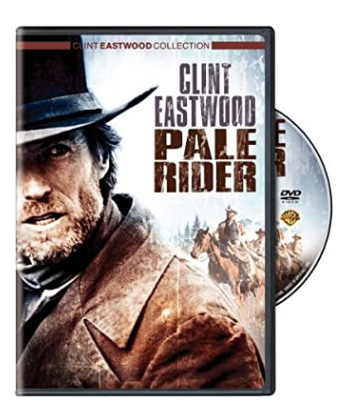
Pale Rider
Synopsis
In a Californian mining camp threatened by a powerful rival, a group of poor prospectors struggles to hold on to their claims. A young girl prays for a miracle, and a mysterious preacher on a pale horse rides into town. As the stranger defends the miners against the hired gunmen of a ruthless mining baron, it becomes clear that he is much more than a man of God. The confrontation that follows will pit the small community against the forces of greed and violence.
The Making of the Film
Pale Rider was directed by and stars Clint Eastwood, who had already made a name for himself as both an actor and a director of Westerns. The screenplay was written by Michael Butler and Dennis Shryack, and it drew inspiration from the classic Western Shane, in which a mysterious stranger defends a family of settlers. The title is taken from the Book of Revelation, in which the fourth horseman of the Apocalypse rides a pale horse whose rider is Death. The film's mix of Western and ghost story echoes Eastwood's earlier work High Plains Drifter, in which a stranger returns to a town to avenge a past crime. It was released in 1985, at a time when the Western was considered a nearly dead genre in Hollywood. Eastwood saw it as an opportunity to revive the form with a story of simple justice and moral clarity. The film was shot in the mountains of Idaho, whose snowy landscapes gave it a stark and majestic look. The cast included Michael Moriarty, Carrie Snodgress, Chris Penn and Richard Dysart, along with the young Sydney Penny as the girl whose prayer begins the story.
Critical Reception
Critics generally gave Pale Rider a positive reception. Many praised Eastwood's confident direction and the film's visual beauty, in particular the use of the Idaho landscapes. They also appreciated its mythic quality and its bold mix of Western tradition and supernatural mystery. Some reviewers felt that it borrowed too heavily from Shane and from Eastwood's own earlier films. Others noted that the film was slow and that its villains were drawn in broad strokes. Overall it was regarded as a strong and impressive revival of the genre.
The film was a significant commercial success, and it was among the most successful Westerns of the 1980s. It confirmed that there was still an audience for the genre and paved the way for later Westerns, including Eastwood's own Unforgiven. Audiences were drawn by the combination of Eastwood's star power, the striking visuals and the sense of mystery surrounding the Preacher. It remains a favourite among fans of Eastwood and has gained a lasting reputation as one of his best Westerns.
Filming anecdotes
The film's spectacular scenery was filmed in the mountains of Idaho, including the area around Sun Valley, which gave it an authentic and untamed look. The Preacher's mysterious past is hinted at through the scars on his back, which look like bullet wounds, and the suggestion that he may be a ghost or avenging angel is never fully confirmed. The scene in which Megan reads from the Book of Revelation, as the stranger appears on his pale horse, establishes the film's supernatural undertone. Eastwood has said that he wanted the film to feel simple and elemental, like an old folk tale. The film's release coincided with that of Silverado, another Western, which led to talk of a possible revival of the genre that year.
Themes explored
At its heart, Pale Rider is a story about justice and redemption, in which a mysterious stranger helps the weak to stand against the powerful. It explores the conflict between the small prospectors, who work by hand, and the mining company, which uses powerful hydraulic machines that destroy the land. The film also contains a strong religious dimension, with the figure of the Preacher evoking an avenging angel or the Biblical Death. Faith and hope are embodied by Megan, whose prayer leads to the stranger's arrival. The story deals with the idea of community, showing how a group of ordinary people can find strength when they stand together. There is also an ecological theme, since the film portrays the destruction of nature by greedy industry. The relationship between the Preacher and the women of the camp adds a layer of romantic tension. Overall the film combines the grandeur of myth with the simplicity of a morality tale.
Ending explained
In the final showdown, the Preacher goes alone into the town to confront the ruthless Marshal Stockburn and his deputies, who have been hired by the mining baron. Using his skill and cunning, he kills the deputies one by one, in a series of tense and elegantly staged gunfights. He then faces Stockburn in a final duel in the street, and he kills him, which seems to confirm his supernatural origin. With the villains dead, the miners are free to keep their claims and to continue their lives in peace. The Preacher then rides away into the mountains, leaving behind a community that has found its courage. Megan calls after him, saying that they love him, as he disappears into the snow. The ending reinforces the idea that he was a figure of justice who came from beyond to restore order. It leaves the audience with a sense of wonder and mystery.
Meaning of the title
The title Pale Rider refers to a verse from the Book of Revelation, in which the fourth horseman of the Apocalypse appears on a pale horse, and his name is Death. In the film, the Preacher is the pale rider, appearing on a pale horse at the moment when a girl reads the passage aloud. The title suggests that he is a harbinger of death for the villains, an avenging figure who brings judgement. It also creates an atmosphere of mystery and menace, since it hints at a supernatural dimension. The colour pale evokes ghosts, fog and the colour of death, which fits the character's elusive nature. The word rider connects the film to the classic tradition of the Western hero on horseback. By combining Biblical and cinematic references, the title elevates a simple story into a myth. In this way, it both announces and explains the film's central figure.
Similar Films
If you enjoyed Pale Rider, the obvious companion is Shane, the classic Western that inspired it, with Alan Ladd as the mysterious gunfighter. High Plains Drifter, also by Eastwood, is a darker and more supernatural story of a stranger's revenge. Unforgiven, perhaps Eastwood's masterpiece, offers a more critical and elegiac view of the Western. The Outlaw Josey Wales tells another story of a lone man seeking justice. A Fistful of Dollars, by Sergio Leone, is the film that first made Eastwood a Western icon. The Searchers and The Man Who Shot Liberty Valance are classic Westerns by John Ford that reflect on the myth of the West. Silverado, released the same year, is a more lighthearted revival of the genre. Together these films trace the long history of the Western hero.