

 Français
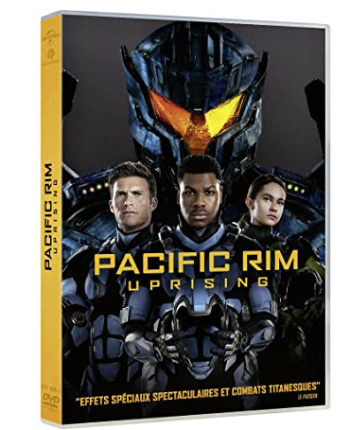
Pacific Rim: Uprising
Synopsis
Ten years after the war against the Kaiju, the world has rebuilt itself and the giant Jaeger robots are still the planet's guardians. Jake Pentecost, the rebellious son of a fallen hero, is pulled back into the program alongside a young and talented hacker named Amara. When a mysterious rogue Jaeger starts attacking cities, a new and far more dangerous threat is revealed. The pilots must join forces to stop a catastrophe that could end humanity.
The Making of the Film
Pacific Rim: Uprising is the sequel to Guillermo del Toro's 2013 monster spectacle, which had been a modest success in the United States but did far better abroad, especially in China. Del Toro stayed on as a producer but handed the director's chair to Steven S. DeKnight, who was known for his work on television series such as Spartacus and Daredevil. The goal was to expand the universe by looking at what happens after the war is won. John Boyega, who had gained fame with the new Star Wars films, was cast as the lead and also served as a producer. The film brought back familiar faces, including Scott Eastwood as a fellow pilot, Charlie Day and Burn Gorman as the eccentric scientists, and Rinko Kikuchi as Mako Mori. The production was supported by Legendary and a Chinese partner, reflecting the film's global audience. The sequel aimed to be brighter and more colorful than the moody original.
Reviews and reception
Summary of professional reviews
Critics were generally lukewarm. Many praised the energetic action and the charisma of John Boyega, while others felt the film lacked the visual poetry and emotional weight of del Toro's original. The story was often described as generic. Some reviewers nonetheless found it a fun and colorful popcorn movie.
Audience reception
The film earned around 290 million dollars worldwide on a budget of roughly 150 million, with China representing a very large share of its income. Fans of the first film were divided, with some enjoying the new energy and others missing the original's darker atmosphere. It found a loyal audience among viewers who love giant robots and monsters. Younger audiences appreciated the new generation of pilots.
Awards and nominations
The film did not receive significant awards recognition. It was nominated for a few popular and genre awards, mostly related to its action and effects. Its main success lay at the box office rather than at ceremonies.
Filming anecdotes
Director's inspirations
DeKnight has said that he wanted to honor the spirit of Japanese kaiju movies and mecha anime. He aimed for a faster, more playful tone than the first film, with larger battles and a more youthful cast. The idea was to keep the sense of awe while moving the story forward.
Production difficulties
Most of the film relies on elaborate visual effects, which meant shooting a lot of material against green screens. Filming took place in Australia and other locations, with large sets for the Jaeger cockpits. Coordinating a huge international cast and crew was another challenge.
Original casting plans
Del Toro was initially expected to direct the sequel, but he became busy with other projects, including The Shape of Water. This opened the door for DeKnight to take over. Idris Elba's character from the first film is only referenced, as his story had ended.
Themes explored
The film continues the theme of unity against an overwhelming threat, showing that humanity's survival depends on cooperation. It explores legacy, as Jake struggles to live up to the memory of his father, Stacker Pentecost. It also looks at the next generation, with young recruits taking on responsibilities too early. Technology and its dangers are central, particularly the idea of autonomous machines that may turn against their creators. The story asks how a society should remain alert after a victory. Underneath the spectacle, it is a tale about redemption and finding purpose.
Ending explained
In the climax, the Kaiju-infused rogue machines threaten to destroy Mount Fuji and, with it, a large part of Japan. The surviving Jaegers and their pilots come together in a desperate battle to stop the destruction. Their combined effort succeeds, and the threat is eliminated at a great cost. The final scenes hint that new dangers may still lie ahead, leaving the door open for further adventures. Jake and Amara emerge as the leaders of a new generation of pilots.
Meaning of the title
Pacific Rim refers to the ocean edge where the Kaiju emerge from a rift beneath the sea. The subtitle Uprising announces a rebellion, in this case the revolt of machines and the human response to it. It also suggests the rise of a new generation of defenders. The title therefore combines geography with the idea of revolt.
Original Soundtrack
Lorne Balfe composed the score, reusing and expanding the iconic main theme created by Ramin Djawadi for the first film. His music emphasizes heavy, driving rhythms that suit the giant battles.
Similar Films
- Pacific Rim (2013): the original film that started the franchise.
- Godzilla (2014): a modern take on the classic giant monster.
- Transformers (2007): giant robots fighting on a global scale.
- Kong: Skull Island (2017): an adventure full of colossal creatures.
- Edge of Tomorrow (2014): another sci-fi story about soldiers fighting an alien invasion.