

 Français
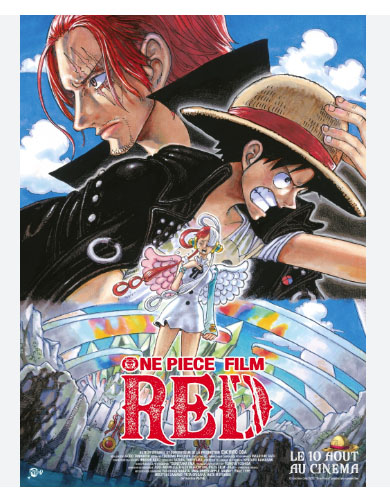
One Piece Film: Red
Synopsis
During a massive music festival on the island of Elegia, the Straw Hat Pirates join a wildly ecstatic crowd to witness the first-ever live public performance of Uta, the world's most beloved pop diva whose identity has always been shrouded in mystery. As Luffy and his crew get closer to the stage, a shocking revelation rocks the arena: Uta is actually the estranged biological daughter of Red-Haired Shanks, one of the most powerful pirate emperors in the world. However, Uta's enchanting melodies conceal a radical utopian dream to trap humanity within an eternal, painless dream world governed by her music. Luffy and his crew must team up with rival pirates and marine forces to shatter her illusion and save the world from eternal slumber.
The Making of the Film
Produced to celebrate the 25th anniversary of Eiichiro Oda's legendary manga franchise, this musical fantasy adventure was directed by Gorō Taniguchi. Franchise creator Eiichiro Oda served as executive producer, taking an active role in designing characters, overseeing the script, and ensuring the emotional stakes honored the core lore. The filmmakers wanted to center the narrative around music, collaborating with Japanese superstar singer Ado to provide Uta's powerhouse vocal performances. Production utilized a seamless blend of traditional hand-drawn animation and cutting-edge digital CGI during explosive musical concert sequences. The project aimed to deliver both high-octane action and a deeply emotional father-daughter drama.
Critical Reception
Critical Reception
Critics praised the film for its dazzling visual spectacle, electrifying musical numbers, and surprisingly emotional exploration of trauma and utopian escapism. Reviewers highlighted how Ado's soaring vocal performances elevated every battle and emotional beat, creating a unique cinematic concert experience. The integration of beloved franchise characters alongside fresh mythology received widespread acclaim from anime critics. Many commentators noted that the climax delivered satisfying action choreography.
Audiences flooded theaters worldwide, driving the film to historic box office heights and making it the highest-grossing film in the entire One Piece franchise history. Fans celebrated the emotional closure and rare canonical insights into the mysterious past of Red-Haired Shanks. Social media platforms were dominated by covers of Uta's songs and passionate debates regarding the film's philosophical themes. Viewers praised the breathtaking animation quality during the finale.
While traditional western award circuits rarely recognize anime features, the film swept numerous Japanese box office milestones and animation industry accolades. It earned multiple Japan Academy Film Prize nominations, including categories for animation and popular music achievements. Critics' circles commended its bold decision to structure a shonen action film around a musical narrative framework. Industry analysts celebrated its monumental global box office triumph.
Behind-the-Scenes Stories
Eiichiro Oda personally requested director Gorō Taniguchi because they had previously collaborated on the very first One Piece animated special back in 1998, bringing their creative partnership full circle. Oda spent months designing Uta's elaborate punk-rock pirate wardrobe and writing background notes on her tragic childhood history with Shanks. The sound production team recorded Ado's vocals in isolated studio sessions before finalizing the matching animation frames to capture raw vocal intensity.
Production faced massive logistical hurdles coordinating simultaneous theatrical rollouts across dozens of international territories while maintaining strict secrecy regarding plot twists. Animators worked around the clock to hand-draw the surreal, neon-soaked dream dimensions governed by Uta's sheet music powers. Voice actors recorded their emotional confrontation scenes with tears in their eyes, deeply moved by the heavy family drama. The music composition team blended symphonic orchestral arrangements with modern electronic J-pop.
During a recording studio session, singer Ado pushed her vocal cords to such extreme limits during a high-register battle anthem that the audio engineers had to recalibrate mixing boards to prevent distortion. The prop department created replica musical staff microphones for promotional fan events worldwide. Character designers iterated dozens of times on Uta's multi-colored hair styling.
Kaori Nazuka provided Uta's speaking voice with delicate emotional vulnerability, while Ado handled the explosive singing voice. Veteran voice actor Shūichi Ikeda returned with immense gravitas to voice Red-Haired Shanks. Mayumi Tanaka anchored the film with her iconic, energetic portrayal of Monkey D. Luffy.
Themes Explored
Themes Explored
The dangerous allure of escapism and creating a comforting illusion to escape a cruel, war-torn reality form the central philosophical conflict of the story. Father-daughter estrangement, forgiveness, and the heavy burden of past abandonment are examined through Shanks and Uta's tragic history. The therapeutic and unifying power of music versus its potential mind-control weaponization is highlighted throughout the festival. Additionally, the clash between individual freedom and forced utopian safety defines the climax.
Ending Explained
In the climactic multi-dimensional battle, Luffy and Red-Haired Shanks synchronize their attacks from both the real world and the dream realm to break Tot Musica's demonic control over Uta. Recognizing that her dream has brought harm rather than salvation, Uta consumes a waking antidote and sings one final, life-saving melody to release everyone from the sleeping trance. As the dream world collapses, Uta peacefully passes away in her father's arms surrounded by music and reconciliation. The touching conclusion shows the Straw Hat Pirates sailing away as the world heals from the trauma.
Meaning of the Title
Meaning of the Title
Refers to both the title character Uta (whose name translates to "song" in Japanese) and her infamous father's pirate moniker, Red.-Haired Shanks.
Original Soundtrack
Original Soundtrack
A monumental J-pop masterpiece featuring seven distinct vocal tracks performed by global phenomenon Ado, blending operatic vocals, rock anthems, and emotional ballads.
Similar Films
Similar Films
Dragon Ball Super: Super Hero, Jujutsu Kaisen 0, Demon Slayer: Kimetsu no Yaiba – The Movie: Mugen Train, Belle, Weathering With You.