

 Français
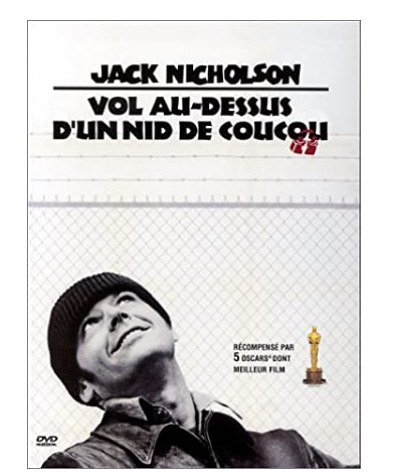
One Flew Over the Cuckoo's Nest
Synopsis
Randle McMurphy, a rebellious criminal, fakes insanity to escape a prison sentence and is sent to a mental institution. There he clashes with Nurse Ratched, the cold and controlling head of the ward. McMurphy encourages the other patients to stand up for themselves and rediscover their dignity. His defiance brings hope but also a high price.
The Making of the Film
The film is based on the 1962 novel by Ken Kesey, who had worked as an aide in a psychiatric hospital and had participated in experimental drug studies. The book was adapted into a successful stage play by Dale Wasserman in 1963, starring Kirk Douglas. Douglas held the film rights for years but was unable to get the project made, and eventually passed it to his son Michael Douglas, who produced it with Saul Zaentz. Czech director Milos Forman, who had fled communist Czechoslovakia, was chosen to direct. Jack Nicholson was cast as McMurphy, and Louise Fletcher as Nurse Ratched. The film was shot in 1974 at the Oregon State Hospital in Salem, using real staff and patients as extras. It was released in 1975 and became a cultural landmark.
Reviews and reception
Summary of professional reviews
Critics hailed the film as a masterpiece, praising the performances, the direction and the powerful mix of comedy and tragedy. Nicholson and Fletcher received particular acclaim. The film was seen as a bold critique of institutional authority.
Audience reception
The film was a huge success, earning about 109 million dollars worldwide on a budget of around 4 million. Audiences were deeply moved by the story and the characters. Over the decades, it has maintained its reputation as one of the greatest American films. The character of Nurse Ratched has become an icon of villainy.
Awards and nominations
The film won the five major Academy Awards: Best Picture, Best Director, Best Actor, Best Actress and Best Adapted Screenplay. It was only the second film in history to do so, after It Happened One Night. It also won several Golden Globes and BAFTA Awards. Its sweep of the Oscars cemented its place in cinema history.
Filming anecdotes
Director's inspirations
Forman, who had grown up under authoritarian regimes, saw in the story a metaphor for oppression and the struggle for freedom. He insisted on a documentary-like realism and spent time with the real patients. The film's blend of humor and tragedy reflects his own view of life.
Production difficulties
Filming in a working psychiatric hospital required careful coordination with the staff. Forman asked the actors to live among the patients before shooting to understand their world. The cast bonded closely, which gave the scenes a naturalistic feel.
Anecdote about a particular scene
The scene in which McMurphy tries to lift a heavy hydrotherapy console to escape and fails, saying that at least he tried, is one of the film's most memorable moments. The Chief later succeeds in lifting it at the end. Another unforgettable sequence is the fishing trip, which shows the patients experiencing freedom.
Original casting plans
Several actors were considered for the role of McMurphy before Jack Nicholson was chosen, including Marlon Brando and Burt Reynolds. The part of Nurse Ratched was offered to several actresses, and Louise Fletcher won it after many others turned it down.
Themes explored
The film is about the clash between individual freedom and institutional control. It questions how society defines sanity and who has the right to decide. Nurse Ratched represents authority that crushes the spirit through rules and fear. The story also explores friendship and the awakening of dignity among the patients. Rebellion and sacrifice are central, as McMurphy pays a heavy price for challenging the system. It is both a comedy and a deeply moving tragedy.
Ending explained
After McMurphy's attempt to escape fails, he attacks Nurse Ratched and is subjected to a lobotomy. When he returns to the ward, he is a shell of himself. Chief Bromden, who cannot bear to see his friend in this condition, smothers him with a pillow in an act of mercy. He then lifts the hydrotherapy console and throws it through a window to escape. The ending suggests that McMurphy's spirit lives on in the Chief and the other patients.
Meaning of the title
The title comes from a children's rhyme about birds flying over a nest, which is used in the novel. The cuckoo's nest is slang for a mental institution, since cuckoo means crazy. The person who flew over is the one who escapes. The phrase carries both a playful tone and a dark meaning.
Original Soundtrack
Jack Nitzsche composed the score, which uses unusual instruments such as the musical saw and the singing glass to create an eerie, haunting atmosphere. The delicate, strange sounds reflect the fragile state of the patients. The music is subtle but memorable.
News
The story returned in 2020 with the television series Ratched, which imagined the early life of Nurse Ratched. The original film remains regularly rediscovered and studied.
Similar Films
- Girl, Interrupted (1999): a young woman in a psychiatric hospital.
- Shutter Island (2010): a thriller set in a psychiatric institution.
- A Clockwork Orange (1971): a story about free will and state control.
- Rain Man (1988): a story about mental difference and family.
- Awakenings (1990): a doctor and patients in a hospital.