

 Français
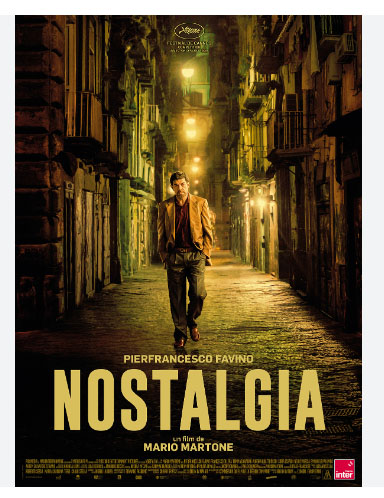
Nostalgia
Synopsis
After spending forty years living abroad in Lebanon and Egypt, Felice returns to his native city of Naples. He walks through the labyrinthine, sun-drenched alleys of the Rione Sanità district, rediscovering the sights, sounds, and ghosts of his youth. As he reconnects with his aging mother and encounters a charismatic local priest fighting against organized crime, suppressed memories of his past begin to resurface. However, Felice's return is not merely a nostalgic journey; it is shadowed by a dangerous youthful secret involving a former friend turned powerful mob boss. He must confront the choices that defined his life before time runs out.
The Making of the Film
Directed by acclaimed Italian filmmaker Mario Martone and adapted from the bestselling novel by Ermanno Rea, this gripping drama was conceived as a profound meditation on memory, home, and urban identity. Martone wanted to capture the pulsating, chaotic soul of Naples through intimate camera work that treats the ancient city as a living character. The script was developed in close collaboration with the author before his passing, focusing heavily on the weight of unspoken history. Principal photography took place entirely on location in the historic Rione Sanità neighborhood, utilizing local residents and narrow alleyways to ensure absolute authentic atmosphere.
Critical Reception
Critical Reception
Critics hailed the film as a masterclass in atmospheric filmmaking, praising its profound emotional resonance, haunting sense of place, and Pierfrancesco Favino's stellar lead performance. Reviewers highlighted how Mario Martone transformed a simple homecoming story into a rich, suspenseful exploration of guilt, memory, and criminal underworlds. The authentic depiction of Naples received widespread international acclaim at major European film festivals. Many commentators noted the film's poetic pacing and visual elegance.
Audiences across Italy and international art-house circuits embraced the film's emotional depth, praising its refusal to rely on cheap mob movie clichés in favor of psychological introspection. Viewers were deeply moved by the tragic exploration of lost time and the inescapable pull of one's roots. Fan communities and literary enthusiasts praised the faithful yet cinematic adaptation of Ermanno Rea's source material. The gripping climax left strong lasting impressions on festivalgoers.
At the Cannes Film Festival, the film competed for the prestigious Palme d'Or to widespread critical applause. It went on to dominate the David di Donatello awards, earning numerous wins and nominations including Best Actor, Best Director, and Best Adapted Screenplay. Italy officially selected the film as its entry for Best International Feature Film at the Academy Awards. Critics' circles worldwide celebrated it as a crowning achievement in contemporary European cinema.
Behind-the-Scenes Stories
Mario Martone was deeply haunted by Ermanno Rea's novel for years before securing the rights, feeling that the story mirrored his own complex relationship with his native Naples. He chose to shoot chronologically where possible to help Pierfrancesco Favino physically and emotionally embody a man walking through ghost towns of his own past. The director spent months walking the winding streets of Rione Sanità to find hidden courtyards that had changed little over decades.
Production faced unique logistical hurdles filming in extremely narrow, congested Neapolitan alleyways where heavy film equipment had to be hand-carried up countless flights of stairs. Local residents embraced the production, often providing authentic regional food and advice to the cast and crew. Pierfrancesco Favino underwent intensive physical transformation and learned fluent Arabic dialects to reflect his character's decades spent living abroad in the Middle East. Natural sunlight dictated the mood of nearly every outdoor scene.
During the filming of a tense alleyway reunion between Felice and his former mob boss friend, local neighborhood children accidentally wandered into the background shouting friendly greetings, forcing a charming retake. The art department restored decaying vintage storefronts with authentic 1970s signage to enhance flashback memories. Sound designers layered distant church bells and bustling street noise to create a deeply immersive Neapolitan soundscape.
Casting Pierfrancesco Favino was an absolute priority for Martone, knowing Favino possessed the immense emotional gravity required to anchor the film's quiet silences. Francesco Di Leva brought fierce moral conviction to the role of the courageous local priest fighting the Camorra. Tommaso Ragno delivered a terrifyingly subtle performance as the childhood friend trapped in a life of crime.
Themes Explored
Themes Explored
The inescapable pull of one's hometown and the complex nature of nostalgia are explored as Felice realizes that the past can never truly be recaptured. Guilt, redemption, and the ghosts of youthful choices form the moral backbone of the narrative. The struggle between civil decency and the oppressive shadow of organized crime in southern Italy is highlighted through the priest's quiet crusade. Additionally, identity and cultural displacement after decades of living in foreign lands shape the protagonist's internal journey.
Ending Explained
In a tragic and inevitable climax, Felice meets his estranged childhood friend turned mob boss in a secluded courtyard to settle their unresolved past. Rather than backing down, Felice accepts his fate, refusing to run away from his Neapolitan roots a second time, resulting in a sudden and fatal knife attack. His death cements his permanent return to the soil he fled forty years prior. The haunting final shots revisit the quiet alleys of Naples, showing that the city endures eternally indifferent to individual tragedies.
Meaning of the Title
Meaning of the Title
Derived from the Greek words nostos (homecoming) and algos (pain), perfectly capturing the agonizing ache of longing for a past and place that no longer exists.
Similar Films
Similar Films
Great Beauty, The Hand of God, Gomorrah, Cinema Paradiso, Il Postino.