

 Français
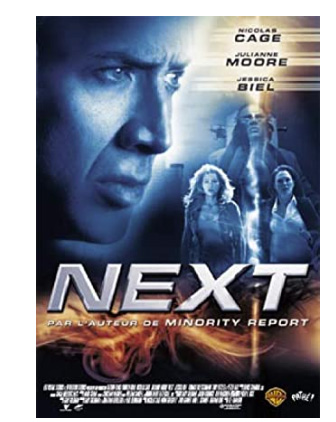
Next
Synopsis
Cris Johnson is a Las Vegas magician who possesses an extraordinary ability: he can see a few minutes into his own future. Living under an assumed identity, he tries to avoid the attention of government agencies interested in exploiting his gift. When FBI agent Callie Ferris discovers his abilities, she wants him to help prevent a devastating terrorist attack involving a nuclear weapon. At the same time, Cris becomes increasingly interested in a woman named Liz, whose presence appears to alter his visions of the future. He must use his unusual talent to navigate an increasingly dangerous situation where every decision can change what happens next.
The The Making of the Film
The film is loosely inspired by Philip K. Dick's 1954 short story The Golden Man. The original literary work explores a mutant whose ability to anticipate the future makes him extremely difficult to capture. Screenwriter Gary Goldman adapted the central idea into a contemporary action thriller built around a protagonist who can see several minutes ahead. The screenplay was subsequently developed with the participation of Jonathan Hensleigh and Paul Bernbaum. The filmmakers expanded the original premise by introducing a nuclear terrorist threat and a romantic storyline. Director Lee Tamahori was attracted by the possibility of combining science-fiction concepts with fast-paced action and suspense. Nicolas Cage was selected to play Cris Johnson, bringing his characteristic intensity to a character whose apparent eccentricity hides an extraordinary ability. Jessica Biel and Julianne Moore joined the production as the romantic interest and FBI agent respectively. The project ultimately transformed a relatively compact science-fiction idea into a Hollywood thriller about choice, probability and the uncertainty of the future.
Critical Reception and Audience Response
Professional Critical Reviews: The film received generally mixed to negative reviews from professional critics. Some reviewers appreciated its central science-fiction concept and the visual possibilities created by the ability to see alternative futures. Nicolas Cage's performance was considered entertaining by some viewers but excessively eccentric by others. The pacing and action sequences received a degree of praise, particularly when the film explored the practical consequences of Cris's unusual talent. However, several critics criticised the screenplay for its complicated narrative and its treatment of the original Philip K. Dick story.
Audience Reception: Audience reactions were mixed, with some viewers enjoying the combination of action, science fiction and suspense. The idea of seeing the immediate future proved particularly attractive to fans of speculative cinema. Others were disappointed by the film's abrupt conclusion and the way certain plot developments remained unresolved. Nicolas Cage's performance generated discussion because of its deliberately unusual tone. Despite its divided reception, the film has maintained interest among viewers who enjoy stories involving time, probability and alternate realities.
Awards and Recognition: The production did not achieve major recognition at the principal international film awards ceremonies. Its most notable contribution to popular culture is its adaptation of a Philip K. Dick science-fiction concept for a mainstream action audience. The film attracted attention for its visual effects and its attempts to represent branching possibilities within a short period of time. Its original score and technical production also contributed to its identity as a commercial science-fiction thriller.
Behind-the-Scenes Anecdotes
Director's Inspirations: Lee Tamahori approached the project as an opportunity to combine the philosophical ideas of Philip K. Dick with the visual language of a modern action thriller. The director wanted the audience to experience the world through Cris's unusual perception of time. The film uses repeated visual situations and rapidly changing possibilities to communicate the protagonist's ability. Its central concept also draws on familiar questions about free will, destiny and the consequences of individual decisions.
Production Challenges: One of the major challenges involved visualising several possible versions of the same future without confusing the audience. The production relied on editing, camera movement and visual effects to distinguish Cris's visions from events that actually occur. Action sequences also needed to reflect the fact that the protagonist could anticipate danger before it happened. Nicolas Cage had to perform scenes in which his character reacts to events that have not yet occurred from the perspective of other characters. The production therefore required close coordination between the actors, director and editing team.
A Memorable Scene: The casino sequences establish Cris's unusual abilities through his interactions with people and everyday situations. One particularly effective idea is that he can observe several possible outcomes before choosing the action that leads to the result he wants. The action scenes involving gunfire and physical confrontations also demonstrate how his gift gives him an advantage over opponents. The film later uses the same principle on a much larger scale when the threat of a nuclear attack becomes central to the story.
Originally Considered Casting: Nicolas Cage was ultimately chosen to portray Cris Johnson, giving the character a recognisable Hollywood presence. Julianne Moore was cast as FBI agent Callie Ferris, while Jessica Biel played Liz Cooper. Their contrasting performances helped establish the three central dimensions of the story: government intervention, personal relationships and the protagonist's unusual abilities. No alternative casting details should be treated as confirmed without reliable production documentation.
Themes Explored
The film explores the relationship between free will and destiny through a character who can glimpse the immediate future. Cris's ability raises the question of whether knowing what may happen allows someone to change it. The story examines the responsibility that comes with possessing extraordinary knowledge. Love introduces an emotional dimension because Cris discovers that his visions become different when Liz is involved. Government surveillance and national security provide a political context for the conflict. The possibility of a nuclear attack raises questions about the balance between personal freedom and collective safety. The film also explores the psychological burden of living with knowledge that ordinary people cannot possess. Ultimately, it suggests that the future is not necessarily fixed and that individual choices remain important.
Explanation of the Ending
The ending reveals that Cris has been using his ability to explore possible futures rather than simply observing a single predetermined sequence of events. After the apparent catastrophe, the film returns to the moment preceding the final events. This twist indicates that what the audience has witnessed was one possible outcome rather than an unavoidable reality. Cris can therefore use the knowledge gained from that vision to make different choices. His relationship with Liz is also important because it appears to expand his perception of what is possible. The conclusion deliberately leaves the precise future unresolved, suggesting that the characters still have an opportunity to change their fate. Rather than presenting a definitive victory, the film ends by emphasising uncertainty and the power of decisions.
Meaning of the Title
The title Next refers to the immediate future and the next event that is about to happen. It reflects Cris Johnson's unusual ability to anticipate what will occur a few minutes ahead of the present moment. The word also suggests the constant succession of possibilities that he experiences when considering different decisions. For the protagonist, the future is not simply something that arrives unexpectedly but something he can partially observe and influence. The title is therefore closely connected to the film's central questions about time, choice and destiny.
Original Soundtrack
The original score was composed by Mark Isham, a composer known for combining orchestral writing with atmospheric electronic elements. His music helps maintain the tension between Cris's relatively ordinary life and the extraordinary events surrounding him. The soundtrack supports the action sequences while also reinforcing the film's science-fiction atmosphere. Its restrained passages are particularly useful when the narrative explores alternative futures and the protagonist's psychological state. The score is an important part of the film's overall suspenseful identity.
Similar Films
Minority Report (2002): Another Philip K. Dick adaptation exploring the possibility of predicting crimes before they happen.
Paycheck (2003): A science-fiction thriller based on a Philip K. Dick story, involving memory, technology and future knowledge.
Deja Vu (2006): A thriller about investigating past events through an unusual technological perspective.
Source Code (2011): A science-fiction thriller in which a man repeatedly experiences a limited period of time to prevent a catastrophe.
The Adjustment Bureau (2011): A story exploring free will, destiny and the possibility of changing a predetermined future.