

 Français
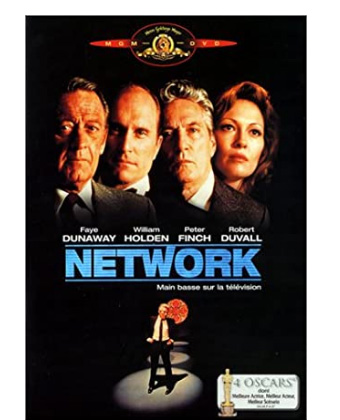
Network
Synopsis
Howard Beale is a veteran television news anchor for UBS who learns he is being fired due to declining ratings and suffers an on-air nervous breakdown, announcing live on television that he plans to commit suicide on his next broadcast. Instead of firing him immediately, the network ratings-hungry programming executive Diana Christensen realizes Beale unhinged rants about corporate decay and societal anger can be exploited for massive commercial profit. Turning Beale into a messianic prophet of the airwaves, the network builds an entire television show around his furious rants until corporate conglomerates and multi-national mergers begin dictating editorial content. As greed and media cynicism escalate, Beale becomes a dangerous commodity whose ultimate elimination is orchestrated for prime-time ratings.
The Making of the Film
Screenwriter Paddy Chayefsky conceived the blistering satirical masterpiece after growing deeply disillusioned with the corporate takeover of television networks and news media. Director Sidney Lumet joined the project to bring fast-paced cinematic realism and theatrical intensity. Metro-Goldwyn-Mayer and United Artists co-financed the high-profile media satire.
Critical Reception
Critics universally acclaimed Network upon its release, praising Paddy Chayefsky razor-sharp, prophetic Oscar-winning screenplay, Sidney Lumet brilliant direction, and powerhouse lead performances by Peter Finch, Faye Dunaway, William Holden, and Robert Duvall. Reviewers lauded the film for predicting the sensationalization of modern television, reality TV, and corporate media control decades before they happened. It is universally celebrated as a masterpiece of American cinema.
Public reception was explosive and phenomenal, turning the satirical drama into a major box-office success and cultural touchstone. Audiences were mesmerized by Howard Beale iconic mad-as-hell window rant. Its cultural footprint is monumental.
The film won four Academy Awards: Best Actor for Peter Finch (awarded posthumously), Best Actress for Faye Dunaway, Best Supporting Actress for Beatrice Straight, and Best Original Screenplay for Paddy Chayefsky. Its critical legacy is untouchable.
Behind-the-Scenes Stories
Director Sidney Lumet drew inspiration from television newsroom culture, corporate media conglomerates, and yellow journalism. He chose authentic New York City television studios and sleek corporate boardrooms to create an elite media atmosphere. His direction pushed Peter Finch to capture manic, righteous fury.
Production went smoothly under Lumet efficient directorial schedule, supported by Chayefsky brilliant dialogue that actors were strictly forbidden from altering. Peter Finch brought terrifying energy to his unhinged news anchor role. Faye Dunaway portrayed the ruthless programming executive with chilling ambition.
A memorable sequence involves Howard Beale stepping in front of his living room window during a torrential downpour to command his viewers to open their windows and shout his immortal catchphrase I mad as hell, and I not going to take this anymore! The scene became one of the most famous moments in cinema history. Finch manic delivery anchored the satire.
The casting process brought together master dramatic actors. Peter Finch was cast as Howard Beale, delivering a legendary performance. Faye Dunaway, William Holden, and Robert Duvall rounded out the powerhouse corporate ensemble.
Themes Explored
The film explores media sensationalism, corporate greed, television exploitation, political cynicism, and loss of humanity. It satirizes how television turns human tragedy into commercial entertainment. Ratings consume morality.
NULL
Meaning of the Title
The title refers directly to the powerful television broadcasting network that consumes its anchors and news staff for commercial ratings and corporate profit. It highlights the institutional antagonist of the satire.
NULL
NULL
Similar Films
Other similar films include Nightcrawler, The Insider, and Ace in the Hole.