

 Français
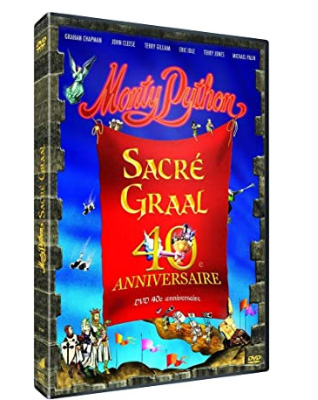
Monty Python and the Holy Grail
Synopsis
King Arthur and his knights set out across medieval England on a quest to find the Holy Grail after a vision from God. Along the way, they face a series of absurd obstacles, including a ferocious Black Knight, a group of knights who demand a shrubbery, a killer rabbit and a bridge of death. Without horses, their servants clap coconut shells together to imitate the sound of hooves. The film is a gleefully silly parody of the Arthurian legend, packed with unforgettable gags.
The Making of the Film
Monty Python and the Holy Grail was the group's first feature film written specifically for the cinema, following the success of their television series Monty Python's Flying Circus. Graham Chapman, John Cleese, Terry Gilliam, Eric Idle, Terry Jones and Michael Palin wrote the screenplay together, drawing on their love of medieval history and Arthurian legend. The film was financed with an unusually modest budget, which came partly from rock bands such as Pink Floyd, Led Zeppelin and Genesis, and from other private investors. Terry Gilliam and Terry Jones shared directing duties, with Gilliam handling the visual style and Jones working with the actors. It was released in 1975.
Reviews and Reception
Summary of Professional Reviews
Critics responded positively, praising the film's anarchic humor, its clever parody of the Middle Ages and its energy. Many saw it as a fresh and fearless comedy that broke the rules of cinema. Over time, it has been recognized as one of the greatest comedies ever made.
Audience Reception
The film became a huge cult success, with fans able to recite entire scenes by heart. Its sketches, such as the Black Knight fight and the Knights Who Say Ni, have been quoted and imitated for decades. It remains a staple of comedy fans around the world.
Filming Anecdotes
Director's Inspirations
The Pythons wanted to subvert the grand tradition of medieval epics by showing the dirt, poverty and absurdity of the period. They used parody, surreal humor and historical references to create a world where nothing is as noble as it seems.
Production Difficulties
The film was shot on a shoestring budget, which forced the team to be inventive. Because they could not afford real horses, they used coconut shells to imitate the sound of hooves, a joke that became one of the film's most famous gags. Authorities withdrew permission to film in several Scottish castles shortly before shooting, so much of the film was shot at Doune Castle, which was used for multiple locations.
Anecdote About a Particular Scene
The Black Knight scene, in which a knight keeps fighting after losing his limbs, is one of the film's most celebrated moments. The sequence plays with the idea of absurd, unstoppable stubbornness and has become one of the most quoted comedy scenes ever filmed.
Themes Explored
Monty Python and the Holy Grail is a satire of heroism, authority and the myths of the Middle Ages. It mocks the idea of noble quests by turning them into a series of ridiculous encounters. The film also pokes fun at social hierarchy, as peasants challenge the king's authority in an early scene. Surreal humor and absurd logic run throughout, undermining the conventions of storytelling. At its heart, it is a celebration of silliness as a form of freedom.
Ending Explained
Just as Arthur and his knights are about to confront the guardians of the Holy Grail, the police arrive and arrest them in a sudden, anachronistic twist. The film then ends abruptly, as the camera is smashed and the credits stop. The unexpected finale is a final joke at the expense of the conventions of cinema and the epic quest. It leaves the Grail forever out of reach.
Meaning of the Title
The title refers to the Holy Grail, the legendary cup said to have been used at the Last Supper, which is the object of the knights' quest in the legend of King Arthur. By attaching the name of the comedy group to this sacred object, the title announces that the story is going to be irreverent. In French, the film was released as Monty Python, sacré Graal, a pun that keeps the playful spirit.
Original Soundtrack
The film features comic songs such as "Knights of the Round Table" and the cowardly "Brave Sir Robin" sequence, composed with the help of Neil Innes. The music is closely tied to the film's humor and has become a favorite of fans. It adds to the film's mockery of medieval pageantry.
News
The film inspired a hugely successful stage musical, Spamalot, created by Eric Idle with music by John Du Prez and Idle. It premiered on Broadway in 2005 and won the Tony Award for Best Musical.
Similar Films
- Monty Python's Life of Brian: the group's other classic film.
- The Princess Bride: a witty fairy-tale adventure.
- Blazing Saddles: another landmark parody of a classic genre.
- Time Bandits: a fantasy adventure co-written by Michael Palin and Terry Gilliam.