

 Français
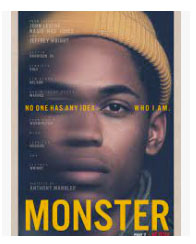
Monster
Synopsis
Note: Alternative English title is Monster. Set in Harlem, a brilliant and sensitive seventeen-year-old honors student and aspiring filmmaker named Steve Harmon finds his bright future abruptly derailed. Accused of acting as a lookout in a botched bodega robbery that ends in murder, Steve is slapped with felony murder charges and faces a potential life sentence. Locked away in a brutal detention center, he uses his camera and notebook to document his terrifying reality and internal trial. As the courtroom battle unfolds, he must fight to prove that he is more than just the prosecution's label. Ultimately, this poignant legal drama explores systemic bias, identity, and survival.
The Making of the Film
Director Anthony Mandler adapted Walter Dean Myers' acclaimed, award-winning young adult novel of the same name to bring a vital social justice story to the screen. The project was conceived as an independent legal drama focusing on systemic racism, presumption of guilt, and adolescent vulnerability. Mandler, renowned for his work in music videos and visual art, drew inspiration from documentary photography, New York street culture, and courtroom archives. The production prioritized intimate subjective camera work, gritty urban aesthetics, and powerful ensemble performances.
Critical Reception
Critics offered generally favorable reviews upon release, praising its vital social message, unique visual style, and stellar lead performances. Reviewers noted that Kelvin Harrison Jr. delivered a deeply vulnerable and nuanced portrayal of a terrified teenager caught in a broken legal system. Some film critics, however, felt that the non-linear editing style occasionally distracted from the courtroom narrative tension. Despite minor stylistic critiques, viewers and civil rights advocates embraced its powerful human core.
Audiences deeply resonated with the emotional honesty, poignant exploration of systemic bias, and the exceptional acting ensemble. Viewers on streaming platforms commended Jennifer Hudson and Jeffrey Wright for their heartbreaking portrayals of supportive parents. It found a welcoming audience among fans of legal dramas and social justice cinema. Many praised its courage in exposing how young Black men are frequently demonized and prejudged in America.
Although major mainstream theatrical awards bypassed the streaming release, it earned recognition at several specialized film festivals and civil rights advocacy organizations. Its acclaim centered primarily on Kelvin Harrison Jr.'s standout lead performance and the film's poignant exploration of identity. The screenplay received praise from dramatic writing guilds for its faithful adaptation of a beloved novel. These accolades helped establish its reputation as a significant contemporary social drama.
Behind-the-Scenes Stories
Anthony Mandler was heavily inspired by Walter Dean Myers' groundbreaking novel, having grown up reading it as a defining text on urban American youth. He wanted to use subjective camera framing and film-within-a-film techniques to reflect how Steve Harmon processes his trauma through a lens. The visual style utilized grainy 16mm film aesthetics, stark courtroom lighting, and intimate close-ups of Steve's sketching and filming. The director also worked closely with legal advisors to ensure courtroom realism.
Shooting on location across authentic urban neighborhoods in New York City presented grounding real-world texture for the independent production. The crew designed the jail and courtroom sets to feel oppressive and inescapable, mirroring Steve's internal confinement. Kelvin Harrison Jr. spent weeks meeting with young men affected by the criminal justice system to prepare for his demanding role. Despite the heavy emotional weight of the subject matter, the cast and crew maintained a deeply respectful and collaborative environment.
During the filming of the intense emotional courtroom verdict sequences, Kelvin Harrison Jr. brought heartbreaking vulnerability to his character's silent terror. Jeffrey Wright and Jennifer Hudson shared profound off-screen warmth that translated into believable, protective parental chemistry. Crew members reported feeling moved to tears behind the monitors during pivotal family visiting room scenes. The profound focus of the actors gave the indie drama its unforgettable emotional resonance.
Casting directors searched for an elite young actor who could project both artistic sensitivity and silent terror under pressure. Kelvin Harrison Jr. was secured for the lead role of Steve Harmon, delivering a career-best performance. Jeffrey Wright and Jennifer Hudson were cast as his devoted parents. The supporting cast featuring John David Washington, Jharrel Jerome, and A$AP Rocky added stellar cultural authenticity.
Themes Explored
The film heavily explores systemic racism, the presumption of guilt, and the devastating flaws of the American criminal justice system. It examines how Black youth are systematically dehumanized and labeled as monsters by society. Another core motif is the power of art, filmmaking, and storytelling as a psychological survival tool. It also touches upon family devotion, fear, and identity preservation.
Ending Explained
The film concludes with the jury returning a split verdict, acquitting Steve Harmon of the murder charges and allowing him to return home to his family. Standing in his old bedroom holding his camera, Steve looks into the mirror, haunted by the experience and struggling to recognize the person looking back. The final lingering close-up captures his silent, unresolved search for his true identity. This sobering finish refuses a neat Hollywood wrapper, emphasizing that the trauma of the trial leaves permanent scars.
Meaning of the Title
The title refers directly to the dehumanizing label weaponized by the prosecutor against a teenage boy during a murder trial. It highlights the central social critique of how the legal system demonizes Black youth by stripping away their humanity. The provocative single-word phrasing sets an urgent, accusatory tone for the social drama. It encapsulates the core battle fought by the protagonist to prove he is a human being, not a monster.
Similar films include Just Mercy, The Hate U Give, When They See Us, and Brian Banks, which feature wrongful convictions, systemic racism, and legal dramas.