

 Français
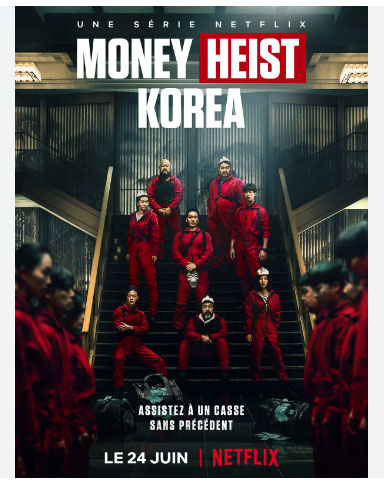
Money Heist: Korea - Joint Economic Area
Synopsis
In a near-future Korean Peninsula on the brink of peaceful reunification, a joint economic zone establishes a stable unified currency to bridge decades of division. However, amid soaring wealth inequality that benefits only the ultra-rich, a mysterious criminal mastermind known only as "The Professor" recruits a crew of elite thieves from both North and South. Their audacious goal: infiltrate the mint of the joint economic zone and print four trillion won in untraceable cash. As they take civilian hostages inside the facility, police forces from both sides must cooperate to neutralize the heist before time runs out.
The Making of the Film
Adapted from the globally massive Spanish television phenomenon La Casa de Papel, this Korean remake was developed by writer Ryu Yong-jae and directed by Kim Hong-sun. The creative team sought to ground the high-concept heist thriller within the unique geopolitical reality and tense inter-Korean history of the peninsula. Setting the story against the backdrop of a fictional peaceful reunification added a fascinating layer of cultural friction among characters from the North and South. Production utilized massive, highly detailed soundstages in South Korea to construct a multi-level mint replica. The directors emphasized psychological tension and martial arts combat to distinguish the rhythm of the adaptation from the original series.
Critical Reception
Critical Reception
Critics praised the series for its clever geopolitical reframing, high-octane action sequences, and stellar ensemble cast portraying iconic characters with fresh cultural nuances. Reviewers highlighted how seamlessly the script integrated inter-Korean tensions into the classic hostage-heist formula. The visual design of the modified Hahoe masks and red uniforms received widespread acclaim for honoring the original while establishing a distinct Korean identity. Many commentators lauded the tight pacing of the first half.
Audiences embraced the high-stakes thriller upon its Netflix release, driving it to the top of global streaming charts within days. Fans of the original Spanish series were particularly fascinated by how North and South Korean dynamics altered character loyalties and interpersonal conflicts. Viewers praised the magnetic performances of Yoo Ji-tae as The Professor and Jeon Jong-seo as Tokyo. Fan communities engaged in intense debates comparing tactical choices between the two versions.
While streaming series rarely compete in traditional cinematic award circuits, the show earned multiple nominations at Asian content awards for directing, visual effects, and lead acting performances. Critics' circles commended its ambitious production scale and slick cinematography. Industry analysts noted its success as further proof of the global appeal of Korean serial dramas. It cemented the enduring versatility of the original narrative framework in foreign adaptations.
Behind-the-Scenes Stories
Director Kim Hong-sun spent months collaborating with writer Ryu Yong-jae to ensure the political subtext regarding Korean reunification felt respectful, nuanced, and gripping. The choice of the traditional Hahoe mask from Andong was selected over the Salvador Dalí mask to symbolize historical Korean resistance against oppression and class inequality. The crew consulted with tactical advisors to ensure all military standoffs and police negotiations looked authentically professional.
Production faced massive logistical challenges coordinating large ensemble casts, stunt doubles, and pyrotechnic specialists inside the cavernous mint soundstages. Actors underwent rigorous physical training to handle realistic firearms and close-quarters combat choreography. The art department constructed intricate underground tunnel networks beneath the set to facilitate the thieves' elaborate escape preparations. Extreme summer heat on indoor soundstages required heavy industrial air conditioning.
During the filming of a tense vault standoff, a prop vault door mechanism momentarily jammed with actors trapped inside, leading to a brief humorous lockdown that the crew resolved with professional calm. The sound design team blended traditional Korean percussion instruments with electronic synth basslines to create a unique auditory signature for the heists. Wardrobe designers custom-tailored the red jumpsuits to allow maximum flexibility during action stunts.
Casting Yoo Ji-tae as The Professor brought a calm, intellectual gravity to the mastermind role. Jeon Jong-seo brought fiery, unpredictable energy to Tokyo, reshaping the character for a modern Korean context. Park Hae-soo, fresh off his Squid Game success, was brought in to play the volatile Berlin, adding immediate intensity to the ensemble.
Themes Explored
Themes Explored
Wealth inequality and the corrupting nature of global capitalism form the moral justification driving the thieves to target the mint. Inter-Korean relations, cultural divides, and mutual prejudices between people from the North and South are dismantled as the crew is forced to trust one another. The illusion of institutional security and government hypocrisy are exposed when the printing press starts rolling. Additionally, systemic corruption versus individual survival highlights the grey morality defining every character.
Ending Explained
The meticulously planned heist reaches its breathtaking climax as the thieves successfully tunnel their way out of the mint with billions in printed cash, leaving police baffled. Internal betrayals and military intervention threaten their escape at the final hour, but clever contingencies orchestrated by The Professor ensure the core crew members slip away. Dispersing across various borders under new identities, the survivors achieve their dream of financial freedom. The final sequences hint that while the immediate heist is over, the geopolitical fallout has only just begun.
Meaning of the Title
Meaning of the Title
A direct adaptation of the global title combined with the specific geopolitical concept of a unified economic zone between North and South Korea.
Similar Films
Similar Films
Money Heist, Ocean's Eleven, Inside Man, The Bank Job, The Negotiation.