

 Français
Money Heist
Synopsis
A mysterious man known as the Professor assembles a group of eight thieves, each known by the name of a city, for the most ambitious heist ever planned: breaking into the Royal Mint of Spain. Instead of stealing existing money, they plan to print their own, holding hostages inside as the police wait outside. As the days pass, tensions rise among the robbers, the hostages and the authorities. The series becomes a gripping duel of intelligence, nerve and loyalty.
The Making of the Film
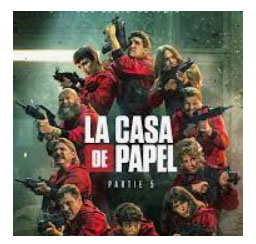
Money Heist, originally titled La Casa de Papel, was created by Alex Pina and first aired on the Spanish channel Antena 3 in 2017. Pina wanted to reinvent the heist genre by turning it into a long-running drama rather than a single film. The idea of robbing a mint rather than a bank gave the story a clever twist, since the thieves would be printing money rather than stealing it. Netflix acquired the series for international distribution, re-edited the episodes and gave it a new life as a global hit. The cast included Ursula Corberó as Tokyo, Alvaro Morte as the Professor, Pedro Alonso as Berlin and Itziar Ituno as Raquel. The use of Salvador Dali masks and red jumpsuits gave the robbers a striking visual identity. Later seasons were produced directly by Netflix, with larger budgets and more complex action. The story concluded with a fifth season released in 2021.
Critical Reception
Critics praised the series for its inventive plot, its gripping pace and its charismatic characters. Many noted that it brought a sense of fun and emotion to a genre that can be cold and mechanical. Some reviewers felt that later seasons strained credibility and that the story sometimes relied on excessive twists. Even so, most agreed that the series was one of the most entertaining crime dramas of its time.
Audiences around the world embraced the show, which became one of the most watched non-English series on Netflix. Its characters, its catchphrases and the Dali masks became a part of popular culture, with fans dressing up as the robbers. The song Bella Ciao, used in the series, became a hit and a protest anthem in many countries.
The series won the International Emmy Award for Best Drama Series in 2018, an early sign of its international reach. It also received several Spanish and international nominations.
Behind-the-Scenes Stories
Pina has said that he wanted a heist where the thieves were not simply criminals but also rebels, a group the audience could sympathise with. The mix of crime, romance and politics gave the series its distinctive tone.
Because the series was shot over several years and in multiple countries, the production grew rapidly in scale. Later seasons required elaborate action scenes and international locations, from Panama to Thailand. Keeping a large cast and complicated plot lines coherent became a major challenge for the writers.
The use of Bella Ciao was inspired by the Italian resistance song, which the Professor teaches to his accomplice. Its repeated use in key scenes turned it into a symbol of the show and helped it spread around the world.
Themes Explored
The series explores rebellion against authority, the meaning of loyalty and the tension between love and strategy. It portrays the robbers as outsiders who fight the system, which makes it easy for viewers to identify with them. Family, trust and betrayal are essential, as the group is held together by emotional bonds as much as by planning. The show also considers the power of the media and public opinion. Beneath the action, it asks what justice really means in an unequal society.
Ending Explained
In the final season, the robbers carry out a risky operation to steal gold from the Bank of Spain. Tokyo sacrifices herself to make the plan work, and the group manages to escape with the treasure. The Professor is eventually reunited with Raquel, and the surviving members of the crew start new lives far from Spain. The closing scenes show them enjoying a hard-won freedom. The ending emphasises that the real victory was not only the heist but the family they built.
Meaning of the Title
La Casa de Papel literally means The House of Paper, a reference to the Royal Mint where the paper money is made. It also suggests something fragile, a house of cards that could collapse at any time. The English title Money Heist is more direct and describes the genre, while the Spanish original has a more poetic and symbolic tone. Both versions point to the central idea of a robbery built around money itself.
Original Soundtrack
The music is one of the series' most memorable elements. The version of Bella Ciao used in the show became a hit in many countries, played at parties and protests alike. The opening theme, My Life Is Going On by Cecilia Krull, also became closely associated with the series. The soundtrack mixes tension, melancholy and a rebellious spirit that fits the characters perfectly.
Latest News
The universe of the series continued with Berlin, a spin-off devoted to the charming thief played by Pedro Alonso, which premiered in 2023 and returned for a second season. A South Korean remake, Money Heist: Korea, was also released in 2022.
Similar Films
If you enjoyed Money Heist, try Ocean's Eleven, the stylish classic of group heists. Lupin is a French series about a modern gentleman thief. Prison Break offers another elaborate escape plan with a mastermind at the centre. Narcos tells the story of crime and power with a similar taste for drama. For another Spanish series with a young and rebellious spirit, you could also try Elite.