

 Français
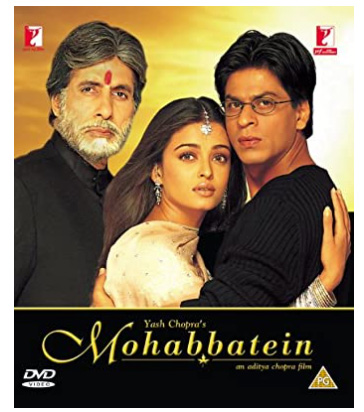
Mohabbatein
Synopsis
At Gurukul, an elite Indian boarding school, the stern headmaster Narayan Shankar rules his students with an iron hand and forbids anything that has to do with love. When the charismatic music teacher Raj Aryan arrives, he quietly challenges this regime by encouraging the young men of the school to follow their hearts. The students' secret romances and the teacher's mysterious past slowly reveal the painful history that lies behind the headmaster's rigid beliefs. What begins as a battle of wills between two stubborn men becomes a confrontation between fear and love.
The Making of the Film
Mohabbatein was the second film directed by Aditya Chopra, who had become one of Indian cinema's most celebrated young directors with Dilwale Dulhania Le Jayenge in 1995. Chopra had actually begun writing the story of Mohabbatein before that first film, but he felt that its subject was too mature for a debut and decided to start with a love story instead. After the release of Dil To Pagal Hai, in which he had also been involved as a writer, he returned to the project. Initially he had thought of the story as a thriller, but over time it evolved into a musical romantic drama about the clash between tradition and love. The film was produced by his father, Yash Chopra, under the banner of Yash Raj Films, which was already one of the most important production companies in Bollywood. It brought together Amitabh Bachchan and Shah Rukh Khan, two of the biggest stars in the country, in a confrontation between two generations. The story is often compared to school dramas such as Dead Poets Society, in which a charismatic teacher inspires his pupils to think for themselves. The film was released in October 2000 and ran for more than three and a half hours, in the grand tradition of Hindi cinema.
Critical Reception
Critics welcomed Mohabbatein as a lavish and emotional entertainment, though opinions were divided on its length and its melodrama. Many praised the confrontation between Amitabh Bachchan, as the austere headmaster, and Shah Rukh Khan, as the romantic music teacher, which they saw as the film's greatest strength. The gorgeous production design and the elaborate musical numbers were also frequently commended. Some reviewers considered the story predictable and felt that the film's pace slackened in its long second half. Others noted that the film was a loving tribute to the traditions of Hindi romance.
Audiences embraced the film warmly, in India and among the diaspora abroad. It became one of the biggest hits of 2000, particularly strong in overseas markets, and has since become a favourite of Bollywood fans. Its songs and its portrait of young love have kept it alive in popular memory, and many viewers consider it a nostalgic classic of the early 2000s. The success of the film also cemented the reputation of Yash Raj Films as a major force in Hindi cinema.
At the 46th Filmfare Awards, Mohabbatein received twelve nominations, including Best Film, Best Director for Aditya Chopra, Best Actor for Shah Rukh Khan and Best Supporting Actress for Aishwarya Rai. It won four awards, including Best Supporting Actor for Amitabh Bachchan and the Critics Award for Best Actor for Shah Rukh Khan. The film also took home several other honours, including four International Indian Film Academy Awards, three Bollywood Movie Awards, one Screen Award and two Zee Cine Awards. Together, these prizes confirm the film's status as one of the most celebrated Bollywood productions of its year.
Filming anecdotes
Aditya Chopra wanted the six young actors who play the students to be new faces, and he and his assistants travelled across India to find five of them. His brother Uday Chopra, who wanted to make his acting debut, was cast as one of the students. The other newcomers included Shamita Shetty, Jugal Hansraj, Kim Sharma, Jimmy Sheirgill and Preeti Jhangiani. Chopra has said that he wanted the cast to understand every detail of the script as he had conceived it, which is why he chose to work with fresh faces. The film was the first time that Amitabh Bachchan and Shah Rukh Khan shared the screen in a major role, which created huge anticipation among audiences.
Themes explored
At its heart, Mohabbatein is a story about the power of love and the damage caused by fear. The headmaster Narayan Shankar believes that discipline, tradition and excellence are the only values that matter, and he sees love as a threat to order. Raj Aryan, by contrast, argues that love is the strongest force in life, and he teaches his students to embrace it. The film explores the generational conflict between old ideas of authority and the desire of young people to express their feelings. Grief is another important theme, since the headmaster's severity is rooted in a personal tragedy involving his daughter Megha. Music is used as a language of emotion and a means to reach hearts that rigid rules have closed. The story also celebrates friendship among the students, who support one another as they face their parents' expectations. In the end, it presents love as a form of courage and a source of healing.
Ending explained
In the film's final stretch, the conflict between Narayan Shankar and Raj Aryan reaches its peak, as both men are forced to confront the history that binds them. The truth about Megha, the headmaster's daughter and Raj's lost love, comes to light and explains why Shankar has built such a rigid world around himself. As the students' romances come into the open, the headmaster is gradually forced to question the principles he has defended for so long. A moment of reconciliation allows him to accept that his fear of love was the real source of his pain. Raj, who has fought for the young couples, also finds a measure of peace. The school's tradition of strict discipline gives way to a more compassionate view of its students. The film ends with the triumph of love over fear, in a celebration that brings the community together. The final scenes combine emotion and music, in true Bollywood style.
Meaning of the title
Mohabbatein is a Hindi and Urdu word that is the plural of mohabbat, meaning love. The title can be translated as Love Stories or Loves, and it suggests that the film is about many forms of romance rather than a single relationship. In the story, it refers to the different couples among the students as well as to the past love between Raj and Megha. The plural also reflects the idea that love comes in many shapes, from romantic passion to the bond between teacher and pupil. The word has a musical quality, which fits the film's use of songs to express emotions. Its soft and sensual sound makes it an ideal title for a romantic drama. In the film's central conflict, the title also serves as a challenge to the headmaster's belief that love is dangerous. By choosing a simple and poetic title, Aditya Chopra put the film's message in a single word.
Original Soundtrack
The soundtrack of Mohabbatein was composed by the duo Jatin and Lalit, with lyrics by the veteran Anand Bakshi, and it became one of the most popular film albums of its year. Songs such as Humko Humise Chura Lo, Aankhein Khuli Ho Ya Ho Band, Soni Soni and Zinda Rehti Hain Mohabbatein were widely loved and remain closely associated with the film. The melodies are lush and romantic, and they carry the story's emotional peaks from first love to heartbreak. Veteran singers such as Lata Mangeshkar and Udit Narayan lent their voices to the most celebrated numbers. The musical sequences were shot on a grand scale, with elaborate choreography and colourful settings. Music is also part of the film's story, since Raj Aryan is a music teacher who uses song to open his students' hearts. The album's success helped make Mohabbatein one of the defining Bollywood musicals of its era.
Similar Films
If you enjoyed Mohabbatein, the first film to see is Dilwale Dulhania Le Jayenge, Aditya Chopra's debut and one of the most beloved romances in Indian cinema. Dil To Pagal Hai, a musical love story with a similar sensibility, is another Yash Raj classic. Kuch Kuch Hota Hai, by Karan Johar, shares the campus setting and the mixture of friendship and romance. Kabhi Khushi Kabhie Gham, with Amitabh Bachchan and Shah Rukh Khan, explores generational conflict within a family. Veer-Zaara is a later Yash Raj epic about love across borders. Dead Poets Society, the American drama about a charismatic teacher and his students, is often cited as an inspiration. To Sir, with Love, from 1967, tells another story of a teacher who changes the lives of his students. Together these films form a rich tradition of romantic and educational dramas.