

 Français
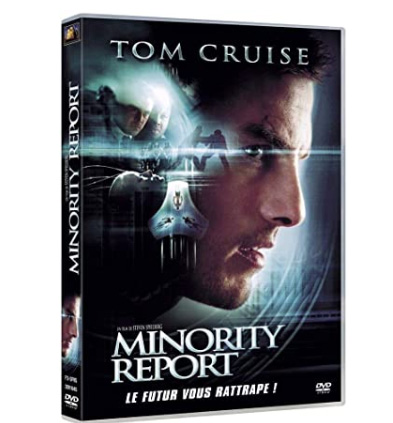
Minority Report
Synopsis
Set in Washington, D.C., in the year 2054, a specialized police unit called PreCrime prevents murders before they happen by utilizing psychic visions generated by three mutant humans known as precogs. The dedicated head officer of PreCrime becomes a fugitive overnight when the system generates a prediction naming him as the future murderer of a man he has never met. Desperate to prove his innocence, he goes on the run while uncovering deep systemic corruption within the infallible crime-prevention program. He must outsmart his own unit before the predicted murder takes place.
The Making of the Film
Director Steven Spielberg adapted the film from Philip K. Dick's acclaimed 1956 sci-fi short story of the same name. The inspiration came from Spielberg's desire to collaborate with Tom Cruise on a hard-boiled sci-fi noir thriller exploring free will and predictive justice. The production team consulted extensively with futurists, scientists, and urban planners to design a terrifyingly plausible Washington, D.C., of 2054. The script was crafted to blend high-tech spectacle with existential philosophical questions.
Critical and Reception
Professional critics heaped widespread critical acclaim upon the film, praising its visionary world-building, suspenseful pacing, and smart exploration of determinism. Audiences turned the sci-fi thriller into a major global box-office blockbuster and cultural touchstone. Viewers marveled at the innovative gesture-based computer interfaces and tense action set pieces. The movie secured its legacy as one of the finest science fiction films of the 2000s.
Filming Anecdotes
Director Steven Spielberg drew inspiration from classic film noir detectives, German expressionism, and visionary sci-fi literature. Production faced meticulous design challenges as the crew constructed advanced holographic user interfaces and futuristic vehicles. During the iconic glass factory and subway escape scenes, Tom Cruise performed numerous demanding physical stunts. The studio supported Spielberg's cold, high-contrast visual palette dominated by desaturated blues and sleek architecture.
Themes Explored
The film explores free will versus determinism, privacy rights, government surveillance, and the ethics of predictive justice. It examines whether individuals can alter a future written in stone. Grief and trauma drive the protagonist's personal motivation throughout the conspiracy. Additionally, technological hubris highlights the dangers of infallible systems.
Explanation of the Ending
The narrative concludes with the protagonist exposing the corrupt director of PreCrime as the true mastermind behind a manipulated prediction, leading to the permanent shutdown of the program. The precogs are freed from captivity to live peacefully in seclusion, and the officer reunites with his estranged wife as they await the birth of a new child. The corrupt director faces imprisonment, restoring moral order to the justice system. The resolution provides a deeply satisfying and poetic closure to the sci-fi thriller.
Meaning of the Title
The title refers directly to the dissenting psychic prediction generated by one of the precogs that differs from the majority consensus, representing an alternate outcome where the crime does not occur. It signifies free will, individual choice, and the flaw in absolute predictive systems. The name creates an intelligent, enigmatic hook for a sci-fi mystery. It captures the core plot device driving the narrative.
Original Soundtrack
The film features a suspenseful and atmospheric musical score composed by John Williams, earning special praise for its blend of traditional orchestral tension and futuristic electronic textures. Williams's compositions expertly mirror the paranoia, frantic pacing, and emotional melancholy of the sci-fi noir setting. The musical themes elevate the futuristic detective investigation into a classic cinematic experience. Critics and fans frequently celebrate the soundtrack for enhancing the film's thrilling atmosphere.
There are no recent major developments or active news items regarding this film.