

 Français
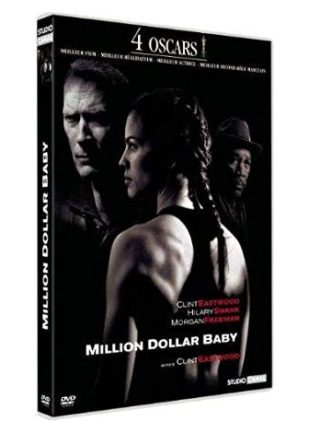
Million Dollar Baby
Synopsis
Frankie Dunn is a gruff veteran boxing trainer who runs a rundown gym in Los Angeles and has a strained relationship with his daughter. One day, a determined young waitress named Maggie Fitzgerald walks in, asking him to train her, despite being told that he does not train girls. With the help of Eddie "Scrap" Dupris, the gym's former fighter, Frankie reluctantly takes her on. As Maggie rises through the ranks, an unexpected bond grows between the two, until a tragic turn changes everything.
The Making of the Film
Million Dollar Baby is based on stories from the collection "Rope Burns" by F.X. Toole, the pen name of the boxing trainer Jerry Boyd. Clint Eastwood directed the film and plays Frankie Dunn, with Hilary Swank as Maggie and Morgan Freeman as Scrap. The screenplay was written by Paul Haggis, who would later direct "Crash". Eastwood, who also composed the score, filmed in a spare and classical style with low-key lighting. Hilary Swank trained for months to prepare for the physical demands of the role. The film was released in the United States at the end of 2004 and arrived in France in early 2005.
Reviews and Reception
Summary of Professional Reviews
Critics acclaimed the film as a powerful and deeply moving drama. They praised Eastwood's restrained direction and the extraordinary performances of Swank and Freeman. Many reviewers highlighted how the film starts as a classic sports story and then transforms into something much more devastating. A few critics took issue with its final turn and the questions it raises.
Audience Reception
Audiences were deeply moved, and the film was a significant box-office success, earning over 200 million dollars worldwide. It also stirred strong debate for the way it handles its final act. Some disability rights activists criticized the film's portrayal of a person with a disability, while others defended it as a human story. It remains one of the most discussed dramas of its decade.
Awards Received
The film won four Academy Awards: Best Picture, Best Director for Clint Eastwood, Best Actress for Hilary Swank and Best Supporting Actor for Morgan Freeman. It also won Golden Globe Awards for Best Director and Best Actress. This made it one of the most decorated films of its year. Eastwood became one of the oldest directors to win the Best Director Oscar.
Filming Anecdotes
Production Challenges
The project was reportedly difficult to finance, as studios were wary of a drama about a female boxer with such a heavy storyline. Eastwood kept the production efficient, famously shooting quickly and with few takes. Swank underwent intensive training, gaining muscle mass and learning the details of boxing technique. The result lent authenticity to the fight scenes.
Themes Explored
The film is about family, ambition and the ties that people build when blood relations fail. Frankie and Maggie each lack a real family, and their bond becomes a form of parent-child relationship. It explores determination and the cost of chasing a dream, showing how far a person will go to be recognized. Faith and guilt hover over Frankie, who is haunted by his estranged daughter. The film also confronts difficult questions about dignity, suffering and the right to choose how to live. Behind the ring, it is a story about love and sacrifice.
Ending Explained
After Maggie suffers a devastating injury in the ring, she is left paralyzed and begs Frankie to help her end her life. Frankie, torn between his faith and his love for her, ultimately honors her wish before disappearing. The story closes with Scrap's narration in a letter to Frankie's daughter, revealing that he is the one telling the story. The ending is both heartbreaking and ambiguous, leaving viewers to wrestle with the moral weight of the decision.
Meaning of the Title
"Million Dollar Baby" is the nickname given to Maggie during her rise as a boxer, reflecting her potential and her worth to the people around her. It carries an ironic weight, since the film shows that what truly matters to Frankie and Maggie has nothing to do with money. The title also sums up the sports-movie fantasy before the film subverts it.
Soundtrack
The score was composed by Clint Eastwood himself, who has written music for several of his films. His simple, melancholy guitar and piano themes give the film a reflective and intimate atmosphere. The understated music is a perfect match for Eastwood's restrained visual style.
Similar Films
- Rocky (1976): the classic story of a boxer's determination.
- Raging Bull (1980): a darker portrait of a boxer.
- Cinderella Man (2005): a boxing drama set in the Great Depression.
- Gran Torino (2008): another Eastwood film about redemption and unlikely bonds.