

 Français
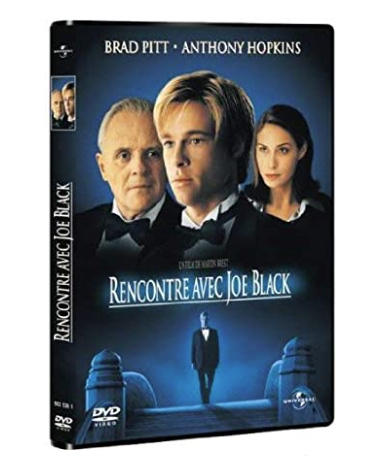
Meet Joe Black
Synopsis
William Parrish, a wealthy media tycoon, is about to celebrate his sixty-fifth birthday when he starts hearing a mysterious voice. Death, curious about human life, takes on the body of a young man and proposes a deal: William will be granted extra time if he acts as his guide on Earth. Calling himself Joe Black, Death moves into the Parrish mansion and meets William's daughter Susan. As he discovers food, love and emotion, he begins to question his own role.
The Making of the Film
Meet Joe Black is a remake of the 1934 film Death Takes a Holiday, which was itself based on an Italian play by Alberto Casella. The original story imagined Death taking a break from his duties to discover why humans cling so much to life. Producer-director Martin Brest, who had made Midnight Run and Scent of a Woman, wanted to reinterpret it as a modern romantic drama. The screenplay was written by several hands, including Ron Osborn, Jeff Reno, Kevin Wade and Bo Goldman. Brest was fascinated by the idea of a conversation between a man who is about to die and Death himself. He wanted to explore how mortality changes our perception of love and time. Brad Pitt and Anthony Hopkins were cast to give the story an intense star power. The film was conceived as a long, contemplative tale that took its time to unfold.
Reviews and reception
Professional critics' summary
Critics gave the film mixed reviews, finding it beautiful but overlong and slow. Many praised Anthony Hopkins for his dignified performance and noted the strong chemistry between him and Brad Pitt. Others thought that the film's three-hour running time did not justify its simple story. The cinematography and production design were widely admired.
Audience reception
The film earned about 140 million dollars worldwide, a decent result that did not cover its high budget. Audiences were divided, with some finding it moving and others considering it too slow. Over time, it has gained a following among viewers who appreciate its romantic and philosophical tone. Certain scenes, such as the party at the end, are often cited by fans as highlights.
Awards
The film did not win major awards. Its cinematography, by Emmanuel Lubezki, drew praise from critics and professionals. It was nominated for several lesser prizes. The film remains better known for its cast and its atmosphere than for trophies.
Filming anecdotes
Director's inspirations
Brest wanted to make a film that felt like a modern fable, with a slow rhythm that invites the audience to reflect. He took inspiration from classic Hollywood melodramas and from European art cinema. The elegant interiors and gardens were designed to evoke a sense of timeless luxury. He chose to let scenes play out in long takes, allowing the actors to find the emotion.
Production difficulties
The production was long and expensive, with a shooting schedule that lasted for months. The exterior of the Parrish mansion was filmed in Rhode Island, using a historic estate. Brest was known for his perfectionism, which led to many retakes. The film's original running time of nearly three hours was a challenge for the studio.
Anecdote about a particular scene
One of the most famous scenes shows Joe Black trying peanut butter for the first time, which becomes a comic and tender moment. Another memorable sequence shows Joe and William walking together in the garden, discussing life and death. The scene in which Joe and Susan fall in love is staged with soft, intimate lighting. These moments help to give the film its distinctive tone.
Originally planned casting
Brad Pitt was cast as Joe Black, a role that required him to play both a naive stranger and an ancient presence. Anthony Hopkins played William Parrish, bringing gravity and warmth to the character. Claire Forlani played Susan, whose emotional journey is at the centre of the story. Jeffrey Tambor and Marcia Gay Harden completed the main cast.
Themes explored
The film is a meditation on death and the meaning of life. It asks what we would do if we knew that our time was running out. Another theme is love, shown as a force that can transform even the most distant figure. It looks at the relationship between a father and a daughter, and the importance of leaving things unsaid. The story also raises questions about greed and power, since William's company is threatened by ambitious executives. It suggests that the small pleasures of life, such as food, music and touch, are more important than success. It portrays the acceptance of mortality as an act of courage. In the end, the film is a gentle reflection on how to live well.
Ending explained
During William's birthday party, Joe Black tells Susan that he must leave, because it is William's time to go. William says goodbye to his daughters and walks with Joe toward the end of the garden. Joe's departure releases the body he borrowed, which belongs to the young man Susan met in a coffee shop at the start of the film. That man comes back to life with no memory of what happened. He approaches Susan, who realises that something extraordinary has occurred. The film ends with fireworks, and with the suggestion that Susan will find love again. It is a poetic and hopeful ending that celebrates life after loss.
Meaning of the title
The title is a play on the way in which Death introduces himself to the characters. When William asks what he should call his guest, he is given the name Joe Black, which sounds like a simple human name. The word Black, however, hints at darkness and mourning. The title also invites the audience to meet Death in a more personal way, not as a frightening figure but as a curious visitor. The word meet turns the film into a story about discovery and connection. The title therefore combines humour, mystery and a touch of melancholy. It sets the tone for the encounter that changes William and his family forever.
Original Soundtrack
Thomas Newman composed the score, using delicate piano and orchestral textures to evoke mystery and tenderness. His music gives the film a sense of floating time, which fits the story's dreamlike atmosphere. The score helps to underline the emotional weight of the final scenes. It is often admired as one of the best elements of the film.
Similar Films
Death Takes a Holiday, from 1934, is the original film on which this story is based. Heaven Can Wait and City of Angels also mix romance and the supernatural. Ghost and The Lovely Bones explore life after death. Scent of a Woman, also directed by Martin Brest, shares the theme of two very different men who learn from each other.